All You Need is Love

We have another free Valentine’s Day free printable set.  This set includes one print and one business card sized candy tag.

The Candy Tag is a 3 inch wide by 2 inch tall design, ready to print and add to your Valentine’s gifts.

The All You Need is Love 8.5 inch by 11 inch print is a perfect splash of color for your home.  I especially love this for a child’s room.

So, Happy Valentine’s Day a little early.

Another Cut Out Art Design

We’ve already released two nature inspired faux bois cut out art pieces, and we’re ready to add another.  The design is similar to the Birch Tree Carved Initials Cut Out.

In a never ending quest for variety, we’ve added an oak pattern.  Without further ado, here is our newest addition.

Like its Birch brother, the Oak design features a heart with two customizable initials. 

This custom, one-of-a-kind, signed and dated original cut out art measures 8.5 inches wide by 11 inches tall, so it can be framed in an 8 inch by 10 inch or 8.5 inch by 11 inch format.

Of course, we have other art and pillows available for purchase in our Etsy shop, and we love custom orders, so please don’t hesitate to ask.

Pin Prick Art

I’ve been obsessed with cut out paper art recently, so it’s only natural that I decided to give pin pricking a try.  To make your own, you’ll need:

A template

Cardstock or paper

Thumbtacks, pins or a needle

Cardboard or something else to punch into.

To start, I created a template in Photoshop, printed to regular paper and cut it to size.  I lightly taped my template on my cardstock.  Before I started on my actual design, I tested different pins, level of pressure, and working direction.  I chose to use a thumb tack on a semi-soft cutting mat working from the front. 

For a less subtle design, work punch holes from the back. 

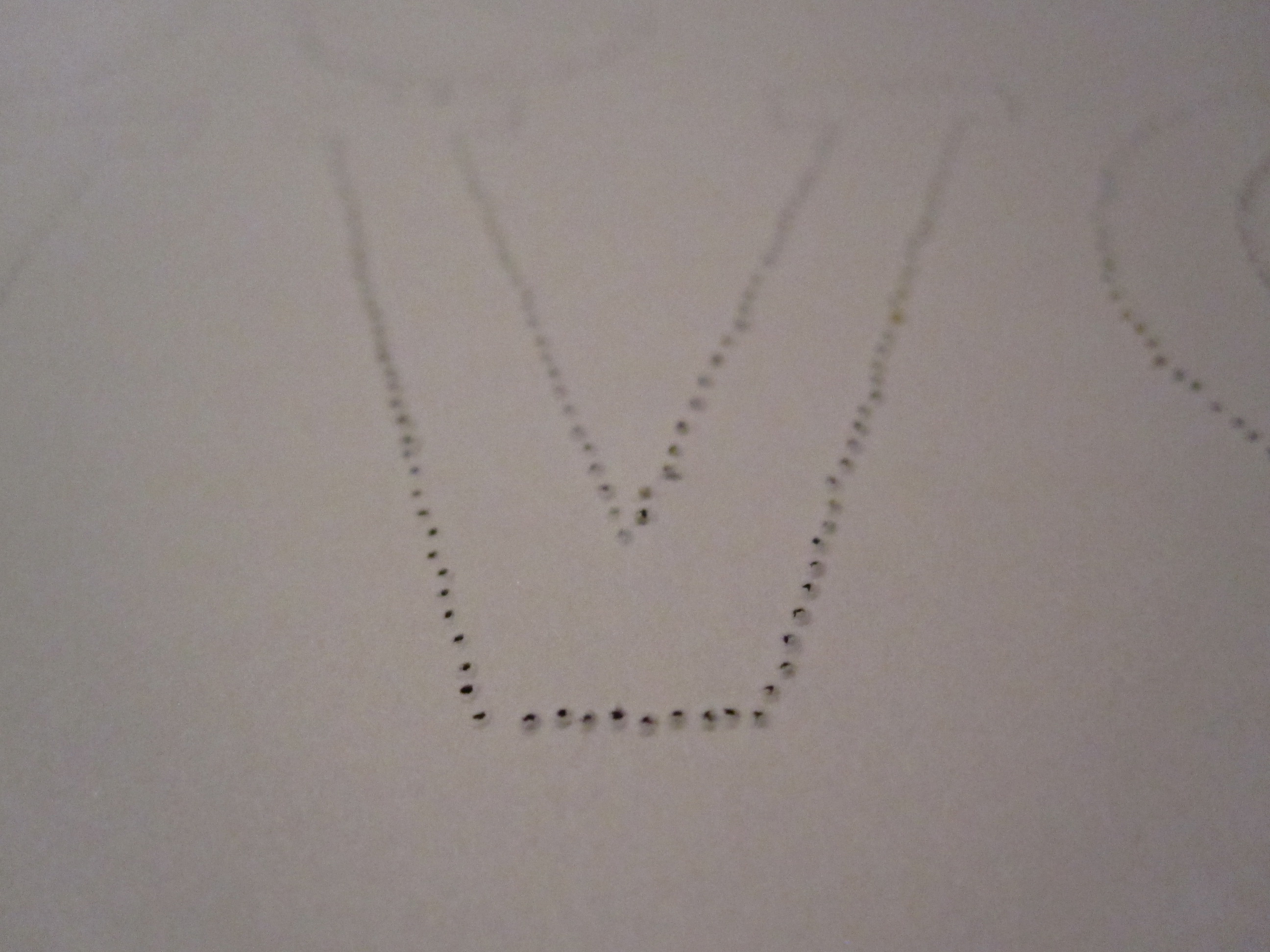
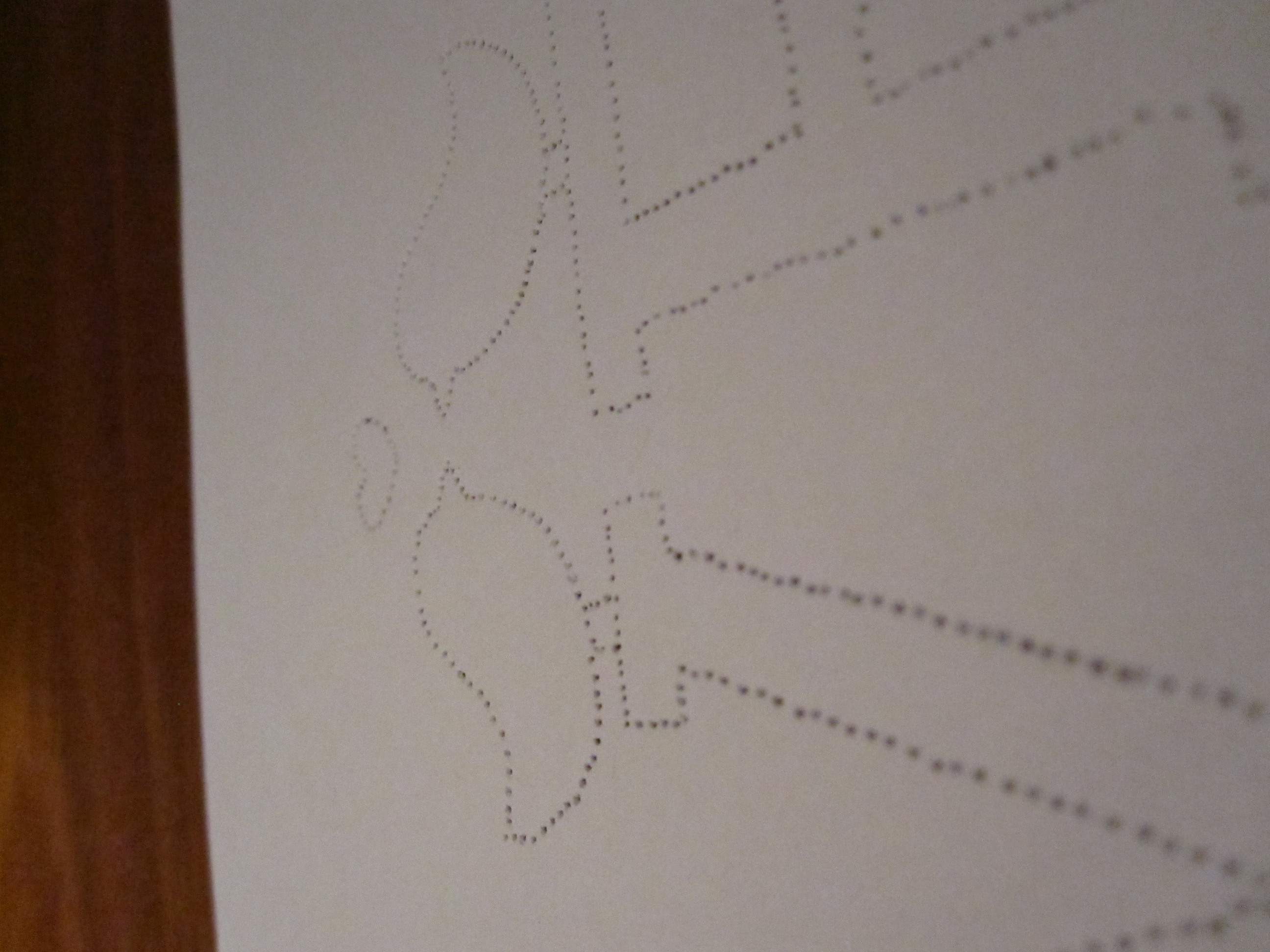
Working on my cutting mat, I traced the design with the pin.  I decided I liked the design better as just an outline, but if you prefer, you can fill yours in. 

As you can see, the design is subtle, but I love the texture. 

If you like the template, you can buy one for $3.00 in our Etsy shop. 

The Crowning Jewel

When we asked our readers to take a brief survey at the beginning of the year, we asked if you’ve seen something in our house that you would like to know more about.  One reader was wondering how the lighting in our master bedroom worked.  Let’s start at the beginning, the trim.

We decided to install crown moulding over the doors and windows of our master bedroom and adjoining bathroom.  Ben had a great idea, why not install rope lighting on a dimmer switch above each?  I said, “Sure.  You’re the one doing the wiring, so if it’s a pain, you have yourself to blame.”

You see, I have a tendency to come up with tedious projects that Ben has to complete, so this was all him.  Guess what?  It was a pain.  But I already said that.  Why was it a pain you ask?  Well, dear friends, because each window and door has a header above, made of 2 by 4s, to give the structure strength.  So, Ben had to drill through finished sheetrock, through each header, then fish his wiring through his holes.

Once he ran the wiring, it was easy.  Ben wired outlets, all set on a dimmer switch, inside each crown piece.

(Please disregard the dust, its there for moral support, though I did vacuüm inside for you.  Oh yeah, you see the traces of red, that’s not blood, it’s paint.  Yeah, Ben wanted our bedroom burgundy.  So, we painted it, then quickly painted it again).

Then, we bought basic rope lighting from Home Depot.  Home Depot has tons of rope light options, but we chose five 6 foot lengths.  Why 6 feet?  Rope lighting isn’t especially bright, so we decided to double up anything that was shorter than 6 feet.  Next, plug the lights in.  Luckily, the windows and doors don’t look any brighter than the closet.  After tucking the lights down in the crown moulding, Ben used plastic fasteners to keep everything tucked neatly in its place.

Here, you can catch a glimpse of the crown construction.  Ben cut the crown pieces to size, then applied glue to the joints and nailed in place.  Ben always goes a little overboard to make sure things he builds are super strong, so he cut scraps of wood to match the angle of the inside corners.  Then, he nailed the crown into the blocks and they’re like a rock.

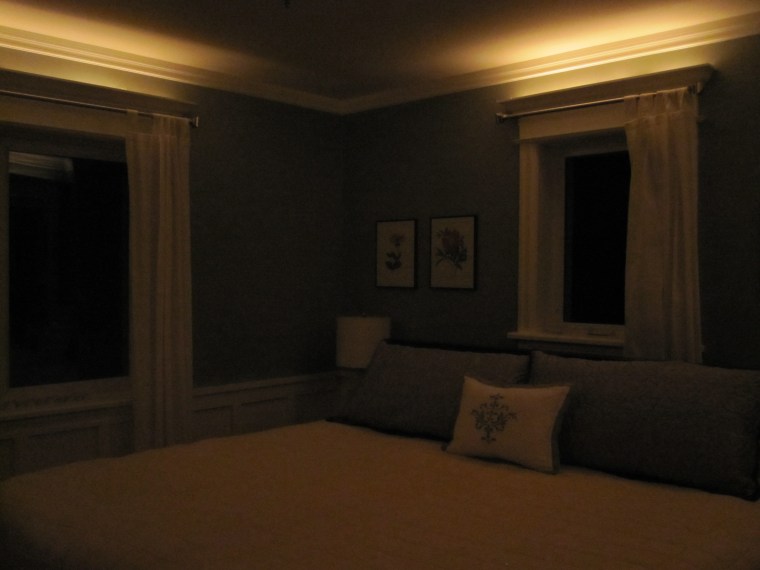
The room glows with the lights on at night.
Please note:  If you are not an electrician or comfortable working with electrical systems, please do not attempt this your self.  This post is not a step-by-step tutorial, just a guide on how Ben created our lighting.  We are not liable for any damages or injury.

Green = Green: Perpetual Calendar

I shared a few thrifty finds last Thursday, including two small file holders for $0.99 each. 

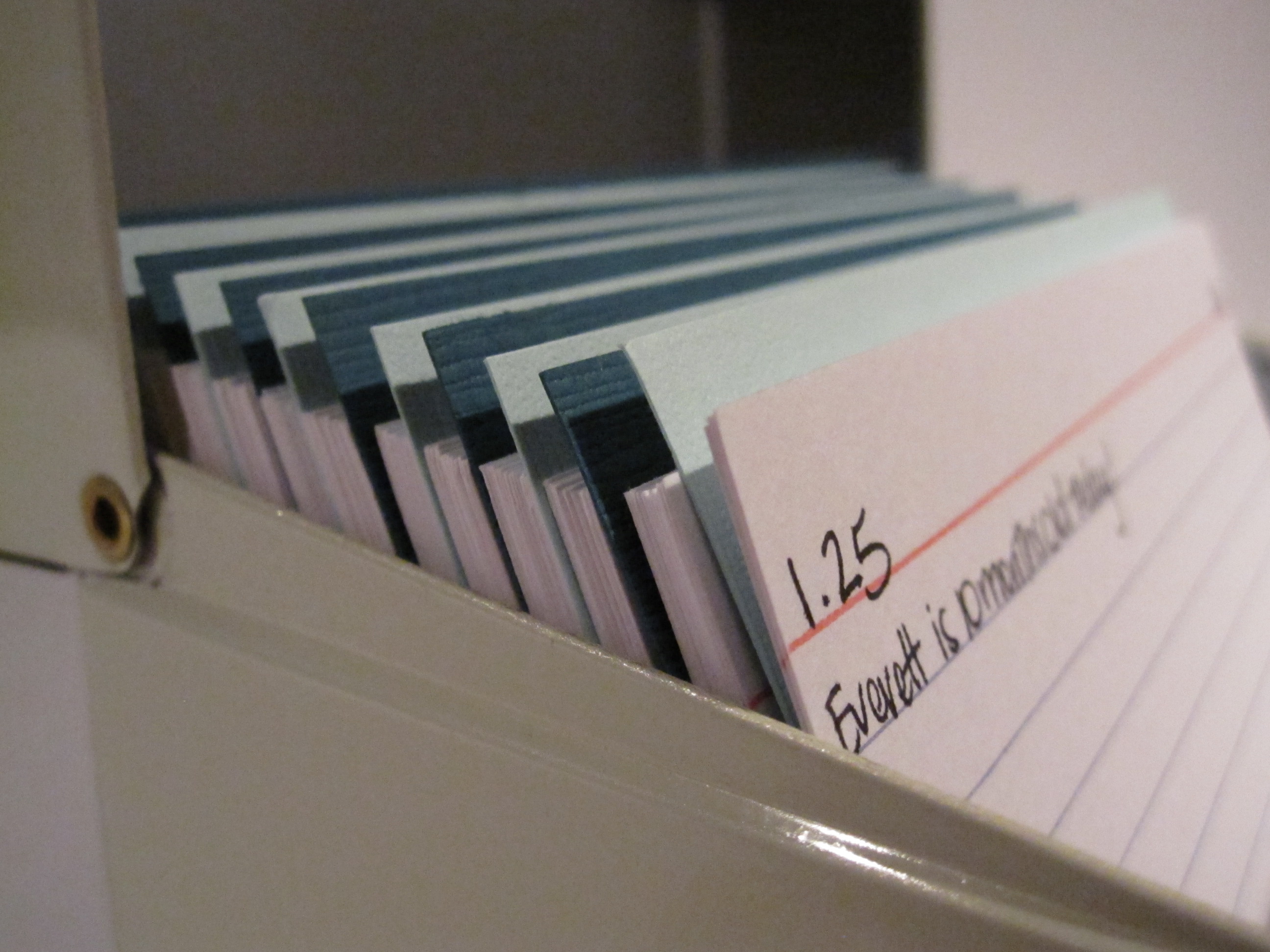
I mentioned that I saw an idea for a perpetual calendar by Ashley Ann for Design Sponge.  I always love a good calendar, so I decided to make a perpetual journaling box set.  The small tan box is perfect for 3 inch by 5 inch note cards, which I happened to have two packages of.  I don’t have a date stamp, so I wrote each date in the upper corner of each index card.  It was pretty quick because I used a number format (1.1 for January 1st, 1.2 for January 2nd, and so on).  Also, I decided not to cut the cards because my box was already sized perfectly. 

After I numbered each card, I used two colors of cardstock, also already owned, to cut dividers for each month.  I made each divider 5 inches wide by 3 1/4 inches tall so I could easily see the dividers above the notecards.

This project took under twenty minutes and cost under $5.00 (if you don’t already have the materials), but what I really love is the sentiment.  I’ve missed the first few weeks of journaling, but it will be cool to see what we did on this day ten years from now. 

I also really love the Max 365 perpetual calendar by Massimo Vignelli, but I could to without the $74.00 price tag.

Obviously, the Max 365 calendar can be used over and over, which eliminates the need for a new calendar year after year.  But, my DIY perpetual calendar can be used for the next ten years (I have ten lines of journaling per sheet).  By using a perpetual calendar, I’m saving paper, making the earth a little greener.  I also saved some green ($73.00 to be exact) by creating my own calendar using a thrift store file box and supplies I had on hand.

Ashley had a great idea, right?!  Anyone out there inspired to make their own perpetual calendar?