Cabinet Doors? Done

Almost.  I’ve got some touch up painting to do, but I’ll explain that later.  On Saturday, Ben built eight cabinet doors including two glass frames.  Details to come later, but you can bet I filled the doors right away.  Sunday morning I sanded those babies down and filled a few areas again.  While impatiently tapping my fingers waiting for filler to dry, I dreamed about installed cabinet doors.  A few hours later, I gave the doors a final sanding and started painting with my two in one Behr paint.  Love that I don’t have to prime.

I don’t know why, but Behr paint seems to dry faster than any other brand.  Which is good news for me because I got two coats of paint on the fronts of the cabinets on Sunday.  Then I flipped ’em over on Monday and gave the backs two more coats.  Tuesday morning, I flipped back to the front for one more coat.

Once that coat dried, I hauled the doors up to the kitchen and propped them in place.  You know, just to get a feel of what they would look like.  Because I’m impatient like that.

That’s when I discovered a problem.  The two glass door frames were about 1/8 inch wider than their lower counterparts.

Ben happened to come home to get his wallet during this and I pointed out the problem.

When Ben got home that afternoon, I politely asked begged, pleaded, and whined for him to install the cabinet doors.  He ripped down the glass door frames to make everything even and flush.  Then he started with the install of the fridge and bar doors.  To install the hidden hinges, Ben measured and marked his the hole locations.  He carefully drilled into the frames to hollow out a hole to recess the hinge in.

I admit, I was holding my breath while watching this.  Ben is skilled (as you all know) but I imagined him drilling too far or popping a screw through the front.  Luckily, everything went smoothly, other than one screw head breaking off.  Then he popped the hinge in, used a square to keep it straight and put 3/4 inch screws in to hold it in place.

Handy Sammy was over for dinner, so he held the door up for Ben to hang.  I’m too short, I can’t reach.  Okay, I’m not that short, but it is nice to pawn a job off on an unsuspecting guest.

We didn’t want the wood cabinet frames to split, so Ben used a small drill bit to make a pilot hole, followed by a 1 1/4 inch screw in each hinge to hold the door in place.  After the two bar and two fridge cabinets, Ben called it quits for the night and took a shower.  While I was in the shower, Ben did a little more work.  I walked out to see two door knobs in the fridge cabinets.

Speaking of the knobs, I had a little trouble deciding on the placement.  Like Goldilocks, one was too low; centered in the bottom corner.

Another was too high; the outer edge of the knob above the bottom edge detail.

But one was juuuust right.  And Ben agreed.  Centered width wise on the edge detail, but also centered on the cross edge.

Fortunately for me, this made measuring a cinch.  I just lined my ruler up with the raised detail and marked 1 1/4 inch from the edge (because our banding is 2 1/2 inches wide).

Yesterday afternoon, Ben finished installing the doors.  Where’d the microwave go?  Oh, it’s hidden behind a cabinet door.  Sneaky us.

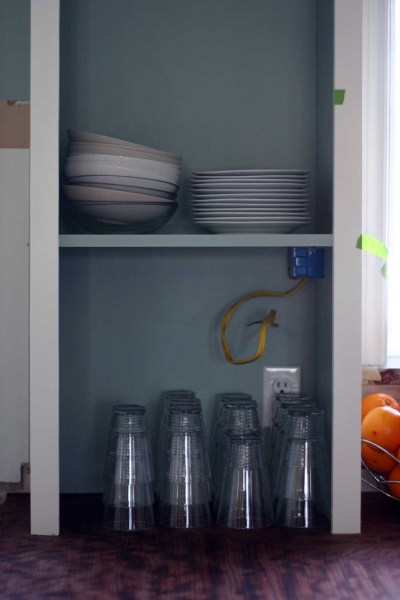
And now you can’t see our pile of mail or the toaster.  But you can see our pretty dishes!

Add a few sparkly knobs and we’re done.  Wait, we’re not.  I’ve got to paint the crown moulding, those MDF brown trim pieces we’ve added, repaint the edges of the glass frames, and, oh yeah.  Get glass!  Notice the lack of glare?  Ben thinks we should leave the doors glass-less so we always have clean and clear glass that’s under control (not to be confused with the face cleanser).

And I’ve already made this a long post, so why not make it a little longer, all in the name of eye candy?  Oooooh, shiiiny.

I did realize why the knobs were so cheap, though.  Some of the bolts are bent.  Nothing Ben and a little man muscle can’t fix.

Edit:  Here are the pictures I promised to add.  I’ll have to touch up the paint on the glass frames.

And, here’s something I really love.  Ben bought soft close hinges.  No more slamming doors.

We’ve got tons more storage on the bar side, too.  So far, the only thing inside is Ben’s food dehydrator.

We used three hinges on these heavy guys.

Once we get the glass in the frames we’ll have a full cabinet building post.  I’m just excited we’ve covered the gaping holes and you can’t see our junk.  Before, it was like we left our zipper down, but no one told us.  Well, we figured it out.

One more thing checked off our to do list, one step closer to a finished kitchen, but it’s finally starting to look finished.  Just a little more sanding, priming, and painting…  Of course then we’ve got organizing and little building projects to do, but nothing that has to be done.

What do you think?  What’s your favorite part?  Who’s excited to see some paint on those walls?

The Big Splash

Warning!  This post is filled with over enthusiastic commentary and gratuitous tile pictures.

Along with installing most of the trim, we’ve finished another item on our long to do list.  Along with the drawer fronts, I think the marble backsplash has made the biggest difference in the kitchen, making it feel more finished.  I guess it kind of almost is finished.

First, take a look at our old back splash.  A four-inch tall piece of oak topped laminate.  Not. Pretty.  And, it didn’t function well protecting the wall from water.  In fact, the laminate covered a piece of particle board.  Particle board and water are not friends.  When wet, particle board swells more than my feet when I was pregnant.

So, we decided to make our new back splash pretty and functional in a wet area.  And that’s why we chose 3 inch by 6 inch marble subway tiles (from Home Depot), taking the tile up to the ceiling.

Before I get to the big back splash, lets take a look at the smaller one behind the stove.  We had to approach this one a little differently.  You see, our floors aren’t perfectly even, so the space between the counter top and the bar top varies about 1/2 inch from the far left side to the right end.  The wood tops are 3 1/2 inches apart.  If we had used the same 3 by 6 tiles, this difference would have been much more noticeable because the cut slivers would vary.  Luckily, Home Depot also carries four packs of 6 by 6 inch marble tiles.  The perfect solution to our uneven problem back splash.

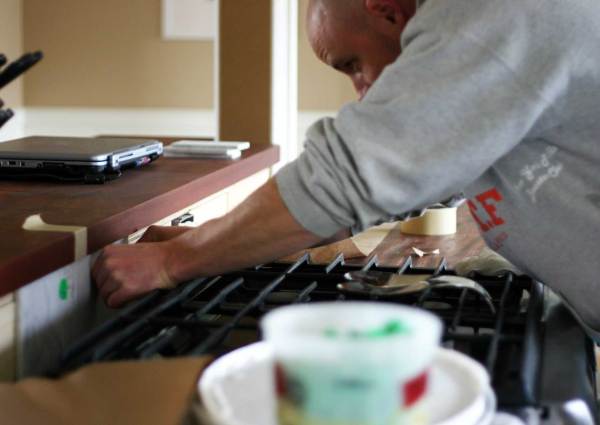
Now for the install.  We started by measuring and marking the center of each wall space and the first tile.

Back butter the tile, line up the marks, and press firmly into place.

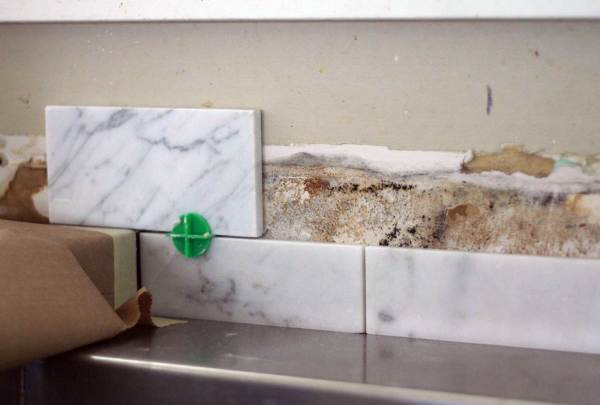
Because our first four tiles tuck behind the stove, we decided to leave them the full 6 by 6.  Then Ben measured each opening, cutting one tile per side, installing, then measuring for the next.

I’m guessing the marble tile cuts like a hot knife through butta because Ben made very nice detail cuts, like these around the outlets.

And he joked the he’ll start carving chess pieces from marble when we finish the house.  Here’s another shot of the tile behind the stove.  Once it’s pushed back in place, it won’t look any different.

Bright and pretty, just the way I like ’em.

Now that we’ve gotten the little ‘splash out of the way, let’s get to the main event; the back splash behind the sink.  Our starting process was similar, but Ben had some cutting to do first.  We agreed the first full row of tile should start at the counter, so Ben had to cut pieces to fit in the lower sink area.

Thanks old back splash for leaving so much ugly junk behind.  That’s why water and particle board are a bad combo.

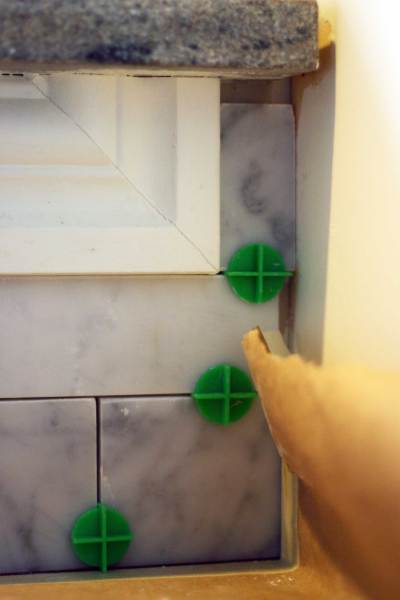
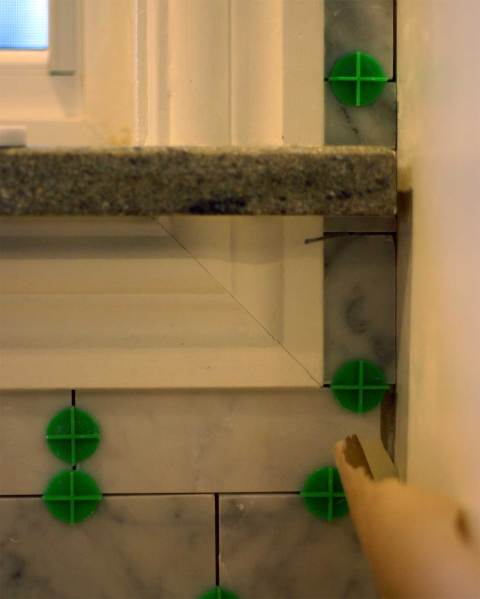
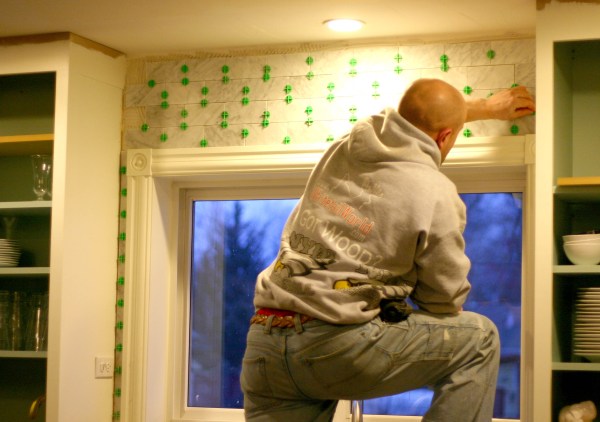
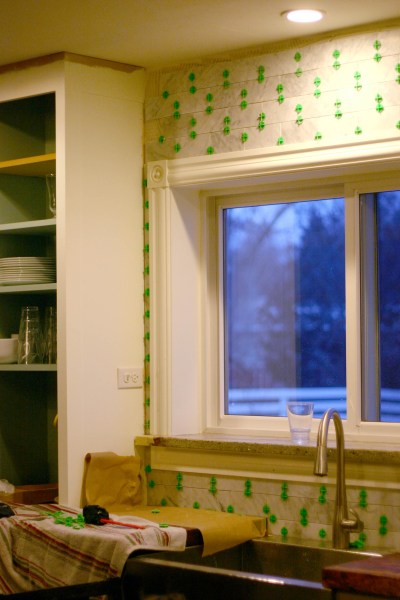
With the sink row cut, things went up really quickly because Ben installed the full tiles, then moved to the smaller, detailed pieces.  Here’s a little space under the window sill.

And after, with the tiny pieces stuck forever.

Tons of one inch pieces on each side of the window and we made it to the top.

Instead of back buttering each tile for the part above the window, Ben spread the mastic on the wall.

Putting in some of the final cut pieces.

Because we’re putting crown moulding along the tops of the cabinets, we decided we’ll continue the crown across the front of the marble, covering the gap near the ceiling.

Before going to work the next morning, Ben pulled the spacers so I woke up to this pretty wall ‘o tile.

Pretend all the shelves are painted and we’ve got crown at the top, okay?  Oh, and pretend we’ve got doors on the upper cabinets, too.

Is it wrong that I want to stare at it all day?  Maybe I’m turning into a tile stalker.

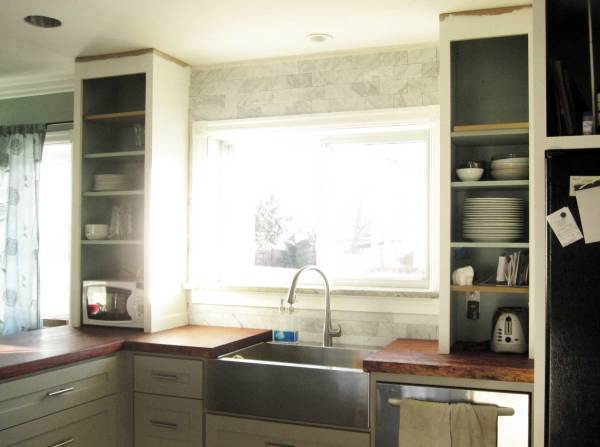
The blue-gray works so well with the stainless, gray cabinets, and the warm wood counters.  Which is why I love this shot.

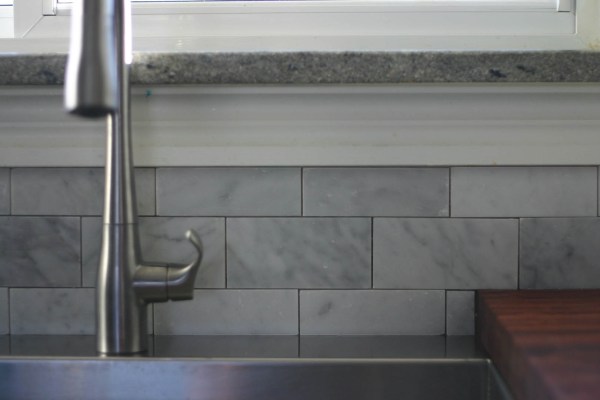
Just a detail shot of the cuts around the sink.

Now, a before and after for added drama.  Before:

After:

Ahh, the magic of the internet.

What do you think?  I’m in love.  Like seriously, in. love.  I’m just visualizing this shot with trim and doors and I have a dopey, just-fallen-in-love smile on my face.

Of course we still have to grout the tile, so we’ll be back to share more info on the install and pictures when we’re done.

Upper Peninsula

What?  No, we haven’t added another peninsula.  We’ve painted the cabinets above the peninsula.  And the rest of the upper cabinets.  Which sounds like a lot but isn’t because we have only two others.  The last cabinet update we shared centered around the drawer fronts, but you also caught a glimpse of the upper cabinets, complete with a decorative face framing.

Before going to Minnesota, I procrastinated packing to give the cabinets a coat of paint.

Because our upper cabinets shouldn’t be as affected by dirty, slimy, jam-handed kids as the lowers, we decided to save $20 by using Behr Two in One paint in a satin finish.  To match the trim in the adjoining rooms, we used the same color, Behr’s Vermont Cream.  Following the same process as I did for the drawer fronts, I painted the outsides of the cabinets.  Three coats later, gently sanding with 220 grit paper between coats, we’re done.   Oh, don’t mind the tape along the bottoms of the cabinets either.  Ben was working on sealing the counter tops again and I wanted to protect my hard work.

Actually, we’re not because we still have trim to add.  See the tops?  Yeah, we’ll finish that off with the same crown moulding we’ve used throughout the house.  Rather than cut the tiles for the back splash around the crown, we’ll attach the crown after the tile is done for a seamless look.

The same goes for the vertical piece along the back of the cabinets.

I debated waiting to paint everything at the same time, but decided against it because I want to get shelves up and use those babies!

To find the shelving height, I started placing our dishes in the cabinet.  A piece of tape marks where I want a shelf placed.

After deciding on the height of each shelf, Ben drilled four holes, one in each corner, for the pins to rest in.  We used something like the silver L style:

The height of each shelf is adjustable two inches in either direction, too, so we I can move the dishes around for the best look and fit.

The lower the shelves, the more often the dishes get used.  So our everyday glasses, mugs, and plates are the lowest for shorties like myself.  I want to add a third shelf in each cabinet for lesser used, but pretty dishes.  Ben wants to space the shelves out more evenly, but have only two.  Seeing as we had two shelves in our old cabinets which were a foot shorter, I think we need to utilize the height we added by removing the soffit.

Those are the only shelves we’ve installed so far.  We’ll be sure to share more info on the process and pictures when we get the other shelves in place.

  • Buy all appliancessinkstovevent hood, dishwasher
  • Tear out the upper cabinets and soffit {more on that here}
  • Add support on load bearing wall before tearing out
  • Knock down the wall between the living room and kitchen {more on that here}
  • Install the vent hood {more on that here}
  • Remove the lower cabinets, counter tops, and sink
  • Rip out the tile floor and sub floor {more on that here}
  • Install the new hardwood floors {more on that here}
  • Build toe kick bases, wire everything for lights, replace the cabinets and sink {more on that here}
  • Get the new stove in place and hooked up {more on that here}
  • Add the cabinet above the fridge and frame it out {more on thathere}
  • Install the new dishwasher {more on that here}
  • Build the five remaining drawers we’ve waited on (we needed to see how things were in place before we could build one drawer in the dining room, the trash can pull out, and the under the sink drawer)  {more on that here}
  • Fill, sand, prime and paint said drawers
  • Install every drawer, 16 total 
  • Decide on sconces and buy them {more on that here}
  • Buy the wood for the counters 
  • Haul the wood slabs to a cabinet shop to have them sand both sides smooth {more on that here}
  • Cut the wood to fit and install the counters {more on that here}
  • Add decorative face trim to all cabinets for a smooth, pretty, even front {more on that here}
  • Fill, sand, prime, and paint all cabinet faces {more on that here}
  • Install the toe kicks and rope lighting
  • Hang the upper cabinets
  • Build the drawer fronts
  • Buy bar stools {more on the debate here}
  • Fill, sand, prime, and paint the drawer fronts 
  • Install the drawer fronts and hardware pulls {more on that here}
  • Add crown molding to the top of the cabinets
  • Cut shelves for the cabinets
  • Build the cabinet doors, including two glass front doors
  • More filling, sanding, priming, and painting of the cabinet doors
  • Sand the ceiling and walls smooth
  • Prime and paint the kitchen and living room.  Probably the dining room too.
  • Add lights: sconces, light over the sink, and recessed light halos
  • Trim out the posts and door frames
  • Decide whether we want to add decorative trim to the vent hood or paint it to match the wall color
  • Install the pretty new marble tile backsplash
  • Put everything back in place and enjoy

Next on our to do list: cut shelves, build cabinet doors, and install trim so we can get started on our back splash.

What’s on your to do list?  Something resolution related?  I know I’m going to get some cleaning and orgainzing done.

I Like Big Drawers and I Cannot Lie

Due to the impending holiday, we’ve been slacking in the kitchen update department.  Shame on us.  Spank us and take away our birthdays.  Yesterday, we did share a cabinet painting tutorial, but I know you really want to see the installed, finished product.  Am I right?  After locking myself in the basement bedroom for several hours each day for a week, I finally finished priming and painting the fronts and backs of 20 drawers.

We’ve found the easiest way to install drawer fronts is by first marking and drilling holes for the handles.  Use a spacer as a guide to keep the spacing even.  In our case, we wanted a 3/4 inch reveal on all sides of the stack, so a few scraps of 3/4 inch plywood worked wonderfully.  While Handy Sammy held the drawer front in place, Ben put a screw in the holes he drilled for the handles.

For spacing between the drawers Ben used two quarters stacked together and followed the same process.  Once he liked the spacing, he went back and screwed the fronts on from inside the drawers.

Easy enough, right?

Yeah, kinda.  Some how, I don’t quite know because Ben is perfect, he misjudged the depth and screwed into the center, popping the screw through the drawer front.  He said he did it to show he is human because that fact is easily forgotten.  Haha, nerd!

In a few hours, we finished fourteen of the twenty fronts, including the stove side:

What a big difference it makes.  The lower drawers are finished.  Minus minor touch ups like one screw pop and scratches.  Oh, and you can see we decided on two handles for each of the large drawers.  Just one seemed dinky.

Ben and I agreed the handles looked better centered on each drawer.

You can see the small stack was still lacking in the drawer front department.  And, where’s Vincent?

And, here’s a look at our false front covered trash drawer.  Notice we framed out the upper cabinets, too.

We’ve got three more false fronts on the back of the peninsula.

Obviously, the other side has real drawers, and there’s also a stack of drawer fronts opening in the dining room.  Rather than a blank like the end panels, we decided to go with the false fronts.  Ben drilled the holes for the handles first, attached the handles, then screwed the panels on from inside the cabinet.

The functional drawers are customized, too.  Everything looks normal behind the curtain, right?

Wrong!  The protruding window sill called for a smaller top drawer to avoid smashing into granite.  This is the only drawer front we didn’t center the handle on.  Instead, we wanted the handles to line up to so everything looks the same.

There’s no denying it, the kitchen is starting to look finished.  Lower cabinets: done!

We found a mini microwave from Home Depot, too.  Man was than an ordeal.  It just fits in the cabinet.  When Ben told me he built the cabinet 20 inches wide, I assumed that was the inside dimension.  You know what they say about assuming…  The inside dimension is 18 inches wide and most microwaves are 18 or 19 inches.  So we started thinking of different places we could put a microwave.

Option 1: Inside one of the bar cabinets.

But those cabinets aren’t deep enough because the cabinet is built around the support post.  Next idea.

Option 2: Removing a drawer to add a microwave hidden behind a door.  We have two small-ish drawer stacks to choose from, but in the peninsula.  The front-runner to remove was the middle drawer opening on the dining side.

But it seemed inconvenient to microwave something in the dining room.  If we did this, we’d also lost a fair amount to storage space in the depth of the cabinet.  We would have the same problem if we put the microwave in the middle drawer of the kitchen peninsula.

Option 3:  Build a buffet to house a microwave and other stuff.  When we bought the marble for our dining table, we also bought a piece to top off a buffet.  Then, we gave the small desk to my sister and liked how open the room felt.

Again, not the most convenient location, and building another piece of furniture isn’t going to happen right now.

Option 4:  Build a new, wider upper cabinet to fit a microwave.  I may have mentioned this idea to Ben which he very quickly rejected.  I don’t blame him, after all, we had just added the trim detail.

Option 5:  Live without a microwave.  At first, I thought this wouldn’t be very difficult, but how would I make a baked potato?  Certainly not the old-fashioned way in the oven.

We’re so glad we found a microwave to fit in the intended cabinet.  High-fives abounded.  I never thought I’d be that excited about a cheap, ugly microwave.

That’s what we’ve been up to.  Holiday decorating, kitchen updating, and Minnesota planning.  What’s new with you?  Any kitchen work going on?  Holiday decorating and planning?  Are you going to stop by Goodwill to meet up with us?  Do you prefer a hidden microwave?  Ever gotten excited about a small appliance?

On the Drawer Front

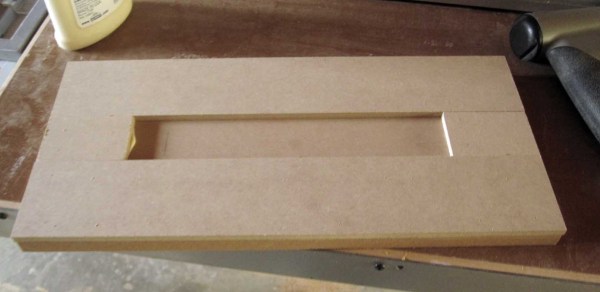
Yesterday, we shared some of our kitchen progress.  On Sunday, Ben the builder and Handy Sammy worked on drawer fronts.  We have a post in the works detailing how we made our own cabinets, drawers, drawer fronts, and cabinet doors, so I won’t get into too much detail right now.  Basically, Ben cut a sheet of 1/2 inch thick MDF to the drawer sizes.  Then he cut countless strips of 1/4 inch thick MDF into 2 1/2 inch wide strips.  Then, he glues…

and nails (using the same pin nails) the thin strips on the 1/2 inch MDF.

Wipe away the excess glue and you’ve got a drawer front.

Repeat these steps twenty or so times and you’re almost done.

Ben likes to run each edge through the table saw to get everything perfectly lined up.  Once that’s done, he passes the unfinished fronts on to me.  Montana winter is setting in, so I hauled all 20 drawer fronts to the large basement bedroom to get started on filling the holes and seams.

In a way, I’m happy Ben used pin nails.  The holes are tiny, which makes filling easier.  At the same time, it makes finding the nail holes much more difficult.  Can you spy all six nail holes in this picture?

The brown flecks in the MDF make it difficult to decide whether I see a nail hole or just a spot.  But, I just filled every hole and crack I saw.  I like to use my finger to fill nail holes and a small spatula to fill the seams.

Two episodes of Bones later, I finished.

With the fronts!  I still have to fill all four sides of the drawers.

Now, if you’ll excuse me, I’ve got to fill some seams.  I think I’m going to go crazy after that.  After that, tons of sanding, priming and painting.  Yep, I’ve got plenty to keep me busy.  And you thought our kitchen was chugging right along.  This is going to take a while.

Does filling holes, priming, and painting drive you batty?  How about waiting for paint to dry?  I’m so not looking forward to all that painting, but I want pretty drawers.  Wish me luck.  Hopefully we’ll have something to share in a week or two.