That Was Hard(wood)

It took more muscle and time than we hoped, but we’ve successfully pulled up the tile floor, cement board, subfloor and installed the new hardwood.  The rebuilding has officially started.  Ben tore out the tile on Monday night, which left us with a lovely kitchenette.  Simply a stove, microwave, and one cabinet.

He took the week off to work on the kitchen.  Fun vacation, right?  With the tile up, Ben, with a little of my help, painstakingly tore up the cement board.

Seriously, it was a pain.  The screws from the tile backing held like crazy and the nails were abundant.  Luckily, Handy Sammy came to help.

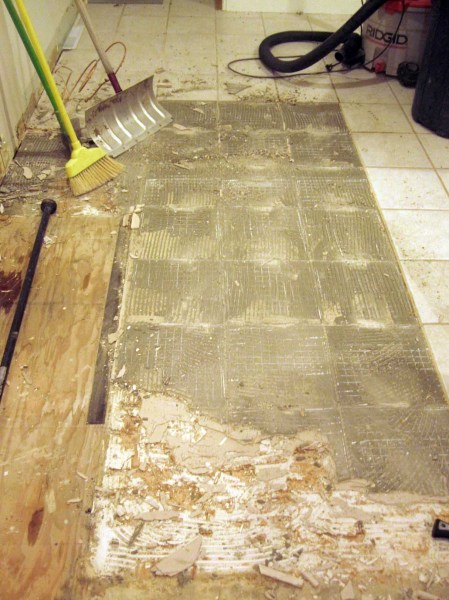
Removing the sub floor took a lot of muscle.  Some areas received too much muscle.  The boards flexed and some broke.  I’m not going to lie, I freaked out a little.

As always though, Ben had a plan.  True to form, things have to get worse before they can get better.  So, Ben started by cutting off the damaged boards, leaving a hole between the joists.

Actually, this happened in four spots.

Did you notice the chaos and mess?  And the fridge placement?  Anyway, back to fixing the gaping holes in our floor.  Ben screwed pieces of two by fours on each side of the hole into the joists first.

Then he covered the holes with pieces of 3/4 inch wood material.

Before we could get started on the floor install, we screwed every board  to the joists, just to prevent any squeaking.  That was a pain in the butt, too.  I’ve never had to use a drill for that long.  Makes me want to invent a cushy drill grip.  After all that screwing (haha), we laid down the rosen paper.

We had to nail one row of the wood perpendicular to the existing dining room hardwood floors.  It would have been way to difficult to line the new floor up with the old floor if we hadn’t done this.  Unfortunately, Ben laid this with the groove against the dining room floor.

Which meant he had to start installing from the stove side.  He had a few wires and the gas line to cut around.  The first few rows are always the most difficult to install, because everything is based off that.

Fortunately, the 5 inch wide planks installed quickly and easily.  While Ben installs the planks, I select which boards will go where.  I have a method to my madness, though.  First, I pick out the pieces of wood I like best.  These will go front and center.  This wood had tons of pieces with large knots, so I made two more piles.  One of the knotty pieces (not to be confused with naughty) and another of clean wood.

We had to remove all the trim that was against the floor, too.  The new floor is 3/4 of an inch lower than the old floor, so we’ll have to lower everything.

Ben borrowed an air nailer from a friend, which made the job quick and easy.

He wanted me to show you how great of a multi-tasker he is.  Here, he’s using both of his hands to nail and his foot to hold the clamp down.  Ooooh, ahhhh.

And here’s the floor we finished as of a few hours ago.

And now for some detailed shots.  The transition between the original flooring in the dining room and the new floor.
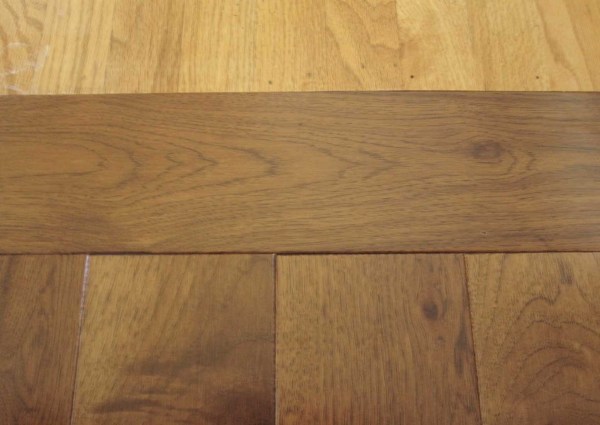
Toward the wall, Ben had to face nail because the other nailer can’t get that close to the wall.  That’s okay though, this won’t be seen as the cabinet will cover everything.

The back door landing looks great, too.  We still have to add a piece along the top of the stairs.

Now you’ve seen the most recent progress.  I’m hoping to get at least a sink back some time today or tomorrow.

Have you ever ripped out a beast of a floor?  Put down pretty new hardwoods?  Do you prefer wider planks?

After the Dust Settles

Yesterday was Ben’s birthday.  His gift?  No more kitchen tile.  Pretty awesome of me, right?  Actually, it was his idea.  I was going to take him out to dinner; he insisted on removing the floor.  Before the floor could come out, we had to tear out the cabinets.  Yeah, our kitchen is no longer usable.

Ben unhooked the sink plumbing and faucet.  Vincent helped.

Buh bye, backsplash!  You and your swollen middle will not be missed.

After unscrewing the cabinets, Ben started hauling everything out.  His dad wants the cabinets for his shop.

To keep the kitchen as usable as possible, we rotated the stove to the other side and put an old cabinet next to it.  We’ve down graded from a full kitchen suite to a kitchenette.

Then the real demo work began.  The tiles came up rather easily, but the cement board did not.  And we have to tear the floor down to the subfloor.

Ben pulled up part of the plywood floor to see how difficult it would be.  Turns out, one of the boards below had a small hole.


Then, Ben went back to tearing up the floor.  What a mess.  But it has to get worse before it can get better.

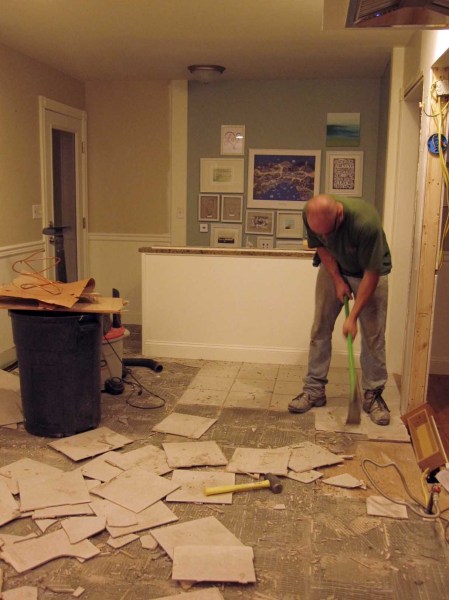
To tear out the tile, Ben used a pick axe.  Pick axe plus muscle equals mega damage.  In the best way possible, too.

Here’s what everything looked like after four hours.  Tile anilihated.  Mission accomplished.

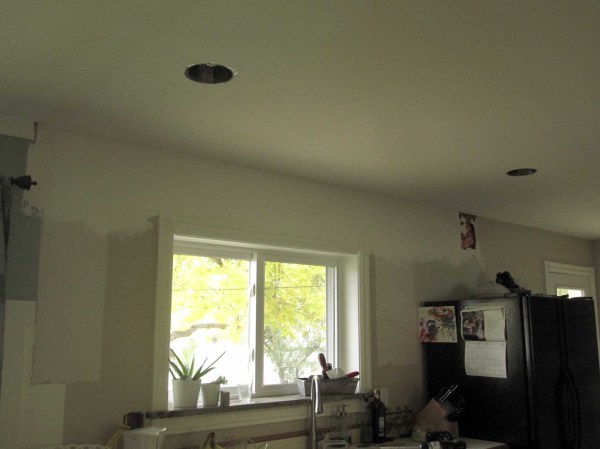
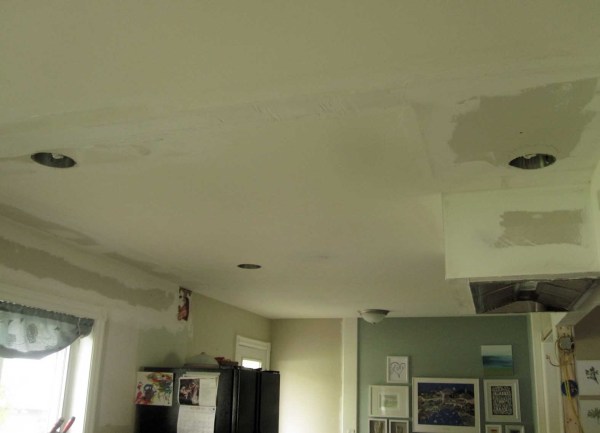
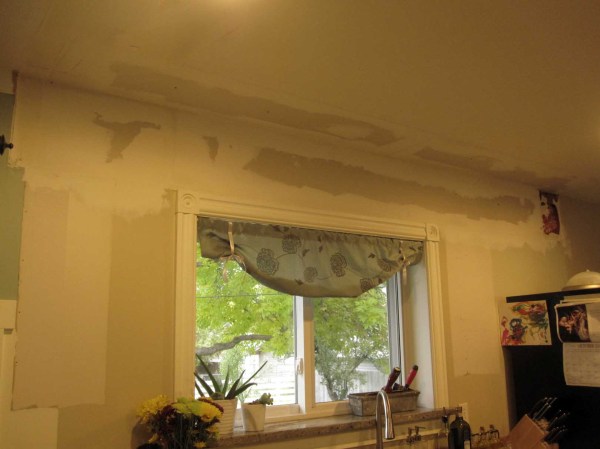
And, things are looking up.  Literally.  Here’s what the ceiling looks like with three coats of mud.

Obviously I took these pictures before the demo began.  Sanding still to come.

Do I get the best birthday giving award?  I thought so.  Now we have another long day of demo and work.

Countertop Specifications

I think I was a little ambiguous in yesterday’s countertop discussion.  Allow me to clarify for you.  Here’s our list of requirements:

  • Must look good
  • Natural material
  • Stain resistant
  • Low maintenance
  • Economical
An added bonus, but not required:
  • Resale value

Originally, we thought we’d end up with the same marble as our dining table.  You see, we know the horror stories of marble in an eating area.  Before we bought the slab for our table, we tested it out.  That’s right, we brought a small chunk home, poured red wine and grape juice on it, letting it sit overnight.  When we wiped the liquid off, the marble still looked perfect.  It passed our requirements with flying colors.  And it was pretty and a natural stone.  Because it was a mis-order, the granite company wouldn’t get any more in after selling out.

So, we moved on to granite.  Mostly because marble and granite are similar.  And granite has been very popular over the past 10 or 15 years.  Two problems, though.  The biggest one, we haven’t seen anything in stock that we would love enough to put in our kitchen.  Secondly, the pricing.  This really isn’t as much of a reason, but we don’t want to pay a few thousand dollars for something that we know off the bat we’re not in love with.  At least the look of.  And let’s face it.  If we don’t love the look of it, we’re still not going to consider it, despite all practicality.  Especially when we have other options.

Based strictly on looks, we quickly eliminated man-made countertops like Corian, Silestone, Cambria, etc.  This means concrete is off the countertop table, too.  Metal seems too industrial for our home.  Don’t get us wrong, each of these looks great in the right setting, just not our setting.  Which is why we’re going with wood.

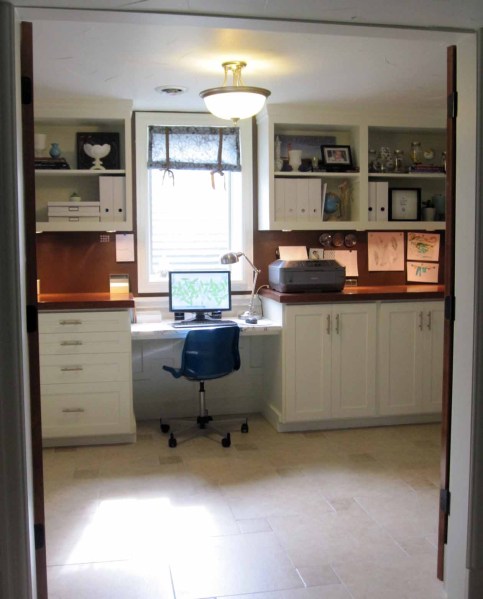
When Ben tossed the wood counter idea out on Monday, I resisted.  Then he gave me more info, like the price and size of the slabs.  Now I’m listening.  He said it looks similar to the Brazilian Cherry in my office, which I love.

But, I was concerned how the grey cabinet paint color would look against the wood tone.  So, I went to the shop and they kindly cut me a sample to clean up and see what we think.  Happily, we love the colors together.

So, let’s talk specifically about the wood we’re interested in.  A local shop is getting two slabs, each three feet wide, eleven feet long, and two inches thick.  That’s one big tree; 66 square feet to be exact.  If you recall, we need about 34 square feet for the countertops, plus another 10 or so feet for the bar top.  (Our wall is 10 feet long and we’re thinking the bar will be one foot deep).  44 square feet total, so we should have 22 square feet extra.

They’re charging $18 per board foot, but this is twice as thick as a board foot, so it’s twice the price.  Or $36 per square foot.  Which happens to be 44 dollars per square foot cheaper than Absolute Black granite.  The 22 square feet of extra wood material also explains why the wood is only $244 cheaper than granite.  But, in the granite math, I didn’t include the ten square feet of material needed for the bar top.  Add another $800 and granite is nearly $1050 more than the wood.  And we’d have a seam, or several, somewhere.  We’ll also have enough wood left over to finish up some other projects, like adding new table tops to our living room end tables.

But back to the wood.  Ben can cut one foot off each slab to make cabinet depth counters.  And they’ll be in one solid piece, no seams.  That’s a plus.  And, Ben should be able to use the remaining pieces, i.e. the 1 foot wide by 11 foot long slab, as a single piece bar top.

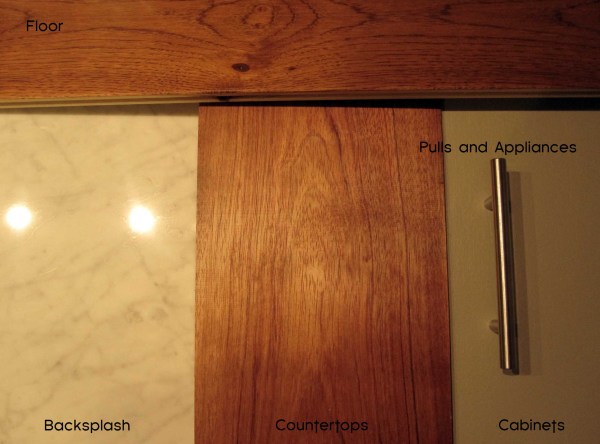
All that to say, the wood should be in town on Thursday.  Barring any oddities, we’re going with wood counters.  And here is what the wood counters will look like when paired with the shiny marble tile back splash (that we have yet to purchase), the hardwood flooring, the cabinets, and stainless steel accents and appliances.

We’re super excited and can’t wait to see everything on Thursday.  Now that we’ve made a firm decision, what do you think?  (Be kind, please)

Oh, and last night, Ben mudded the sheet rock joints.

Two or so more coats to go, then sanding.  After that, we can rip out the cabinets and flooring to get started on installing the new stuff.  Yay!

Countertop Considerations

From the very beginning, Ben and I had planned to use some sort of natural stone as kitchen counters.  When we bought the marble slab for our dining table, we thought we’d use the same marble for counters.  It’s beautiful and has held up really well.

The problem though, is the marble we fell in love with was a mis-order, not something routinely stocked.  So we can’t get it now.

With the beautiful marble eliminated, we turned to granite.  I have yet to see a light granite I love.  The only thing that comes close it Bianco Romano, so we figured we’d end up with something dark.  Ben liked Cosmic Black, I thought it was okay.

{via}

The boys and I looked at granite on Tuesday, but didn’t see anything we fell in love with.  And they’re out of Cosmic Black.  I liked the look of soapstone, until I heard that you can easily scratch it with your fingernail.  I’m not big on a patina look, and the $105 per square foot price tag didn’t help.  Sadly, I learned our default granite, Absolute Black, costs 80 bucks a square foot.  Our kitchen, not especially huge, has 34 square feet of counter tops, excluding the bar top we plan to add.  Do the math.  80 times 34 equals $2720.  Ouch.  Soapstone would come to $3570.  No thanks.  Maybe granite isn’t in the cards.  But, this one is pretty.  And so is this one.

We didn’t even consider a different marble because Carrara isn’t practical for a kitchen.  Ben hates the look of concrete (he doesn’t like how modern and cold it looks) and doesn’t like Corian or Silestone.  We’re both opposed to a metal like stainless steel or copper.  We don’t want tile because we’re not going to clean tons of grout lines.  Formica is too cheap looking.  What does that leave us with?  Wood.  Specifically, Bubinga.  In huge slabs, not butcher block.  Here it has been used as a bathroom vanity top.

I haven’t seen the slabs yet, so that concerns me.  We haven’t completely committed, but we’re strongly considering.   And, just so you can see the thought process in my mind, here’s a pro and con list of each material:

Granite Pros:

  • Durability
  • Seen in many kitchens

Granite Cons:

  • Price, running at least $50 per square foot, for anything we like at least.
  • Availability, limited to the suppliers stock.
  • Seen in many kitchens.  Is granite the Formica of the new century?

Marble Pros: 

  • It’s preeeeeetttyy

Marble Cons: 

  • Everything else, not durable or practical in a kitchen

Wood Pros:

  • Used for hundreds of years.  Can look both modern and classic.
  • If damaged, can be sanded to look new again.
  • Price: For 2 inch thick slabs, the price for the raw cut wood is $2376.  It will cost another $100 to have a cabinet company sand it to 180 grit for a total of 2476 bucks for the entire kitchen.  Still $244  cheaper than Absolute granite, not including the bar top.

Wood Cons: 

  • Can be damaged easily by knives
  • We don’t have much wood in our house, other than our floors, so it could look out-of-place
  • I haven’t seen the slabs yet.  This is a huge con for me right now.
  • Ben has to DIY the counters.  If we had a fabricator do the work and they messed something up, we could hold them accountable to fix it.  Now Ben is liable.
Because I want our counters to look pristine, I’d ask people to not cut directly on the counters.  And I would get a nice cutting board to leave out as a subconscious reminder.  Here are some pretty kitchens I found in my Pinterest research.

Who has wood counters?  Love ’em or hate ’em?  Do you treat them as a large cutting board?  Anything we should know before taking the plunge?

Ventilation

Everyone can use a little ventilation.  Unless you’re Lindsay Lohan or Paris Hilton and you’re getting out of a car with swarms of paparazzi watching every move you make.  Maybe I should say every kitchen should have adequate ventilation, especially over the range.  Just to pull the smells, heat, and moisture out.  It comes in really handy when you burn something, too.  Not that I’ve ever done that.  My point is, after tearing down the wall between the kitchen and living room on Saturday, Ben installed our new vent hood.  I briefly explained our vent hood choice in this post, but we’re sharing all the details now.

We started with a 40 inch insert, with plans to hang it as close to the ceiling as possible.  You know that nice hole we opened up?  Yeah, we didn’t want to cover any of it.

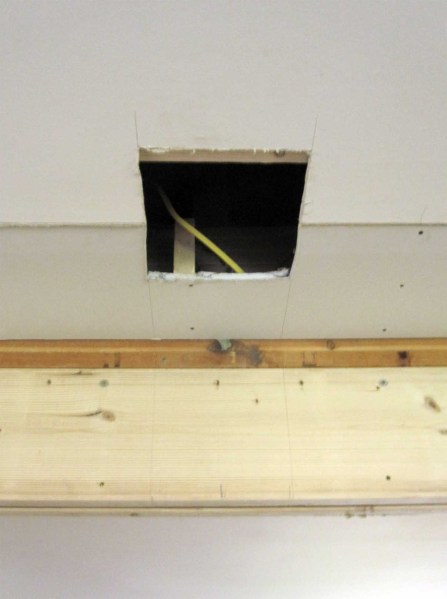
To get started, Ben found the center of the wall and marked it.  Of course, it came out on a joist.  Ben did some bracing in the attic and then proceeded to cut a hole in the sheet rock and joist to run the duct work.

Our vent hood, like most, had one flat side and three angled sides.  Typically, the flat side would be mounted against the wall and the remaining three sides could be boxed out either square or following the angles.

For about two seconds, we considered building a box that followed the angles of the fan, but we decided not to for two reasons.  Number one, we’re planning to add decorative trim and paint everything white and the angles would complicate that.  Number two, Ben worried (and I did too after he mentioned it) about grease and dust settling on the angle and we’d have a perma-dirty hood.  We opted for the simpler square box frame.  Ben carefully measured the vent and built a 2 by 4 box surround to support the new fan.  He screwed it into the joists to make sure it was securely held in place.

In goes the vent, held 1/2 inch from the bottom using the adjustable brackets that came with.  Smartie Ben used a piece of sheet rock as the guide for the spacing.  You’ll also notice that we put the flat part to the front.  This is because our vent has several buttons (for lights and various fan speeds) on the inside of the insert.  I’m short and this sucker (literally) is tucked right up to the ceiling.  If we had turned it 180 degrees, I wouldn’t be able to reach the buttons without either burning myself or getting a chair to stand on.  Neither of which seem ideal.

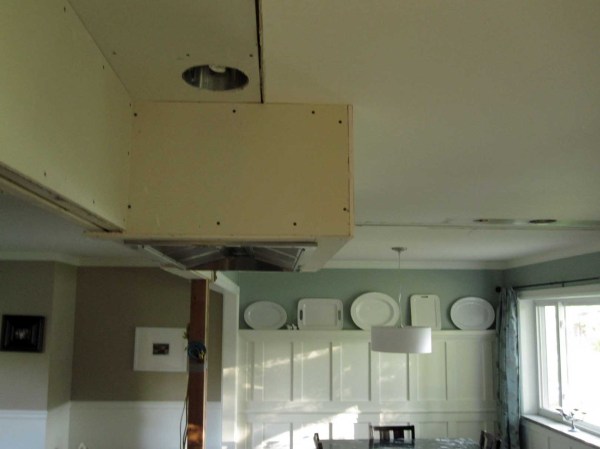
With everything wired up, Ben covered the box with sheet rock.  Now, our giant hole in the wall looks something like this.

In all honestly, I was a little shocked at how deep it was.  In the week since we took the cabinets and soffit down, I had gotten used to the open feel.  And I really liked how much more open everything was after knocking down the wall.  So this seemed heavier than I anticipated.  But, I was so happy the vent hood only drops 1/2 inch below the sheet rock of the support beam.

Not to mention getting task lighting and a fan back.

And it’s still pretty from the underside.

The 1200 CFM fan provides more than enough air circulation and it’s still quiet.  After installing, Ben turned it on the highest setting and we could still hear the music and carry on a normal conversation between the kitchen, living, and dining areas.  Two weeks ago, this is what you saw when you walked in the front door.

And now, behold our kitchen (and Vincent’s head) from the same angle.

It was difficult to get a good picture with all that new light streaming in from the dining room and sink windows.  Still more sheet rocking to do.  And, don’t pay attention to the too tall stove back, microwave, and jumble of wires.  If you’re concerned about safety, we’ve securely closed off the outlets so little fingers can’t get in.

Consider your self up to date on the kitchen progress.  Hopefully we’ll get some sconces, finish up some cabinet work, and look for countertops soon.  Of course we’ll keep you updated on any and all progress.  You’ve been warned.  Annoying minute details are in your future.

The boys and I are off to do some shopping.  Cross your fingers for a good deal!