Green Equals Green: Insulation

Before leaving for our Minnesota vacation we finished a somewhat kitchen related project.  I say somewhat because we finished everything in the kitchen which required attic access.  Support framing for the wall we tore down: done.  Wiring for new lights: done.

Ben is all about energy efficiency.  Since buying our house, we’ve installed new energy-efficient windows and doors, added two inches of foam insulation around the exterior of our house, yanked out our old furnace to upgrade to a geothermal heating and cooling system, and replaced our tank water heater for a point of use water heater.  For years now, Ben has wanted to better insulate the attic but held off until we finished everything in the kitchen.  So, the time had come.

We chose cellulose insulation because it is easy to use, cheap, and eco-friendly.  Cellulose is a fancy word for shredded recycled paper treated with fire-retardant chemicals.   Of course adding any insulation will help reduce heating and cooling bills, saving you money.  But did you know that cellulose is one of the greenest building products?  Here are a few facts I learned during our research:

  • Cellulose takes less energy to make than any other insulation.
  • Has the highest recycled content; up to 85%, reducing paper in landfills.
  • Is regionally produced, limiting trucking and shipping emissions.
  • Homes insulated with cellulose require 26% less energy.
And, as an added bonus, cellulose can slow a fire from spreading by 22 to 55 percent.  Here’s a video demonstrating the fire ratings between houses insulated with fiberglass, cellulose, and without insulation.  Skip about three minutes to see the experiment.
If you’re planning on adding insulation to your home, check out this insulation table to compare different types, R values, and how green each is.

I know, I know.  I sound like I work for a cellulose producer, but I swear we’re not being paid to say this.  In fact, we’ve paid $678 to insulate our entire attic.  When Ben came home with twenty-two 25 pound bags of insulation, I naïvely thought that would be enough.  Turns out, he had to buy 52 more eighteen pound bags to cover the attic with 15 to 18  inches.  It seems strange, but we added 1,486 pounds of insulation to our house.  That’s just paper!  Ben figures we already had an R value (resistance to heat flow) of 20 before insulating.  He added enough insulation to get an R value of 60, including the existing insulation.  Wondering how much you’d need for your home?  Here’s a handy calculator to help you out.

Now that we’ve covered the benefits, let’s discuss the process.  Home Depot offers a free hopper rental if you buy 10 or more bags of insulation.  Two people are required for this job.  One to pour the bags into the hopper and another in the attic spraying it in, moving everything around.  Obviously we tackled this project during the winter.  I think the timing was less than ideal because the hopper is outside with a hose attached to the hopper, keeping the door cracked letting in a lot of cold air.  Our upper level was freezing during the six or so hours it took to get the insulation done.  Luckily, we have a basement and a fire place, so the boys and I hung out down there watching movies.  And that’s why I don’t have any pictures of this.  I’m not about to go in the attic either.  But I would suggest trying this in the spring or fall.

Have you added insulation to your house?  Did you know cellulose had such a great fire rating?  Did I completely bore you with a word filled, picture-less post about shredded paper?

I Like Big Drawers and I Cannot Lie

Due to the impending holiday, we’ve been slacking in the kitchen update department.  Shame on us.  Spank us and take away our birthdays.  Yesterday, we did share a cabinet painting tutorial, but I know you really want to see the installed, finished product.  Am I right?  After locking myself in the basement bedroom for several hours each day for a week, I finally finished priming and painting the fronts and backs of 20 drawers.

We’ve found the easiest way to install drawer fronts is by first marking and drilling holes for the handles.  Use a spacer as a guide to keep the spacing even.  In our case, we wanted a 3/4 inch reveal on all sides of the stack, so a few scraps of 3/4 inch plywood worked wonderfully.  While Handy Sammy held the drawer front in place, Ben put a screw in the holes he drilled for the handles.

For spacing between the drawers Ben used two quarters stacked together and followed the same process.  Once he liked the spacing, he went back and screwed the fronts on from inside the drawers.

Easy enough, right?

Yeah, kinda.  Some how, I don’t quite know because Ben is perfect, he misjudged the depth and screwed into the center, popping the screw through the drawer front.  He said he did it to show he is human because that fact is easily forgotten.  Haha, nerd!

In a few hours, we finished fourteen of the twenty fronts, including the stove side:

What a big difference it makes.  The lower drawers are finished.  Minus minor touch ups like one screw pop and scratches.  Oh, and you can see we decided on two handles for each of the large drawers.  Just one seemed dinky.

Ben and I agreed the handles looked better centered on each drawer.

You can see the small stack was still lacking in the drawer front department.  And, where’s Vincent?

And, here’s a look at our false front covered trash drawer.  Notice we framed out the upper cabinets, too.

We’ve got three more false fronts on the back of the peninsula.

Obviously, the other side has real drawers, and there’s also a stack of drawer fronts opening in the dining room.  Rather than a blank like the end panels, we decided to go with the false fronts.  Ben drilled the holes for the handles first, attached the handles, then screwed the panels on from inside the cabinet.

The functional drawers are customized, too.  Everything looks normal behind the curtain, right?

Wrong!  The protruding window sill called for a smaller top drawer to avoid smashing into granite.  This is the only drawer front we didn’t center the handle on.  Instead, we wanted the handles to line up to so everything looks the same.

There’s no denying it, the kitchen is starting to look finished.  Lower cabinets: done!

We found a mini microwave from Home Depot, too.  Man was than an ordeal.  It just fits in the cabinet.  When Ben told me he built the cabinet 20 inches wide, I assumed that was the inside dimension.  You know what they say about assuming…  The inside dimension is 18 inches wide and most microwaves are 18 or 19 inches.  So we started thinking of different places we could put a microwave.

Option 1: Inside one of the bar cabinets.

But those cabinets aren’t deep enough because the cabinet is built around the support post.  Next idea.

Option 2: Removing a drawer to add a microwave hidden behind a door.  We have two small-ish drawer stacks to choose from, but in the peninsula.  The front-runner to remove was the middle drawer opening on the dining side.

But it seemed inconvenient to microwave something in the dining room.  If we did this, we’d also lost a fair amount to storage space in the depth of the cabinet.  We would have the same problem if we put the microwave in the middle drawer of the kitchen peninsula.

Option 3:  Build a buffet to house a microwave and other stuff.  When we bought the marble for our dining table, we also bought a piece to top off a buffet.  Then, we gave the small desk to my sister and liked how open the room felt.

Again, not the most convenient location, and building another piece of furniture isn’t going to happen right now.

Option 4:  Build a new, wider upper cabinet to fit a microwave.  I may have mentioned this idea to Ben which he very quickly rejected.  I don’t blame him, after all, we had just added the trim detail.

Option 5:  Live without a microwave.  At first, I thought this wouldn’t be very difficult, but how would I make a baked potato?  Certainly not the old-fashioned way in the oven.

We’re so glad we found a microwave to fit in the intended cabinet.  High-fives abounded.  I never thought I’d be that excited about a cheap, ugly microwave.

That’s what we’ve been up to.  Holiday decorating, kitchen updating, and Minnesota planning.  What’s new with you?  Any kitchen work going on?  Holiday decorating and planning?  Are you going to stop by Goodwill to meet up with us?  Do you prefer a hidden microwave?  Ever gotten excited about a small appliance?

Handmade Holidays: Clay Critters

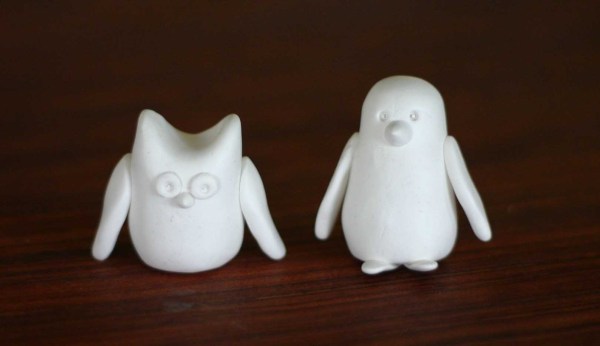
We’ve been at it again.  Making Christmas ornaments, that is.  Jeesh, get your mind out of the gutter.  Haha.  This time, I’ve strayed away from glass balls and moved toward polymer clay.  I had one package of white clay waiting to be used.  Christmas is the perfect time, I guess.  I don’t have a real tutorial for these because I was fiddling around while watching Bones one evening.  By the way, is anyone else in love with Booth?  Anyway, I crafted an owl and a penguin.

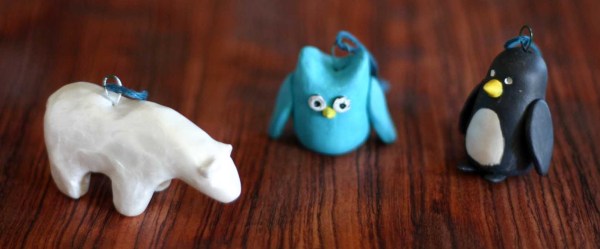
Then, while browsing Pinterest, I saw a cute polar bear ornament.  Sadly, it had already sold and there wasn’t another like it.  I decided to make something similar.  Once I was happy with the little guy, I bent a piece of wire to make a loop and stuck it in.  Following the instructions on the package, I baked the clay for about 45 minutes.

(I’ll explain the other items soon).

After the ornaments cooled, I started the fun part, painting.  I gave the polar bear a coat of pearl white paint for a little shimmer.  And here’s the crew now:

And on the tree:

Doesn’t the penguin look like Wheezy from Toy Story 2?

{image via}

All he needs is a red bow tie.  But, the polar bear is my favorite, despite being wonky and lumpy.

Vincent and Everett love these guys, too.  They pull them off the tree to carry around.  All day.

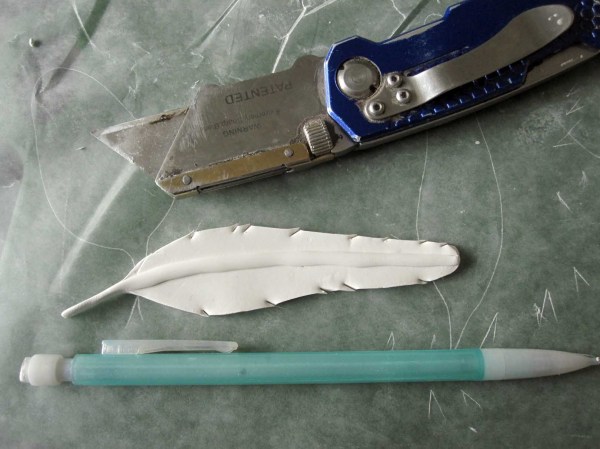
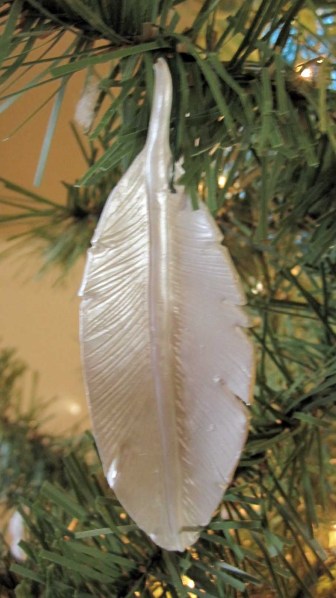
After crafting a few critters, I moved on to feathers.  Of course, I had more Pinspiration.  I started by rolling the clay thinly on a piece of wax paper.  This was so much easier than peeling it off the table.  Then I cut a feather shape out of the clay and made a few smaller notches for texture.  To make the center support, I rolled a piece of clay into a long, thin strip.  After placing it on the feather, I smooshed it own a little and smoothed it out.

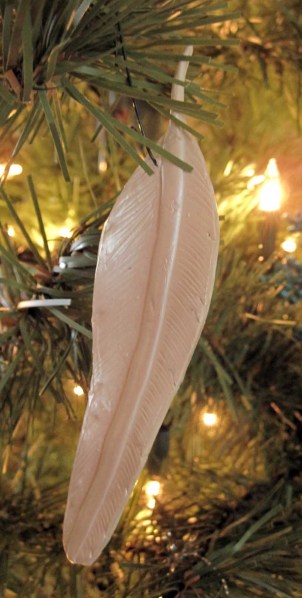
For even more texture, I drew lines with a lead-less pencil, poked a small hole near the top for hanging. To give the faux feathers a more realistic shape, I rolled pieces of aluminum foil and draped the clay over and baked along with the animals.

To finish everything off, I painted two layers of the same metallic pearl paint for extra shimma-shimma.

Total spent: $.98.  And, these are my favorites.  That wraps up all our hand-made ornaments.  How about you?  Have you been working on ornaments?

Handmade Holidays: Owls, Pine Cones, and Trees

You guys, I wish I had some good kitchen progress to share today.  But I don’t.  Told you the drawers would make the progress train come to a screeching halt.  I guess screeching halt isn’t quite correct because I have gotten both sides primed (can you say tedious, time-consuming, paint in the butt?) and I’ll work on painting this afternoon.

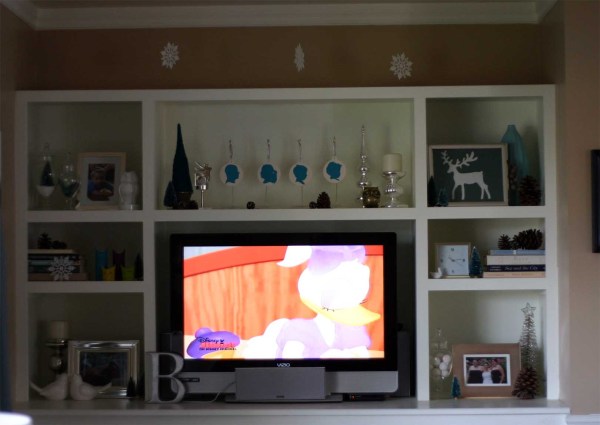
Just doesn’t seem post worthy now, does it?  Instead, you get to see our Christmas-ified entertainment center.  Here it is, complete with complimentary Mickey Mouse Clubhouse for your viewing pleasure.  Tangent, why is it that only Daisy has a sultry voice while the rest of the gang have annoying, high-pitched voices?

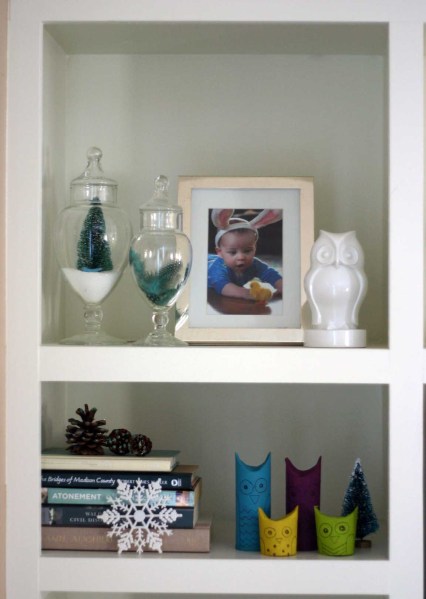
We carried the ‘Winter Wonderland’ theme from the tree over to the entertainment center, too with plenty of trees, a few feathers, and woodland critters.  See those little owls?  They’re made from toilet paper tubes.  I saw this cute idea for hanging owls on Pinterest to create our family, as owls.

The best part, they’re super easy to make and free!  Just fold the tops over, paint, then use a Sharpie marker to draw in details.  Vincent chose green for his owl and Everett requested yellow.  Done!

Randomly placed around the entertainment center you’ll see pine cones.  A few are plain, but using a little Elmer’s glue and glitter, others are covered in Christmas cheer.

Pine cones would be super easy to add to a tree, too, glittered or not.  Just wrap some green wire around the base and then around the tree branch.  Initially, this was my plan, but our tree already looked full.

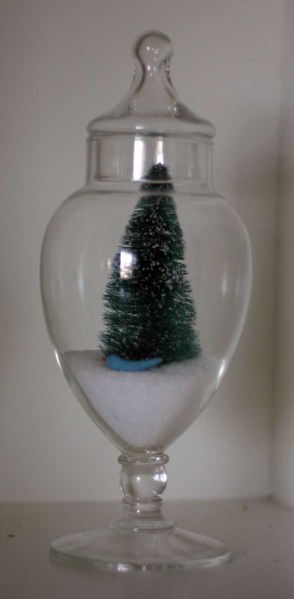
Above the TP owls, we have another owl, a few feathers, and a ‘snow globe’.

Using an apothecary jar I already had, I made a snow globe.  More Epsom salt as snow, a bottle brush tree from the doll house section at HoLo, and a bird from our terrarium.

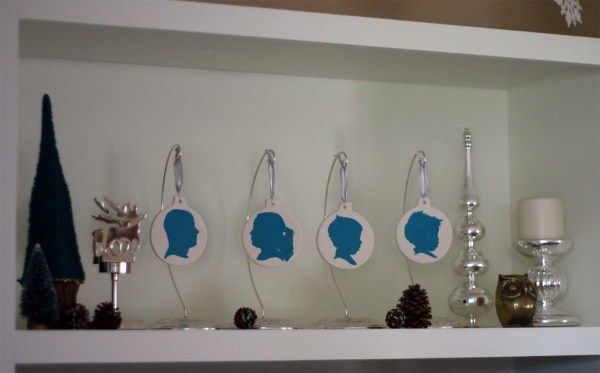
In the center, I’ve continued the silhouette ornament family tradition, this time in a fun turquoise color.  The reindeer candle holder was a dollar at Goodwill, the silver tree cost $7 at HoLo (after 50% off), and the brass owl was three bucks from a local thrift store.

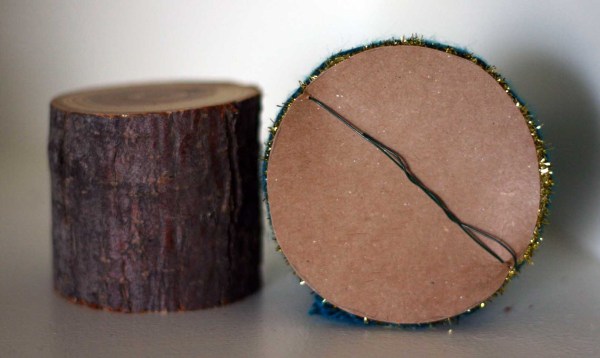
For height, I wrapped a wire form from the Dollar Store in a blueish-green yarn and placed it on a small stump from our wood pile.  That thing has come in handy on several occasions.  I was going to use a styrofoam cone, but at $4.49 each, I ditched that idea.  When did styrofoam become so expensive?!? Luckily, the Dollar Store had my back with garland wrapped wire forms.

Wrapping the form was super easy, but I had to deal with the lack of a bottom.  So, I cut a circle from a pizza box and quickly wired it to the bottom.

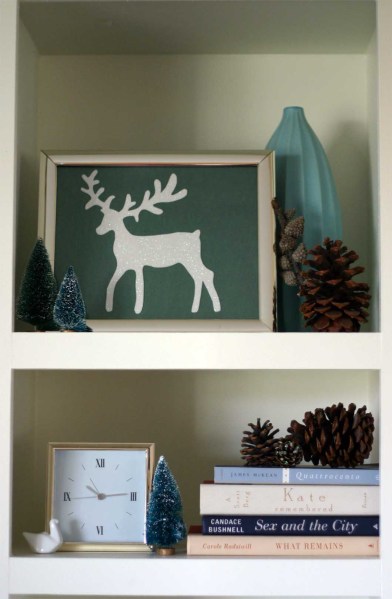
Over to the right we have more bottle brush trees, pine cones, a 99 cent ceramic origami crane chopstick rest from World Market, and a framed reindeer silhouette.

The reindeer was super easy to make.  I made a silhouette in Photoshop, printed it on plain paper, cut it out, traced it to a sheet of glitter foam, cut that out and taped it to a sheet of card stock.  Here’s a template to make your own.

Another apothecary jar filled with sequin ball ornaments, a pine cone, and more trees, including one from Pier 1 last Christmas round out the entertainment center display.

And, our Christmas tree is finally ready for the grand reveal.

Vincent insisted on hanging his V on the bottom, even though it didn’t fit our theme.  And, here’s a glimpse of a few ornaments we’re sharing on Monday.

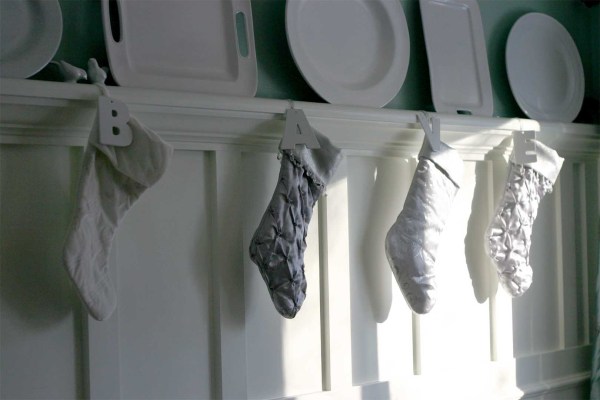
Like last year, we’ve hung our stockings from the plate rack.

We’ve got monograms again, too; ornaments from HoLo for $.50 each.

I planned to paint designs, but haven’t gotten around to it yet.  Maybe I’ll swap out the plain ribbon for something with more color.

We’re officially ready for Christmas.  How about you?  Are you ready?  What areas do you decorate?  Just a tree?  The mantle?  Or are you mantle-less like we are?

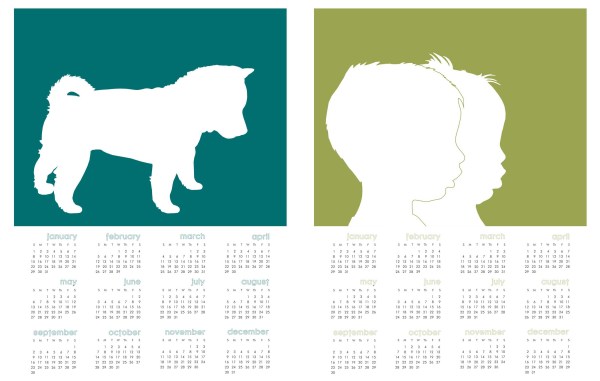
P.S.  We’re ready for 2012.  Are you?  Prepare with our new custom silhouette 11 inch by 14 inch wall calendar.

When 2013 rolls around, cut the silhouette design off to frame for years to come.

Handmade Gifts: S and P

Better (and safer) than S and M.  No, we’re not changing our tag line anytime soon.  Actually, this post don’t have much to do with salt and pepper.  More than anything, we wanted to share a hand-made gift idea.  It all started with, you guessed it, Pinterest.  I saw adorable painted mugs from Country Living.

Even before seeing the article, I had a similar idea, but only knew about the Porcelaine paint pens, but wasn’t thrilled with the results.  Country Living mentioned the PermEnamel brand, found at JoAnn, so I stopped in to see what our local store had.  I found the paints, but the color selection was very limited.  After JoAnn, I went to Michael’s to see what they had.  And there, right next to the regular acrylic craft paints, I had a revolution.  Americana not only makes acrylic paint, but Gloss (and Crystal) Enamels, too.  Perhaps I hadn’t noticed before because these paints are packaged in the same tubes as acrylics.  And, the color selection was much better than the PermEnamel paint.  So, I grabbed a turquoise color and went home to get started.  Started on what, though?  Good question!

You see, before we started the kitchen reno, we kept two small bowls on the back of the stove.  One for salt and another for pepper.

Yes, I am lazy enough to get annoyed at shuffling the spices around to find salt and pepper nearly every day.  The system worked, but I didn’t like that the containers were open.  That, and we now have a backless stove.  Oh, and it didn’t hurt that I found these cute lidded bird jars at World Market for $4.99 each.

Sure they were in the bath section, but why keep these cuties confined?  I bought two for salt and pepper.  That solved the problem of exposure, but now I had another problem.  Which was the salt, and which was the pepper?  And that’s where the ceramic paint comes in.
Actually, in my excitement for the newly discovered painting world, I accidentally grabbed a tube of the Crystal Enamel paint, which is for glass.  Back to Michael’s to get a tube of the Gloss Enamels.  The Porcelaine paints must be baked to set properly.  Bonus, the Gloss Enamels paints can either be baked, or can air cure for 21 days.

After cleaning one bird with alcohol, I started painting.  I worried the paint wouldn’t apply smoothly, but it was wonderful to work with and coverage was great.

This guy has been air curing for about two weeks, with use, without problems.  That’s a win in my book.  Now we know  before taking off the lid, that the blue bird has pepper.

All that to say try the Gloss Enamels paint.  You could paint mugs similar to the Country Living article, but personalize more with a family pet, child, monogram, whatever tickles your pickle, really.  Or, you could paint decorative plates.  Note the emphasis on decorative as the instructions are clear the paints are not for use on food surfaces.

Have you painted a design on glazed porcelain or ceramics?  Thinking of painted gift ideas now?  What would you make?