Going Out on a Limb

You wanna know something?  Pinterest is starting to take over my life, in a good way.  I’ve been inspired to make several items so far, and I’ve just added another to the list.  I’ve already professed my love for birds, so this  is a fitting addition.  One fine day, Pinterest showed me this bird-cage pendant.

Clouds parted, angels sang.  It was a glorious moment.  The price tag, very glorious.  All $615 U.S. dollars of it.  Of course, like any sane DIY-er, I racked my brain for a place to put a similar pendant.  A proverbial light bulb lit for my light in waiting.  Why not my office?  Sure, I already have a light in there.  But, it’s kind of boring.  Just a descended boob fixture.
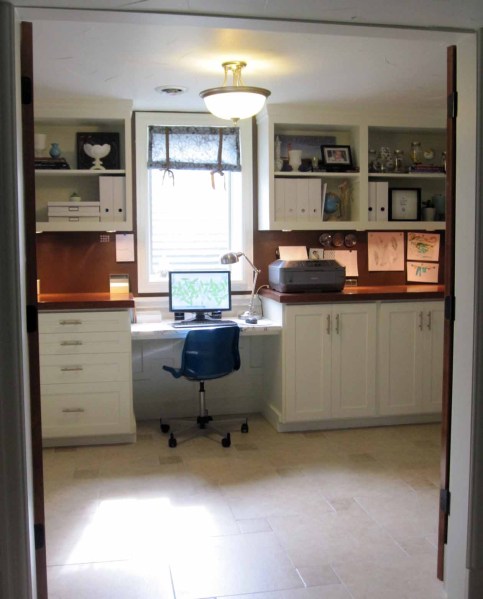
I can’t justify taking down the old light and simply donating it.  The thing cost 50 bucks, people.  So, I had to think of a place for that light, too.  Hey, hey.  Why not the small basement bedroom?
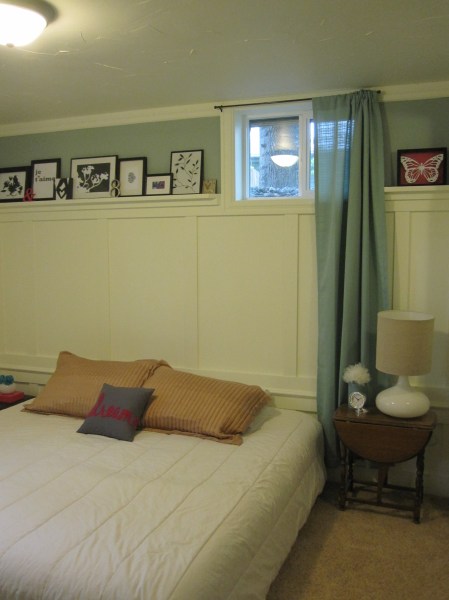
Yes, that’s perfect.  Rather than a perky boob, why not a saggy one?  With my placement strategy ready, I set out to make a bird-cage pendant.  First step, find an old lamp shade to snag the washer top fitting for the base of my shade.  Luckily, I found a large, ugly lamp shade at the thrift store, priced at $5.99.  Not too bad, but this shade had a large tear in the fabric, so the check out lady discounted the shade to only $2.99.  Score!

Next, off to Hobby Lobby to buy me some fake birds.  I came home with 4 sheets, 10 birds total, for $7.96.  After HL, I stopped at two hardware stores, hoping to find a similar wire for the cage.  I did, but the small stores charged about thirteen bucks for a small roll.  I decided to hold out until our next Home Depot trip.  Well, Ben went to Home Depot first, so he bought a two foot wide but five foot long roll of 1/2 inch hardware cloth for $8.34.  Finally, with all my supplies ready, I started working on my pendant.  I tore the ugly fabric off the lamp shade to expose the wire cage.  That’s when Houston called to say we had a problem.  The washer top fitting wasn’t flat, it was recessed.
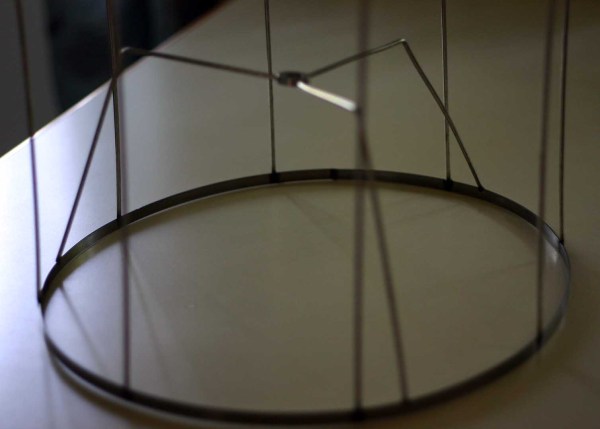
Now, this wouldn’t be a problem if I were covering the shade with fabric, but the recessed adapter would be more of a focal point.  And I worried about the heat of a bulb being too close to the birds.  Why didn’t I realize this before?  Gah.

So, I nicely begged Ben to cut the fitting apart and reattach the pieces for a flat top.  Because Ben is brilliant, he came up with a better solution.  First, he cut off four of the eight rods (leaving every other) supporting the top and bottom rings.  Then, he used a channel lock to bend the rods at a 45 degree angle, bringing each end to the center.
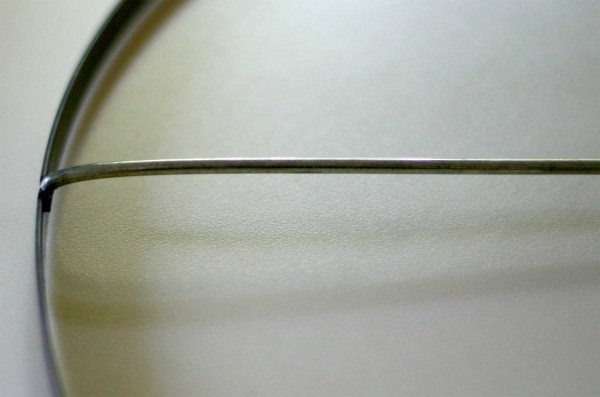
He tried welding the rods together to make a square fitting, but it wasn’t strong enough.  Instead, he welded a washer to the four rods.
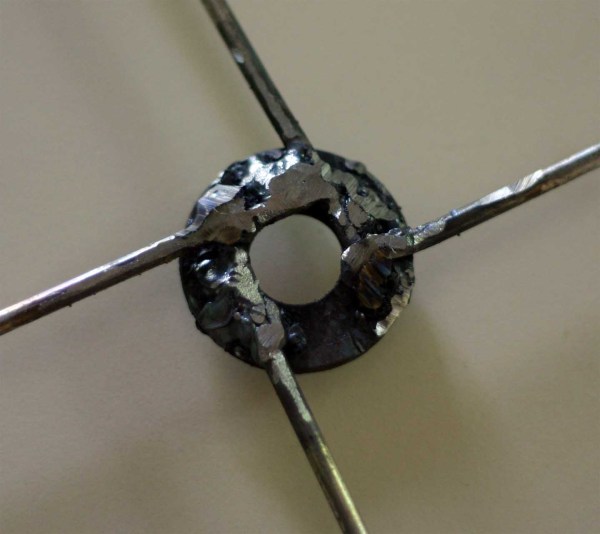
Perfection.  And, whether he planned this or not the ugly side was face up, so it wouldn’t be visible from below.
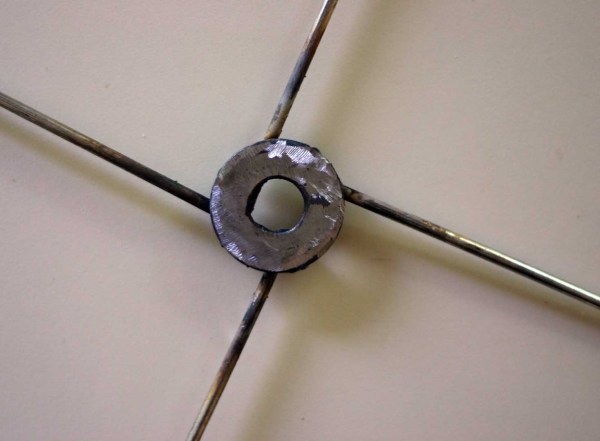
My hero, Ben, was able to make a flush top out of a recessed top. leaving me with this.
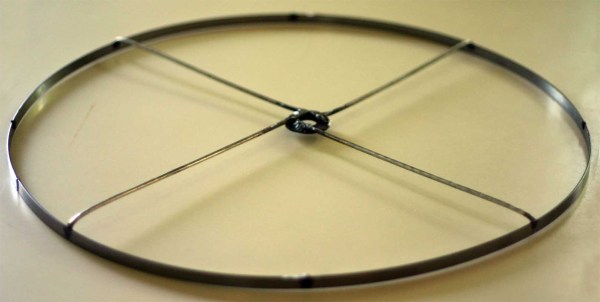
Aaaaaat laaaaast, I could really get started.  I gathered my supplies: one wire ring fitting, one roll of 1/2 inch hardware cloth, 18 gauge wire, styrofoam birds, 6 pound test fishing line, wire cutters, a measuring tape, and sticks.
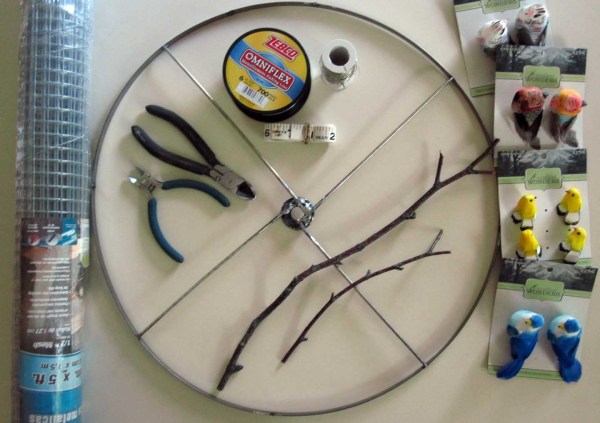
Before I could do the pretty part, I cut down my hardware cloth.  The descended boob hangs down roughly 14 inches from the ceiling, which is the lowest we can have given the shorter basement ceilings.  I want the shade a few inches from the ceiling, so I cut the wire to eleven inches, one tiny wire at a time.
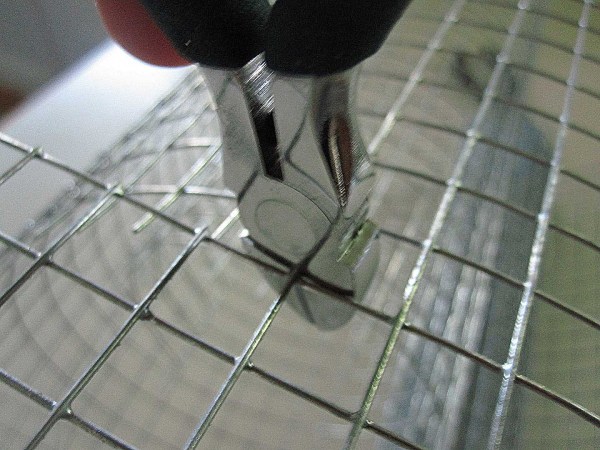
With my 11 inch by 5 foot piece of wire netting cut, I used a channel lock to fold one square over, all along one edge.
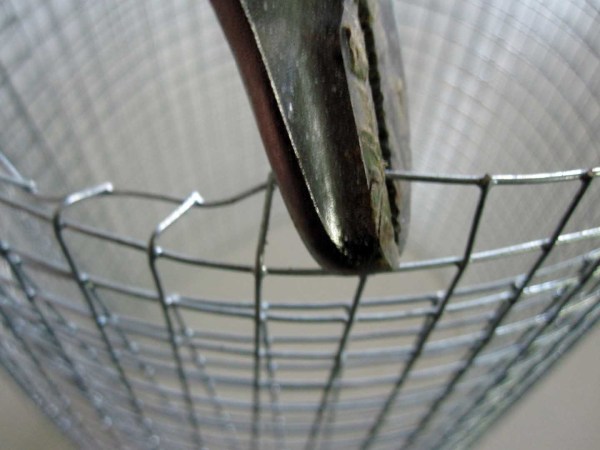
Once I folded the edge, I placed my wire top inside, clamping the folded netting over.
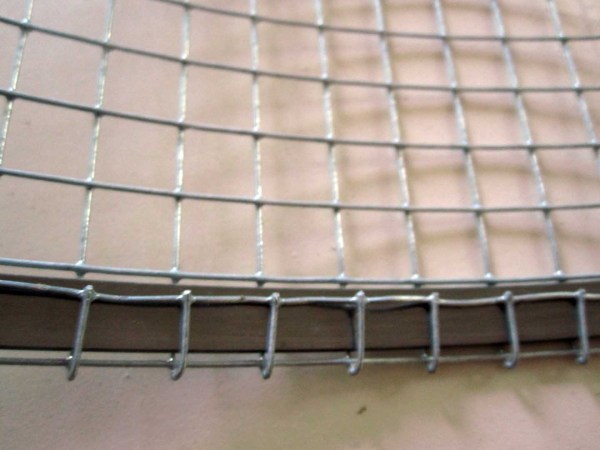
I had to cut a few squares to go around the washer top support rods, but that was easy.
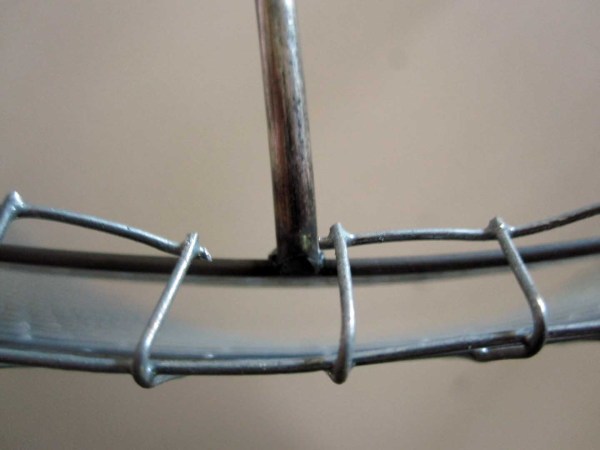
After clamping the entire ring with wire net, I overlapped the ends slightly and cut.  I used a metal clamp (actually a surgical clamp-it worked wonderfully, getting into the tight areas) to hold the ends tightly together before wiring everything shut.
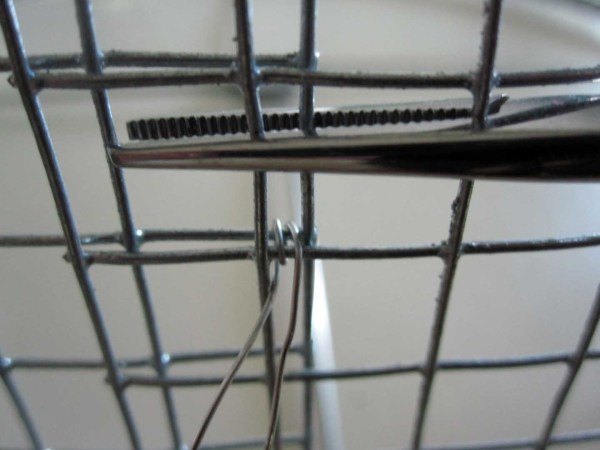
A little bit of wire wrapped around the ends held everything in place tightly.
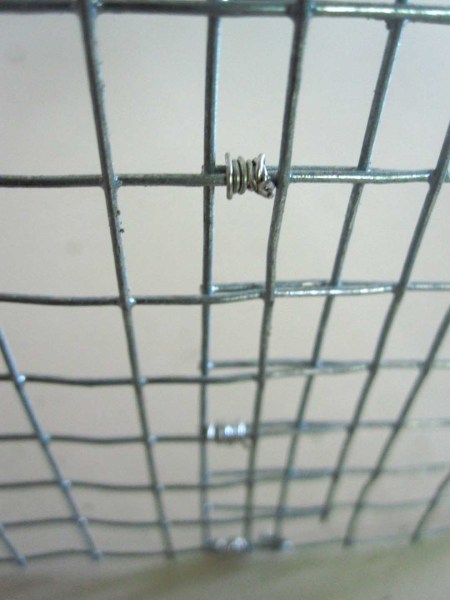
Things are shaping up, literally.  The hardware mesh was sturdy enough that I didn’t have to add a ring at the bottom.  It held its shape nicely.
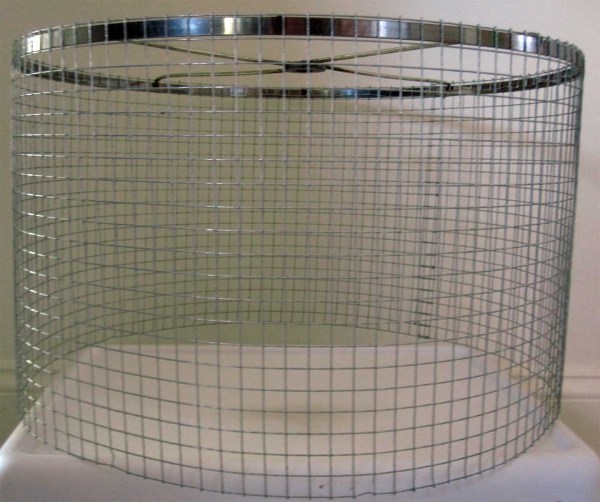
I’m likin’ it.  Now, how about a shot of color?  Bring on the birds.  The birds I bought have a small wire stuck in the middle, so I wrapped the wire around a stick. Seemed to hold, so I wired another bird on the stick.  And another, and another.  And some fishing line to each end.  I tied the bird-laden stick to the wire support.  It looked too sparse, so I tied another stick and two birds on.  Sorry, the birds are blurry.  Vincent kept petting them, so the sticks moved.  A lot.
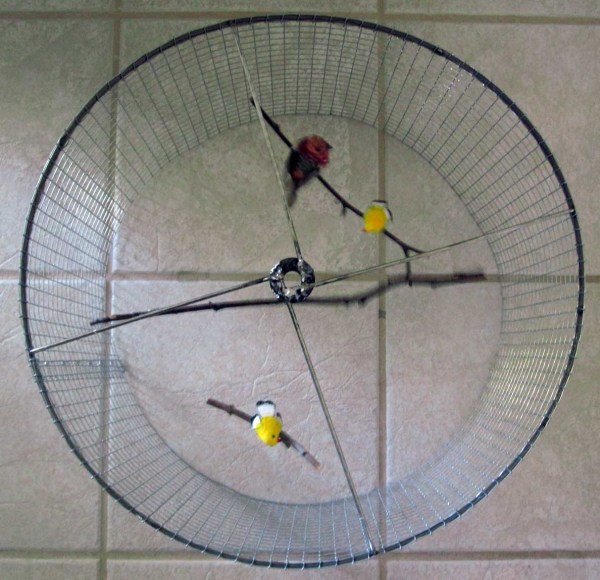
That was still a little plain for my liking, so I found another stick in the yard and looped a wired bird around it, tied it to the cage and stared.  It still wasn’t quite right.  How about another bird stick?  More fiddling and rearranging (to keep the bird from tipping, looking dead) and I finally had all ten birds secured.
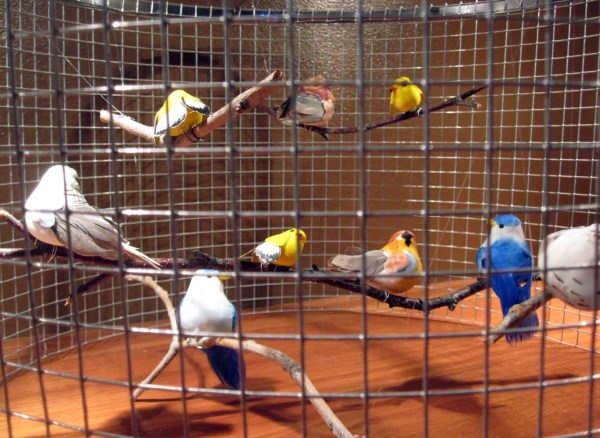
In certain light, the fishing line is visible, but only if you’re looking for it.  See it here?
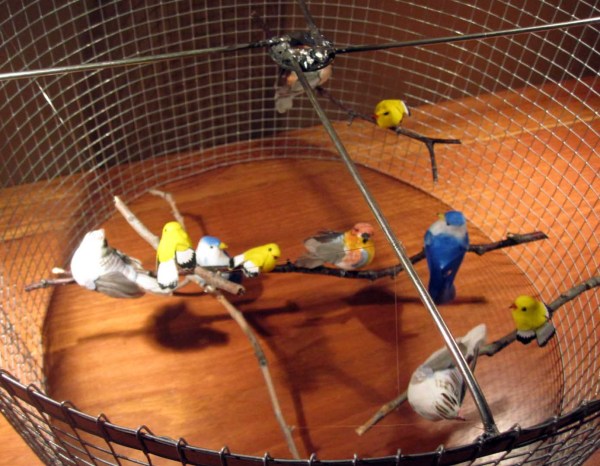
I like the natural metal finish on the cage.  I know the original is copper, but I didn’t have copper spray paint and I felt lazy.
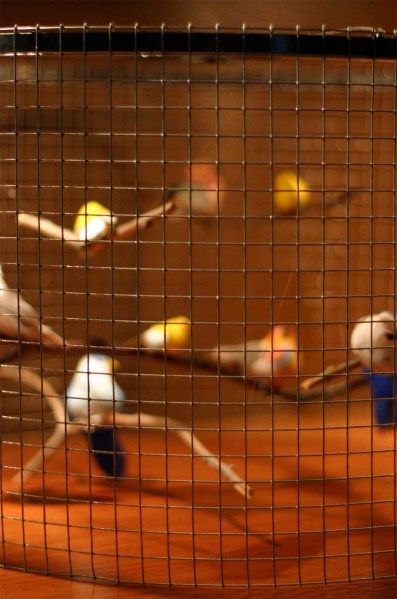
Here she is, done and ready for wiring.  If I see more special looking birds, I’d like to buy a few, just for varied colors.
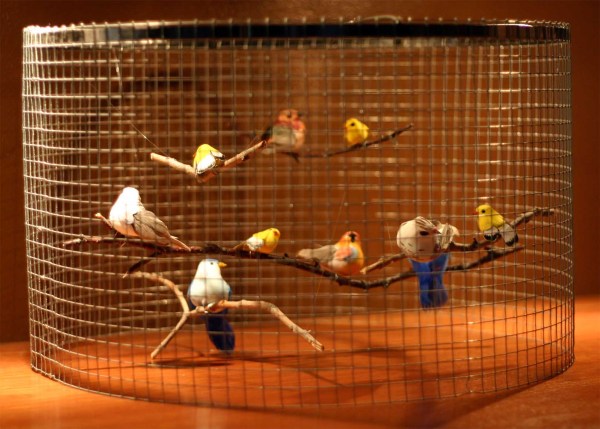
So far, I have a shade but I need to find a wiring kit or cheap pendant to use to hang this whole thing from.  Off to Habitat for Humanity ReStore, I think.  Who knows when I’ll actually get around to wiring and hanging this guy.  Who’s ready for a price break down?

Lampshade: $2.99

4 packs of fake birds: $7.96

Roll of hardware cloth: $8.34

Sticks: Free from mother nature

Fishing line, wire, wire cutters, and tape measure:  Already owned

Total spent so far:  $19.29 and I still have the top fitting of the lamp shade and enough wire netting to make a second pendant, if I so choose.  Perhaps I’ll find a pendant or wiring kit for less than $5.71 to keep my total under 25 bucks.  Think I can do it?  Yeah, me neither.  Fingers crossed ReStore has something.

So, how does this DIY rate against a 600 plus dollar fixture?  Are you constantly drawn to making lights like I am?  Ben jokes that I only make pillows and light fixtures.  Sadly, that seems to be true.  We really need to start on the kitchen so I can focus my energy on something else.  Do you make the same items over and over again?  Please tell me your house is crowded with some sort of DIY project?

And Then Tweak for Perfection

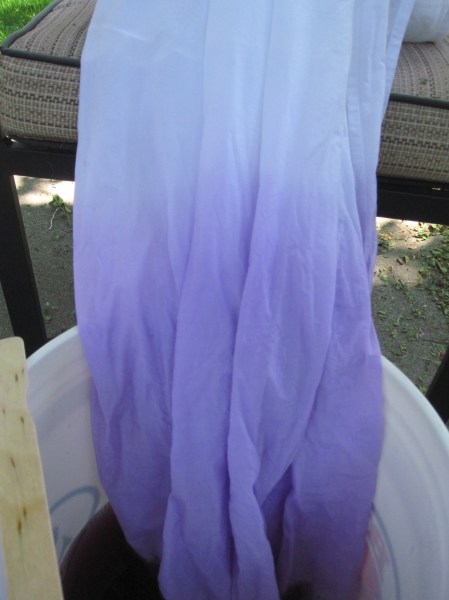
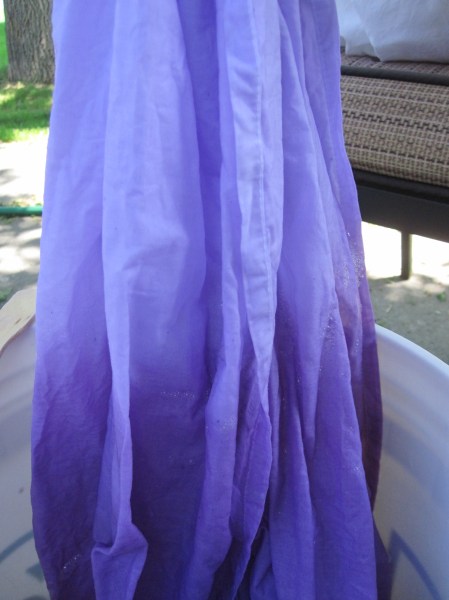
And the ombre dye saga continues.  Last Wednesday, I eluded to yet another dyeing issue.  You’d think I would have learned my lesson, but no.  Sadly, I didn’t rinse the dye out thoroughly enough because the undyed areas were a faint purple with splotches (yes, that is a technical term) of darker color, just like my first round.

Initially, I thought I’d just hem the side with the worst of it, but I would have to remove too much of the fabric and the curtain wouldn’t be wide enough.  I thought I could live with it, but it taunted me every time I looked at it.  I needed to do something about it, or at least try.  While at JoAnn’s, I found a box Rit dye color remover.  I figured if anyone or thing could fix this, my best bet would be to use the same brand.

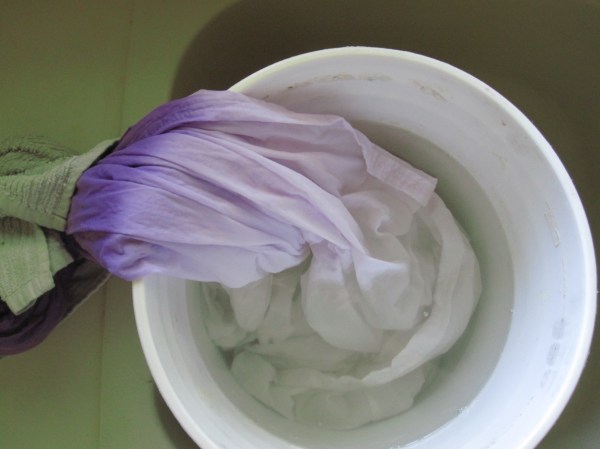
I gathered more supplies, my trusty five gallon bucket, hot water, (I boiled a small pan and filled the rest with hot tap water) rubber gloves, and a spatula.  I poured the powder in the water and let it do it’s thing.

It seemed to work.  I let the curtain soak for 30 minutes, rinsed it out, then tossed it in the washer for another quick clean.  Happily, I had stunning results.  Finally, I could hang my ombre curtain.  Our bathroom is tiny, so it is really hard to get pictures from top to bottom.  Please bear with me for the abundance of photos.

I love that the colors blend well, but you can still see the lines of each level.

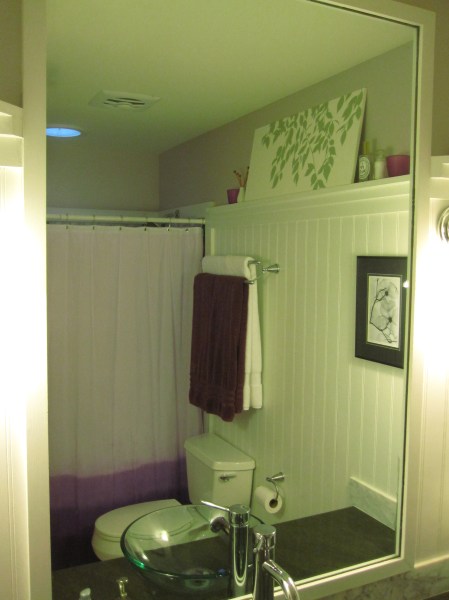
When the shower isn’t in use, we usually leave the curtain open to let as much light from the sky tube into the bathroom as possible.  So, this is what it looks like 95 percent of the time.

Here you can see the opened curtain and how it works with the rest of the bathroom.  That’s how small this bathroom is.  I had to reflect the rest of the bathroom in the mirror.

When closed, this is what you’re welcomed by.

The dipped end hand towels are pretty fun, too.  If only the white stitching took the dye, too.  Oh well.

Now, I need to get around to painting the ugly wooden doors.

After a little Pinterest search, (I love how Pinterest has become the new crafting Google) I found another ombre dye project with a wonderful tip that may have eliminated the need for color remover.  After dyeing, let the fabric dry before rinsing.  Apparently, this sets the dye to keep the colors vibrant, so I’m guessing it can also help reduce bleeding.  Though, this was my second attempt to dye something, so what do I know.

Now, for a total cost break down:

Flat sheet: $9.99

Three boxes of purple Rit dye: $8.25 ($2.75 each)

One box of Rit color remover: $2.75

Thread: Already owned

Grand total spent: $20.99

I’ll probably dye more things in the future, just to hone my skills.  Are you a fan of the ombre trend?  Do you have ombre in your house?  Your clothes?  Your hair?  My sisters are trying to convince me to ombre dye my hair, à la Jessica Biel.  For more ombre inspiration, check out this ruffle shower curtain and this painted dresser.  What is your favorite ombre colored item as of late?

Try Again

As I shared, my first ever fabric dye slash ombre project didn’t go as well as I imagined it would.  (Thank you so much for your tips and tricks.)  Bummer, but I don’t give up that easily. I’m Polish after all.  Wait, maybe Polocks aren’t known for stubbornness as much as ignorance.  Either way, I was determined to try it one more time.

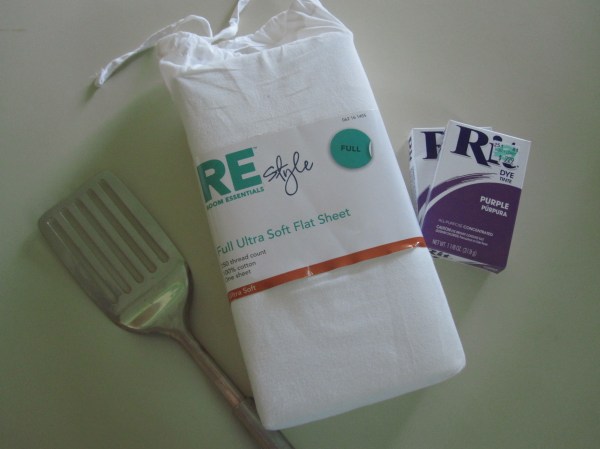
Having learned from my mistakes, I bought two boxes of purple dye and a full-sized flat bed sheet.

I also used the main bath tub. About half way into my process, I laid a junk towel under the bucket to protect the acrylic tub.  Pretty sure a dyed bath tub would be an epic failure, even if I successfully dyed the curtain.

To keep the dye line as even as possible, I hung the sheet on the shower curtain using the existing shower curtain rings and a set of curtain clips I had in the basement. 

I slipped the curtain clips through the curtain rings because the clips were too small to fit on the shower rod.  Then, I clipped my sheet up so I wouldn’t have to touch the curtain, just the rod and clips.  I highly suggest this method.

I decided to use one half of a box to dye my first ombre layer.

I didn’t realize it until later, but I completely forgot to add salt or liquid soap.  Oops.  I did however let the sheet soak for about 20 minutes, stirring constantly with a stainless steel spatula.  With a nice, saturated color, I moved the curtain rod up about eight inches and added the second half of the box to the bucket.

After 20 or so minutes, I moved it up another eight inches and added the entire second box to the mixture to let it soak.  Before dumping the dye solution out, I dyed the ends of two white towels, just for fun.  I rinsed out the sheet and towels, but as I neared the end, Everett woke up from his nap, so I quickly rinsed out the rest and popped it into the washer for a quick clean.

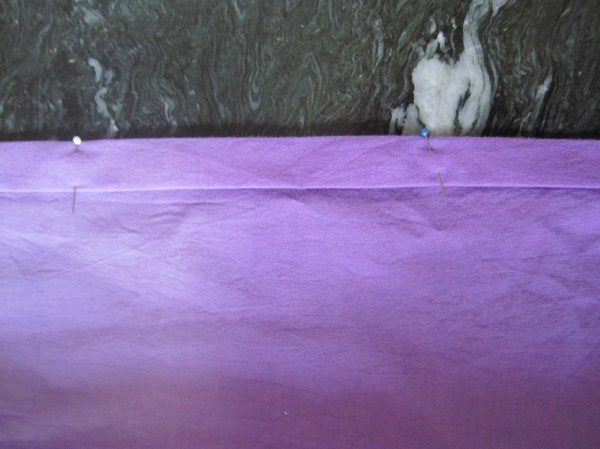
Now, I had to figure out a way to hang this thing.  I started by sewing the sides to the width of our shower curtain liner.  I ironed the edges and got freaked out because the heat of the iron turned the dye pink.  After 15 seconds or so, the color did go back to normal.  So, I continued ironing and folded the edge over twice to get a clean edge and pinned.  I planned to only sew one side and the top to get my measurements.  The white thread from the sheet didn’t absorb the dye, so I was safe using white thread to hem everything.  I sewed my side first.

I considered sewing button holes to hang from, but my button-hole function didn’t want to work for me.  Plan B.  We needed a new curtain liner for our bathroom, so I cut the grommets off the old one to sew to my sheet.  I pinned right sides together so my seam would look as seamless as possible.

Then, I stitched right along the plastic edge, but not on it.

A quick pressing with the iron made a nice crisp seam.  Unfortunately, I did have dyeing issues again.  Off to rectify that situation.

So far, I’ve spent 9 dollars and 99 one hundredths of another buck on a flat bed sheet, and $5.50 for two more boxes of Rit dye, bring our total (including yesterday’s failure) to $18.24.  Not too bad considering the only other curtain I liked cost $29.99.  So, we’re still $11.75 under budget, failures and all.

How much are you willing to spend on a shower curtain?  Have you ever made one yourself?

If at First You Don’t Succeed

I’ve been itching to add more color to our house recently, without breaking the bank.  While innocently browsing Pinterest, I came across an idea.  Dip dyeing fabric.  Easy peasy, right?  You’re smart enough to realize this wasn’t as easy as I originally thought.  So, I went to Hobby Lobby and picked up one box of purple powdered dye and set to work.  What did I dye?  I decided to ditch the plain white shower curtain we had in the main bathroom.

Of course most shower curtains are synthetic or a blend, but the people at Rit suggest an all cotton fabric.  So, I found an old white king sized flat sheet to dye, hem to size and hang as a shower curtain.  With my dye in hand, I gathered the necessary supplies.  A 5 gallon bucket, hot water, salt, dish soap (I didn’t have liquid detergent so I improvised) a measuring cup, bowl, paint stirrer stick, and rubber gloves and took my dirty work outside.

Now looking back, that was mistake number one.  I decided I wanted an ombre dyed curtain, with the top two-thirds white and the bottom a three-layered ombre.  Because of my layers, I decided to divide the box of dye to make my darker shades.  I used 1/4 of the box and about 2.5 gallons of hot water for the lightest layer and let it soak for about 15 minutes.

Then, I mixed up another 1/4 of the box to add to the solution I had going to dye my second layer.

Again, I let this soak for roughly 15 minutes.

I thought the distinction of layers was pretty noticeable, so I continued on with my plan.

Then, I used the remaining half of the box for my bottom layer, adding it to the mix and letting it soak.

When I thought I had several distinguished layers, I started rinsing the fabric in warm water, again outside.  Lesson to you folks, don’t dye large pieces of fabric outside.  Why?  Because the fabric started falling and I grabbed it with my gloved, dye hand.

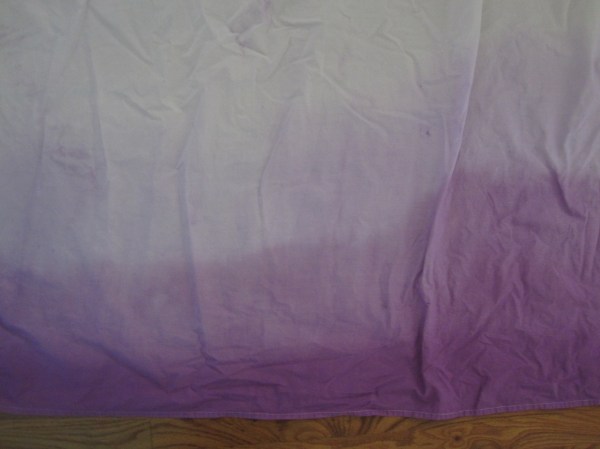
Mistake number two, I didn’t rinse the fabric out thoroughly enough.  After washing in the machine, I had about 10 areas where the dye touched the undyed portion, leaving ugly blobs.

Mistake number three, I just gathered he fabric in my hand, so the bottom wasn’t even, making the dyed are wavy.

Mistake number four, I either used too little dye or didn’t let my fabric soak long enough because the dyed areas weren’t nearly as dark as I’d like.  Of course, this mistake is personal preference.  Total failure cost: $2.75 and a smidge of my pride, which doesn’t make it an epic failure, but annoying none the less.

Please tell me someone out there has made at least one of these mistakes when dyeing something?  Don’t you hate when you have a brilliant idea and it doesn’t work well for you?

Pinspiration: Fall

Yesterday, we shared a few projects we’ve done to gear up for fall, but we’re not done yet.  We decided to tap into our Pinterest account to find more inspiration, or as I like to call it, “pinspiration.”  Leaf Leave it to Martha to have several cute, nature related ideas, like this acorn cap mirror.

It’s a shame we don’t have many oak trees here in Montana.  However, we do have leaves to create a hanging leaves mobile.

I think this same process could be used to make a light shade.  Use a wire wreath form to tie the leaves around and hang over an existing light.

Gather real or fake leaves to make a leaf covered monogram to hang on your front door.

If you have a few bottles of craft paint left over from past projects, ask your kids to help you make painted leaf art.

Gather sticks, twigs and branches to cover a plain table for a statement piece.

Use washing soda to make leaf skeletons.

What is your most recent fall inspired pin?  Willing to give one of these projects a try?  Maybe you already have?