Bow & Arrows

After deciding to paint the backs of the entertainment center yellow, I decided to add pops of yellow in the living room to tie everything together.  My first focus, pillows.  Redesigning the blog inspired a  pattern.  Flipped and repeating arrows.

Of course, I had to make the design.  In Photoshop, I altered the background design for a more suitable stencil.  Enlarging, beefing up the lines and shortening the overall design gave me a good base.

I opened a new page, copied, pasted, and rotated the arrow design 45 degrees.  To make a repeating design, I duplicated my arrow layer and flipped it horizontally.  When I like the placement, I merged my two arrows together and duplicated that layer, this time flipping the design vertically to make this design:

Printing to plain paper gave me my template.  I had transparency sheets on hand, but you can pick up a package at an office supply store.  Taping the template to the underside of my clear sheet made cutting a crisp design quick and easy.

Once I finished cutting my stencil, I gathered my fabric supplies; yellow duck cloth, fabric paint, a foam brush, paint tray, and my new stencil.

I’d suggest marking both the center of your fabric and the center of the stencil.  Making reference points for a repeating pattern would be a good idea, too.  Eyeballing this design wasn’t difficult, but a more intricate design might be.  So, remember that when making a stencil.  Then, starting at the center, I worked my way toward the edges.

Fortunately, the fabric paint dried quickly, but I did cut the edges of my stencil to make overlapping easy.

After the paint completely dried (about 20 minutes later) I cut two pieces of yellow fabric to make an envelope closure style pillow.  Now we’ve got a completely custom pillow on the couch.

Time to start thinking about curtains, but that could be an entirely different post.  So many options, so little time.  What have you stenciled recently?  Walls?  Pillows?  Maybe you’ve been sewing?  Whatcha making?  Or are you starting curtain planning?  Let’s discuss.

Bag of Health

We’ve never had a bathroom that didn’t have drawer storage.  So, I’m working on a few ideas to make the main bathroom as functional as possible, sans drawers.  I’m still searching for the perfect baskets, but I decided to make a zippered bag to store first aid supplies.  To get started, I bought a yard of silver metallic ironing board cover (hey, it was cheap, durable, and shimmered) and a 12 inch blue zipper.

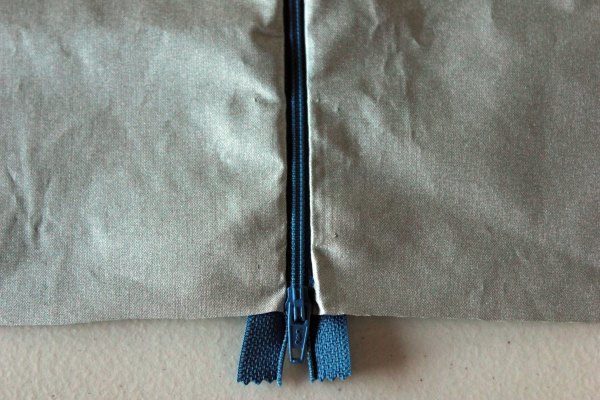
Knowing I want to fit all our first aid supplies in one bag, I cut two pieces of fabric 12 inches wide by 17 inches long.  Yes, this is going to be big.  Then, I placed my fabric on the table, right side up.  Lay the zipper over, face down, keeping the bottom edge of the zipper flush with the bottom edge of fabric.  Pin in place.

If you have a zipper foot for your sewing machine, now is the time to use it.  I thought I did, looked all over for it, and couldn’t find it.  Instead, I sewed the zipper on by hand.  Sew close to the zipper without running into it.

Once you’ve sewn one side on, add the second piece of fabric putting the right sides of the fabric together.  Sew along the zipper edge again.    When the fabric is folded over, right sides out, the zipper will have a nice clean edge.

Because I sewed this by hand, I went back over and added top stitching with my machine, following along the edge of the fabric for a straight line.

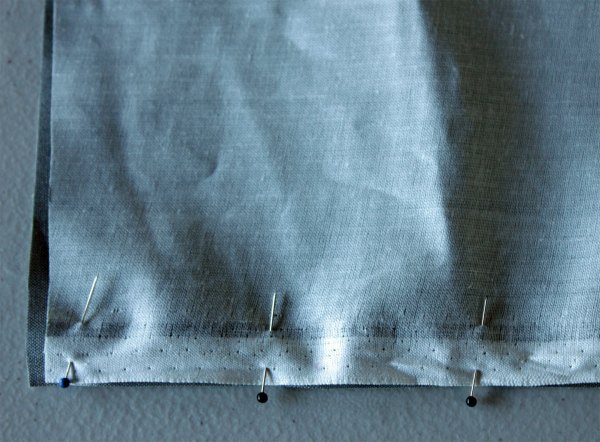
Now face right sides of the fabric together and pin along the bottom.

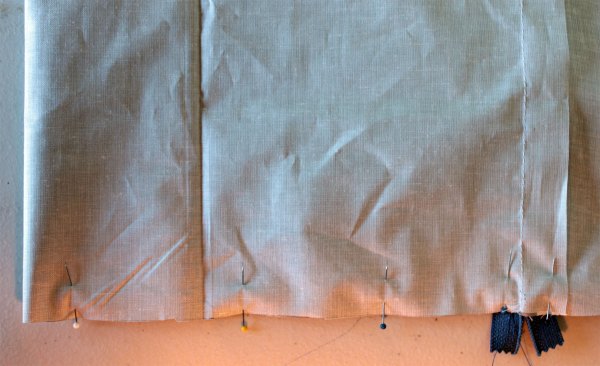
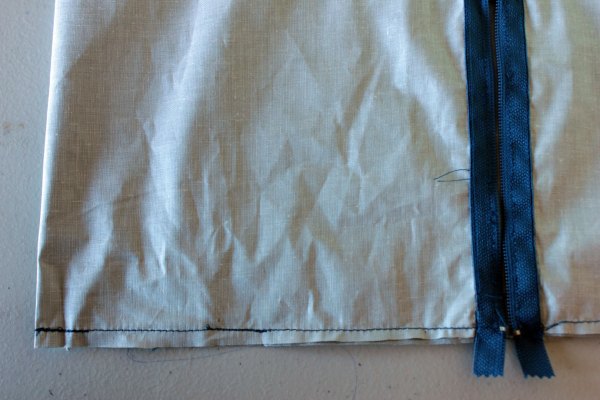
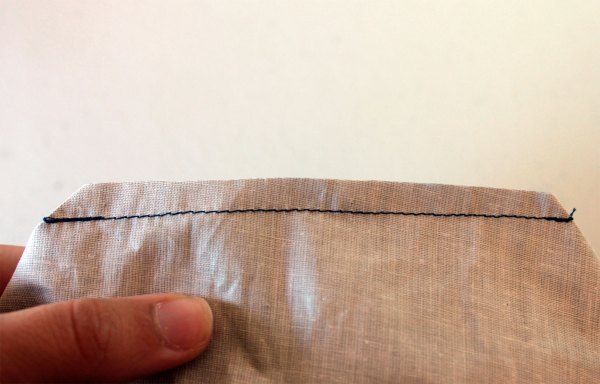
Sew along the edge, leaving a half-inch allowance.  Unzip your zipper few inches-this is crucial to turn it right sides out when you’re done.  Leave the fabric wrong side out.  Pin the edges and sew a straight line, a half-inch from the edge.  Do this to both sides.

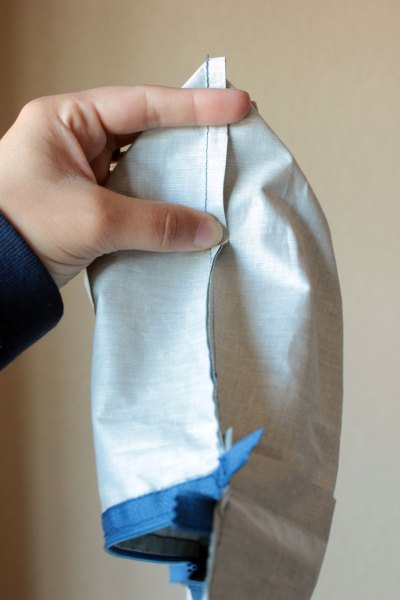
If you were to turn it out right now, you’d have a flat bag.  To give it a boxy shape, pinch the corners together.

I found it easiest to put one finger in the corner of the bag, holding it upright, then flattening the point like this:

Your point will be perpendicular to the edge seam.  Pin the corners to hold in place.

For my first corner, I made a straight lone across and sewed along the line.

Then I measured my width and marked the three remaining corners at five inches, just like my first one.

After sewing all four corners, cut about a quarter-inch above.

Then fill your bag up with cosmetics, travel toiletries, or first aid supplies.

To make a different sized bag, keep this in mind:

  • The zipper length will determine how big the bag is from front to back.  I had a 12 inch zipper, so I cut my fabric 12 inches wide.  For an 8 inch zipper, cut your fabric 8 inches wide.
  • The length of the fabric will change how wide it is from side to side.  I cut my fabric at 17 inches, which is really wide.  For a size more like a regular cosmetic bag, cut the fabric between 8 and 12 inches.
  • For a boxier bag, widen your corners.  I pinned mine at 5 inches, which I think would be perfect for a cosmetic bag, but that can change.

Dog Bed

Here’s a super quick, cheap, and easy dog bed.  All you need is a set of standard pillows and pillowcases.

Sewing machine optional, but it makes this quicker.  I promise, those of you afraid of a sewing machine can do it, one straight line is all it takes.  Just pin the pillowcases together along one edge.

I put my factory sewn edges together, but it’s up to you.  Then stitch a straight line 1/2 inch from the edge, all the way down the case.  Put a pillow in each case and you’ve got a dog bed.  I bought new pillowcases for ten bucks at Target and used old pillows we already had.  If you’re buying all new supplies it would cost around $20.  Not too shabby, especially because this is super easy to wash.  Here’s Miss Priss enjoying her comfortable new spot.

If you don’t have a dog, your kids might like this for slumber parties or lounging around.  Just after I stuffed the pillows in, both V and E flopped down, staking their claim.  I might have to make another…

What kind of dog bed do you have?

Earn Your Stripes

I know, I know.  Stripes are a huge trend and I’m the last to jump on board.  But I love the look, so I did it.  Back when we made the offer on the mountain house, I immediately thought of a green wall color with white and gray striped curtains in the boys’ bedroom.  Green because it’s V and E’s favorite color.  And stripes because they’re bold without being girly.  You saw my 20 yard pile of fabric on Monday, and I’m happy to say we’ve got hanging curtains as of last night.

For the past week, we’ve lived with white mini blinds and old hardware from vertical blinds.

The blinds blocked some of the incoming light, but not enough to let the boys sleep past 6:30.  I love curtains, the look, function, and ease, so I decided to make blackout curtains, hoping for precious sleep.  I bought 10 yards of white blackout liner and 10 yards of a plain cotton liner to use as my curtain.  Joann had drapery fabric on 50% off sale, so the blackout cost $3.49 per yard and the cotton liner was $3.99 per yard for a total of $74.80 for four 54 inch wide floor to ceiling panels.  To get started on my sewing endeavor, I first cut the fabric into 7 foot 4 inch lengths.  Once I had four of each fabric, I pinned the manufacturer straight lines together.

Using a known straight edge helped me keep the curtain panels as square as possible.  After I smoothed out the fabric, I rolled my long edges over twice, keeping a one inch margin, to make a clean back edge.

I did this to all four sides, then started sewing.  And sewing.  And sewing.  I was the energizer bunny of the sewing world that day.  Two Everett naps later, I had my four panels ready for ribbon.  Most often, I make a rod pocket when I sew curtains.  But the thick blackout fabric doesn’t bunch much when pulled to the side, so I needed to fix that.  Curtain clips are an option, but I’m too cheap to spend 28 bucks (four packages at $7 each).  Instead, I used white grosgrain ribbon I already had in my stash, not to be confused with a ‘stache; I don’t have that kind.  I cut my ribbon into 6 inch lengths, then pinned the edges over twice to prevent fraying and to add strength.  Five ribbon loops per panel was perfect for my hefty fabric.

One ribbon loop on either end of each panel first, pinning in the corners.

To place my other three, I skipped measuring and folded my fabric in half, marking center with a pin.

Pin first, then sew three strips, the first forward, second in reverse, and last forward.

With those ribbon loops, the curtains became functional.  Finally time for the fun part.  After folding the edges over twice, my 7 foot 4 inch panels became 7 foot panels, which is perfect for 12 inch wide stripes.  A yard stick made quick work of marking my stripes.  Starting from the top of each to make sure the stripes lined up, I made tick marks at each foot.  Just a light line and I started edging with my paint.  Then I realized my paint dried too quickly and it was going to take an eternity this way.  I busted out a roll of plain masking tape and tested the crispness of the line it made.  Lucky for me, the tape worked perfectly.  So I started using the tape for a crisp paint line, running it along my pencil line.

To ensure a tight seal, I used the end of my paint can opener to really press the tape down.

To get my gray stripes, I used a can of Pewter Tankard, left over from painting the inside of the drawers of our first home’s kitchen.  While at Joann buying fabric, I looked at Fabric Medium.  I decided against using it for a few reasons.  1.  I needed a one to two ratio of medium to paint.  2.  Each 2 ounce bottle cost $2.99 and I’d probably need 4 or more bottles.  3.  I’m painting curtains, so a rough texture won’t be a problem.  No one is sitting or sleeping on it.  So I started painting with my plain latex paint and a brush.  Pouncing along the tape line helps prevent paint bleeding, too.

Working in one foot sections, I edged along the tape, then quickly filled in working from the edge toward the center.  It took about 4 hours to tape and paint twelve stripes (three on each panel).  Vincent and Everett colored near by, occasionally stepping over to see my progress and chat.  I painted two stripes per panel, moved them to the floor to dry and started on the next.  I worked through the panels until my first dried and I painted the last stripe.

I finished painting and remembered I couldn’t use the curtains that night if I didn’t have rods to hang them on.  Originally I wanted to use galvanized plumbing, but parts were more expensive than I anticipated.  Each fixed five foot rod would cost about 30 bucks.  Maybe I can find an adjustable curtain rod I liked more under $30.  The boys and I made a Target run, where I found this Umbra rod I liked.  Our Target only had one, so we looked for another simple option.  Then I saw this one with two in stock.  We grabbed them and headed home.

Last night, Ben and I hung the rods after tearing down the old vertical blind systems.  I didn’t bother patching the holes because we don’t have paint to touch up.  That will happen when after scraping the popcorn off and repainting.  Each bracket is 10 inches outside the window trim, allowing the curtains to fully open.  Here are the new striped curtains:

I did some furniture rearranging to make opening and closing the curtains easier.  Neither window is centered on the room, which is annoying.

V’s bed is about 6 inches away from the wall now, and I turned E’s crib, putting the long side along the window wall.

I smile when I walk in there now.  Oh, and the blackout fabric makes the room super dark.  Mission accomplished.  It’s worth mentioning that the painted curtains aren’t soft and supple, but they sure are pretty.  Even Ben thinks they look cool.  That’s saying something!

I really can’t wait to get a few coats of Refined Tan on the walls, but for now the swatch will do.

How about a before and after?

One thing checked off this room’s to do list, about 846 to go.  Are you on board with the stripe trend?  Where have you added stripes to your home?  Which trend are you loving most these days?  Hate the most?

Try Again

As I shared, my first ever fabric dye slash ombre project didn’t go as well as I imagined it would.  (Thank you so much for your tips and tricks.)  Bummer, but I don’t give up that easily. I’m Polish after all.  Wait, maybe Polocks aren’t known for stubbornness as much as ignorance.  Either way, I was determined to try it one more time.

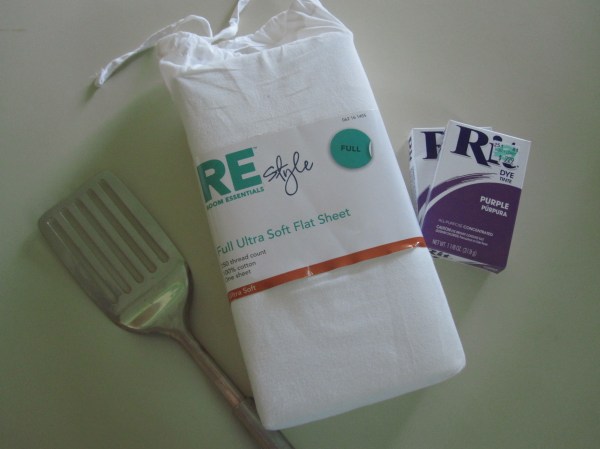
Having learned from my mistakes, I bought two boxes of purple dye and a full-sized flat bed sheet.

I also used the main bath tub. About half way into my process, I laid a junk towel under the bucket to protect the acrylic tub.  Pretty sure a dyed bath tub would be an epic failure, even if I successfully dyed the curtain.

To keep the dye line as even as possible, I hung the sheet on the shower curtain using the existing shower curtain rings and a set of curtain clips I had in the basement. 

I slipped the curtain clips through the curtain rings because the clips were too small to fit on the shower rod.  Then, I clipped my sheet up so I wouldn’t have to touch the curtain, just the rod and clips.  I highly suggest this method.

I decided to use one half of a box to dye my first ombre layer.

I didn’t realize it until later, but I completely forgot to add salt or liquid soap.  Oops.  I did however let the sheet soak for about 20 minutes, stirring constantly with a stainless steel spatula.  With a nice, saturated color, I moved the curtain rod up about eight inches and added the second half of the box to the bucket.

After 20 or so minutes, I moved it up another eight inches and added the entire second box to the mixture to let it soak.  Before dumping the dye solution out, I dyed the ends of two white towels, just for fun.  I rinsed out the sheet and towels, but as I neared the end, Everett woke up from his nap, so I quickly rinsed out the rest and popped it into the washer for a quick clean.

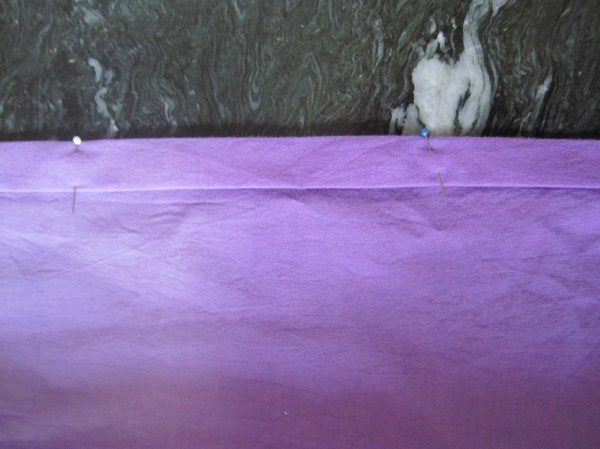
Now, I had to figure out a way to hang this thing.  I started by sewing the sides to the width of our shower curtain liner.  I ironed the edges and got freaked out because the heat of the iron turned the dye pink.  After 15 seconds or so, the color did go back to normal.  So, I continued ironing and folded the edge over twice to get a clean edge and pinned.  I planned to only sew one side and the top to get my measurements.  The white thread from the sheet didn’t absorb the dye, so I was safe using white thread to hem everything.  I sewed my side first.

I considered sewing button holes to hang from, but my button-hole function didn’t want to work for me.  Plan B.  We needed a new curtain liner for our bathroom, so I cut the grommets off the old one to sew to my sheet.  I pinned right sides together so my seam would look as seamless as possible.

Then, I stitched right along the plastic edge, but not on it.

A quick pressing with the iron made a nice crisp seam.  Unfortunately, I did have dyeing issues again.  Off to rectify that situation.

So far, I’ve spent 9 dollars and 99 one hundredths of another buck on a flat bed sheet, and $5.50 for two more boxes of Rit dye, bring our total (including yesterday’s failure) to $18.24.  Not too bad considering the only other curtain I liked cost $29.99.  So, we’re still $11.75 under budget, failures and all.

How much are you willing to spend on a shower curtain?  Have you ever made one yourself?