Picture This!

An observant reader noticed our art gallery wall in our hallway in this Simple Solution post and asked for more info.
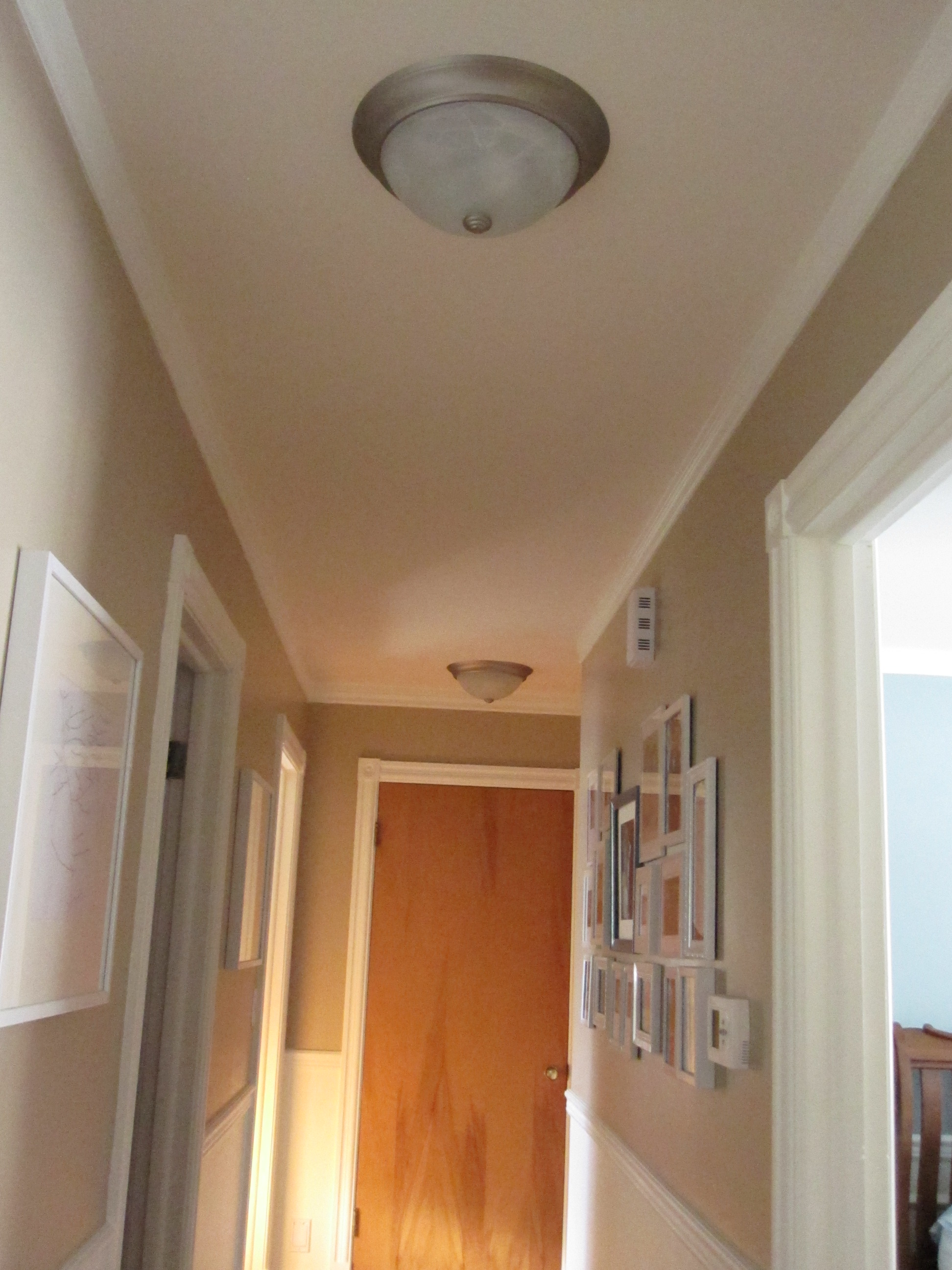
We don’t have tons of personal photos throughout our house, but our hall has photos of every immediate family member.
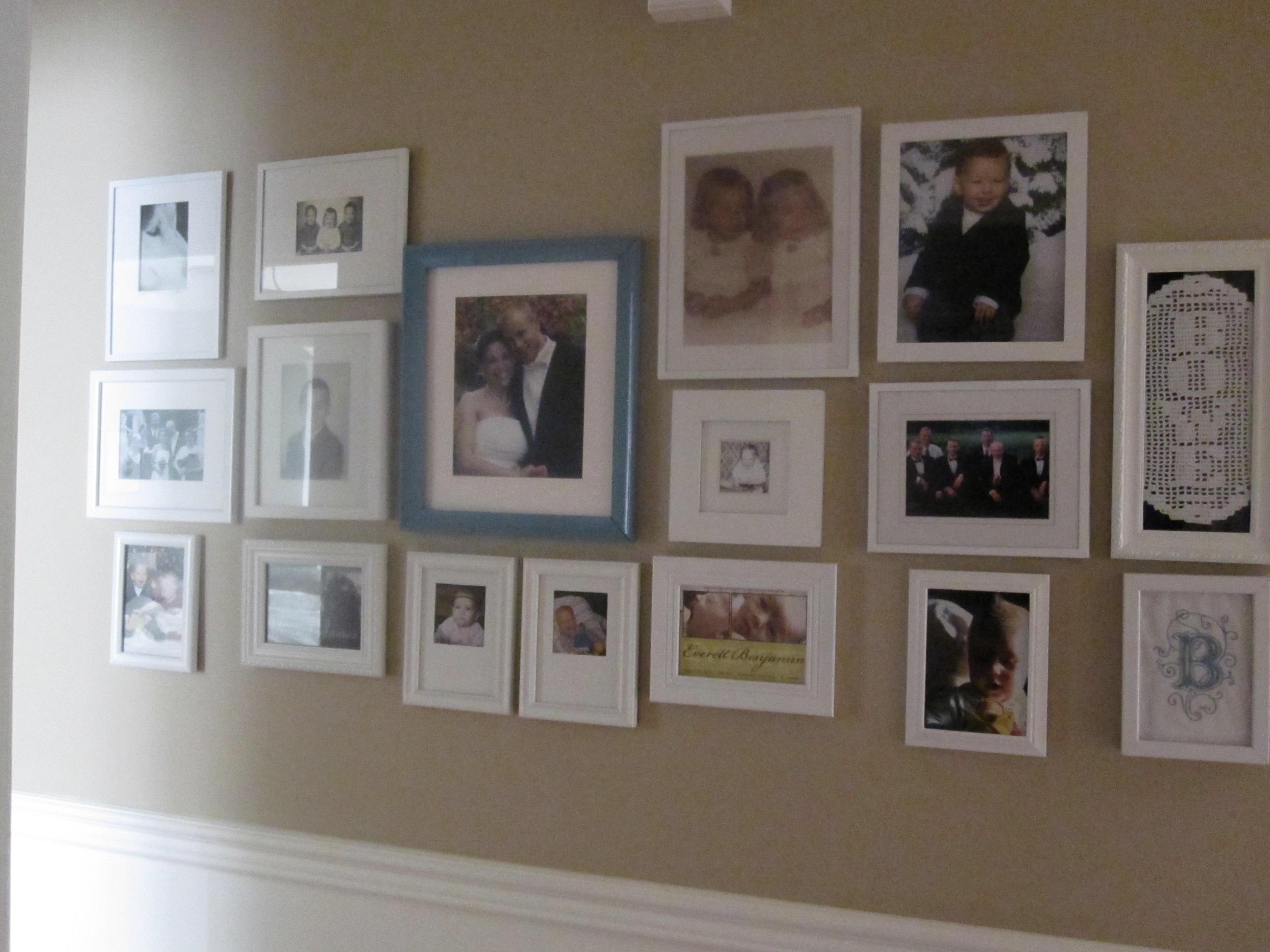
The hall frames were black before I decided to attack them with white spray paint this summer to lighten the group.

Before I saw a tip from Martha Stewart, our wall looked balanced, but cluttered.   I don’t seem to have a picture of the entire layout before I implemented Martha’s tip, but this is how this wall looked for quite a while.
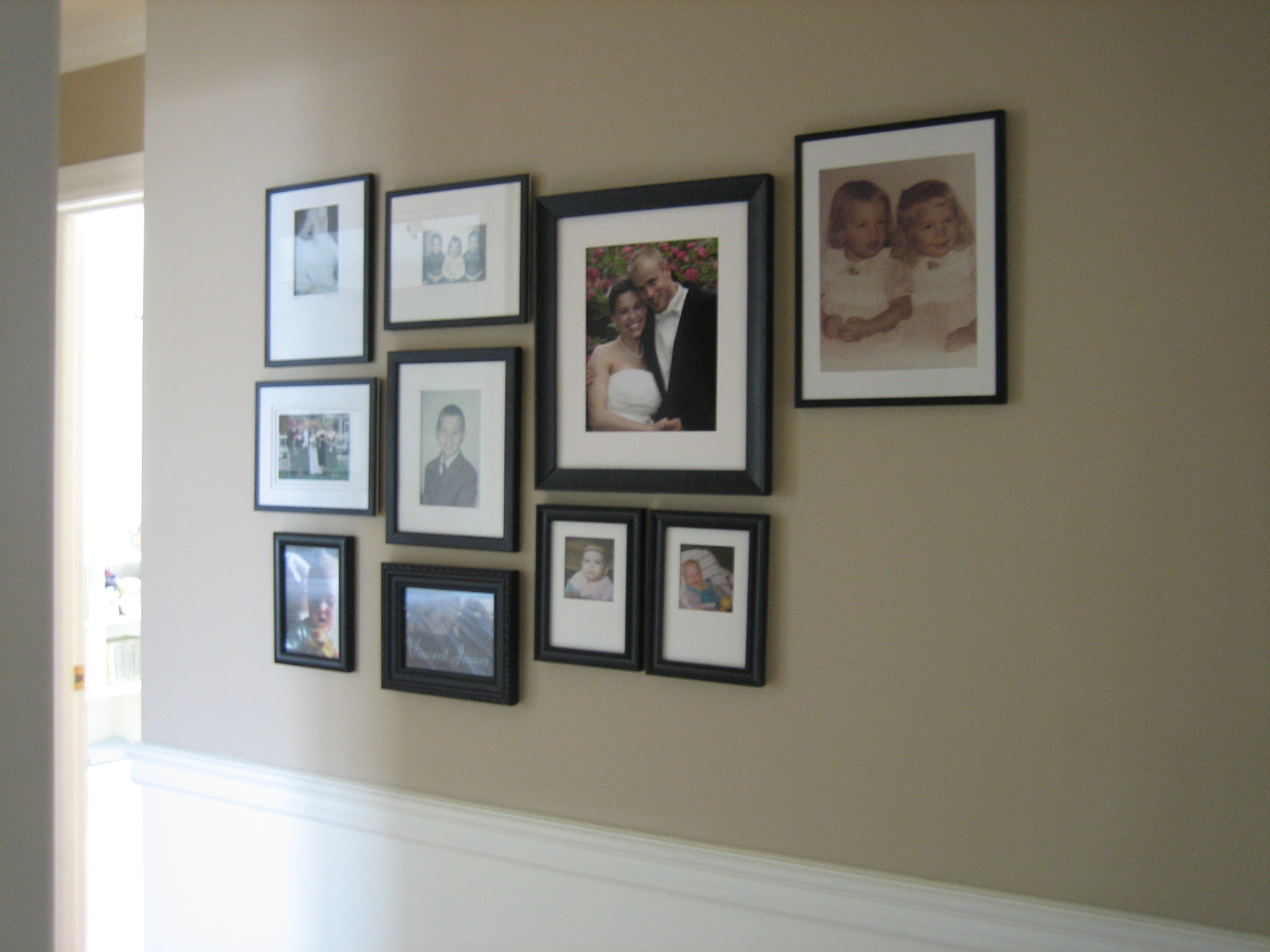
The layout isn’t drastically different, but pay attention to the bottom row of frames.  What was Martha’s tip?  Keep everything above and below a line of painters tape.

The tops of the frames in the bottom row are {roughly} in a line, while to bottoms of the middle row are in a line, too.  To keep the arrangement looking uniform and uncluttered, I spaced the frames as evenly as possible while keeping columns of frames.

To further prevent  an arrangemt from looking messy, keep the frames and mats the same throughout.  We accentuated the center photo by painting the frame a contrasting color.

Obviously, there are endless ways to arrange a gallery wall, but this works for us.  Do you prefer a balanced, symmetrical or completely asymmetrical layout?  What’s your favorite picture hanging trick?  Do you cut paper templates marked with hooks for easy, perfect hanging?  Anyone use velcro or another adhesive?  I’ve been known to keep pesky frames level with sticky tack behind the corners.

The Crowning Jewel

When we asked our readers to take a brief survey at the beginning of the year, we asked if you’ve seen something in our house that you would like to know more about.  One reader was wondering how the lighting in our master bedroom worked.  Let’s start at the beginning, the trim.

We decided to install crown moulding over the doors and windows of our master bedroom and adjoining bathroom.  Ben had a great idea, why not install rope lighting on a dimmer switch above each?  I said, “Sure.  You’re the one doing the wiring, so if it’s a pain, you have yourself to blame.”

You see, I have a tendency to come up with tedious projects that Ben has to complete, so this was all him.  Guess what?  It was a pain.  But I already said that.  Why was it a pain you ask?  Well, dear friends, because each window and door has a header above, made of 2 by 4s, to give the structure strength.  So, Ben had to drill through finished sheetrock, through each header, then fish his wiring through his holes.

Once he ran the wiring, it was easy.  Ben wired outlets, all set on a dimmer switch, inside each crown piece.

(Please disregard the dust, its there for moral support, though I did vacuüm inside for you.  Oh yeah, you see the traces of red, that’s not blood, it’s paint.  Yeah, Ben wanted our bedroom burgundy.  So, we painted it, then quickly painted it again).

Then, we bought basic rope lighting from Home Depot.  Home Depot has tons of rope light options, but we chose five 6 foot lengths.  Why 6 feet?  Rope lighting isn’t especially bright, so we decided to double up anything that was shorter than 6 feet.  Next, plug the lights in.  Luckily, the windows and doors don’t look any brighter than the closet.  After tucking the lights down in the crown moulding, Ben used plastic fasteners to keep everything tucked neatly in its place.

Here, you can catch a glimpse of the crown construction.  Ben cut the crown pieces to size, then applied glue to the joints and nailed in place.  Ben always goes a little overboard to make sure things he builds are super strong, so he cut scraps of wood to match the angle of the inside corners.  Then, he nailed the crown into the blocks and they’re like a rock.

The room glows with the lights on at night.

Please note:  If you are not an electrician or comfortable working with electrical systems, please do not attempt this your self.  This post is not a step-by-step tutorial, just a guide on how Ben created our lighting.  We are not liable for any damages or injury.

(Re)Organized Boys Closet

As our boys grow, I find the need to reorganize their belongings, namely, their closet.  With Ev out growing clothes at a rapid rate, I need access to larger sized clothes without the hassle of digging them out of storage.  Without a dresser in the room, I have to get creative with their storage.  When we last shared our closets, I had it organize, keeping larger clothes on the shelf in a clear covered bin, but it became cumbersome for me (being 5 feet, 4 inches tall) to get large, heavy bins down often.  We needed a change.

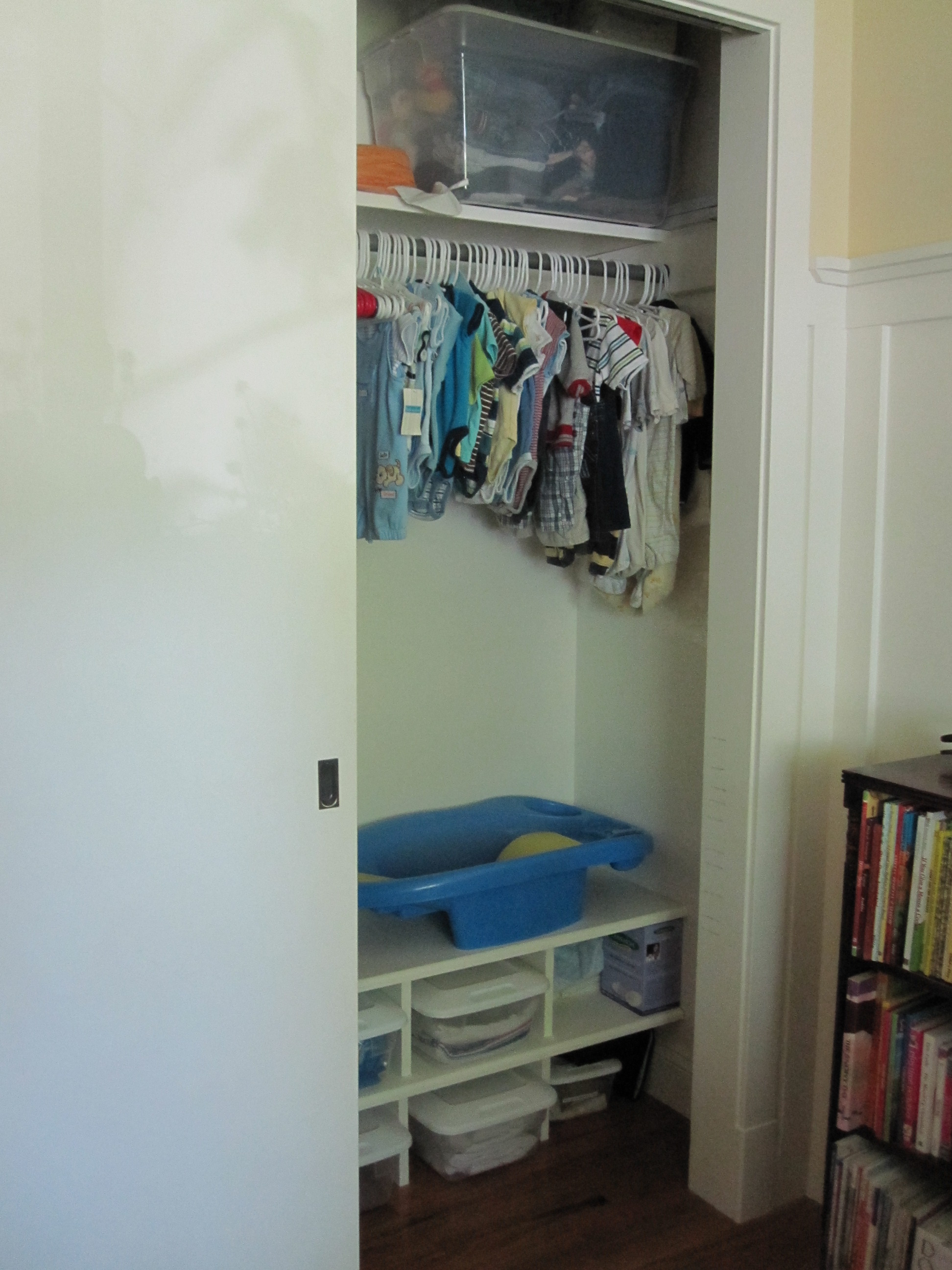
Here was Vincent’s side.  All of his current sized clothes are hanging, larger clothes in the big bin on top, diapers in the small bins in the cubes, and socks in a bin.

Here’s Everett’s side.

Everett’s side was pretty much the same story.  After a while, I started hating that I had to slide the doors to get to their stuff.  As I mentioned above, the large bins were really becoming a hassle, too.

What was our solution?  Ben installed a second closet rod.  We didn’t move anything around, so the rods are close together, but they’re boys.  They don’t have anything that really hangs down, so it’s fine for a while.  By installing a second bar, we can hang both boys current clothes on one side, eliminating the constant sliding of doors.

Another benefit, we now have room to hang larger clothing on the other side of the closet.

We still use a laundry bag to save shelf space.  A small hook holds it securely and out-of-the-way.

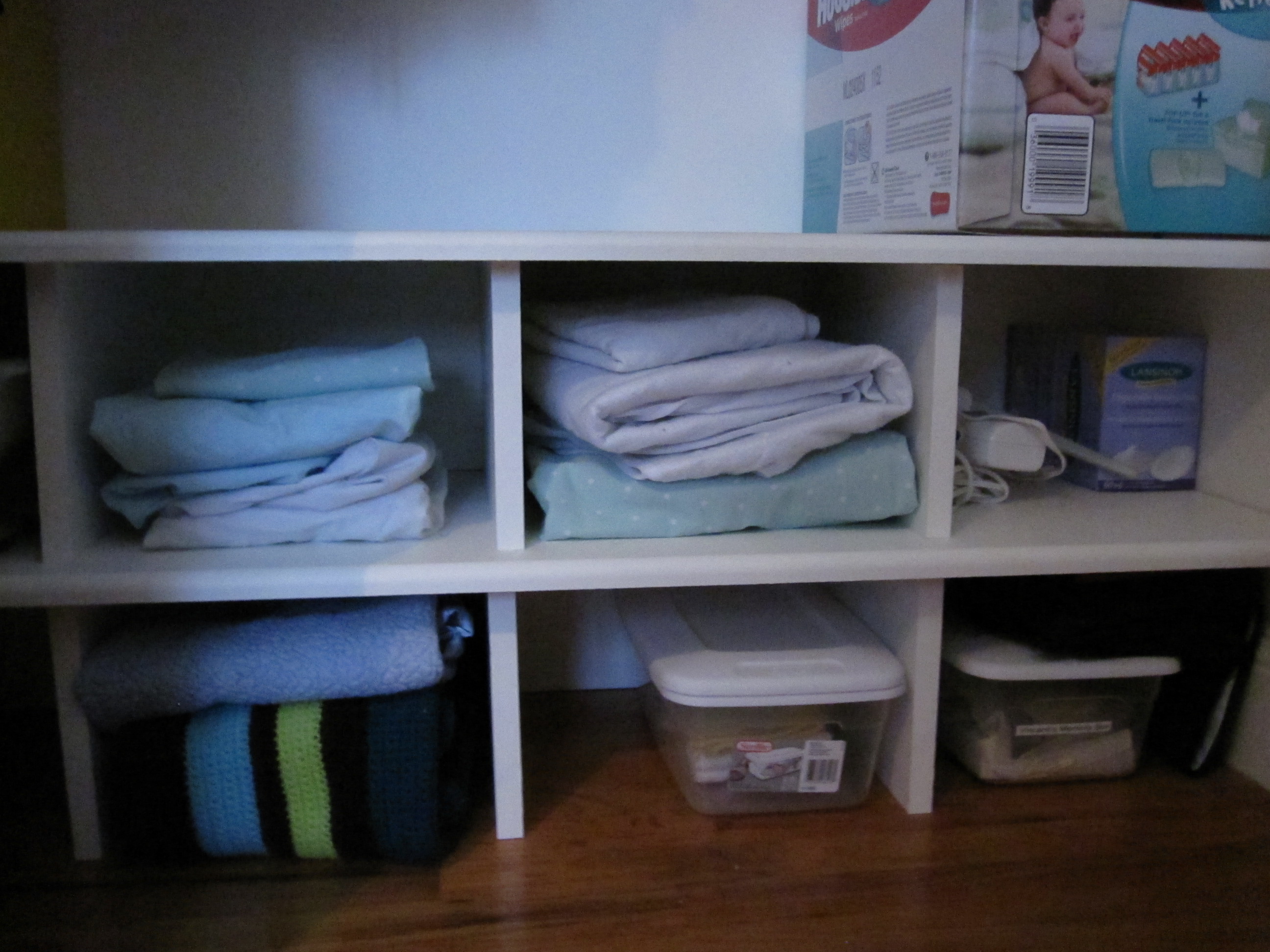
As for the storage cubes, we keep our baby wipes (which we buy in bulk from Costco when we have a coupon), bedding, Everett’s socks, and one bin of diapers for each boy, rather than all their diapers.  The clear bins on top of the cubes have Vincent’s socks and underwear and the yellow bin has pajamas.  I love those yellow bins because they fold flat when not in use, saving space.

We still have a large bin of clothes, but we don’t need to access it often.  We also have shoes, puzzles and a bag of other random items that I still have to sort through.

Where did all the diapers go?  On the top shelf of the right side.  The yellow bin is our donate box.  Anything that I decide our boys no longer need, I put in the bin until it gets full.  The next time I go to a thrift store, the contents get donated.

Previously, we had a plastic baby bath tub.  Everett has since outgrown it, so I donated that, too, which freed up a lot of valuable space.  Now we have a box in its place.  Whenever one of the boys outgrows something, I put it in that box.  When that box is full, I sort the clothes into the proper bin in our basement.

By adding a second closet rod, we’ve doubled our storage space and we have plenty of room to expand.  Score!  Do you have any storage tips, tricks or products you can’t live without?  What do you do with outgrown children’s clothes?  Do you hang your kid’s clothes or prefer to fold?  If you hang, do you use the size dividers?

Office Storage: Revealed

To continue our bookshelf week, we’ll share our office storage system and what’s inside.  Sounds like fun, no?  Well, hold on to your seats because this is a wild ride.  We’ll start with my wall o’ shelves.  Here’s an overall picture, just for reference.

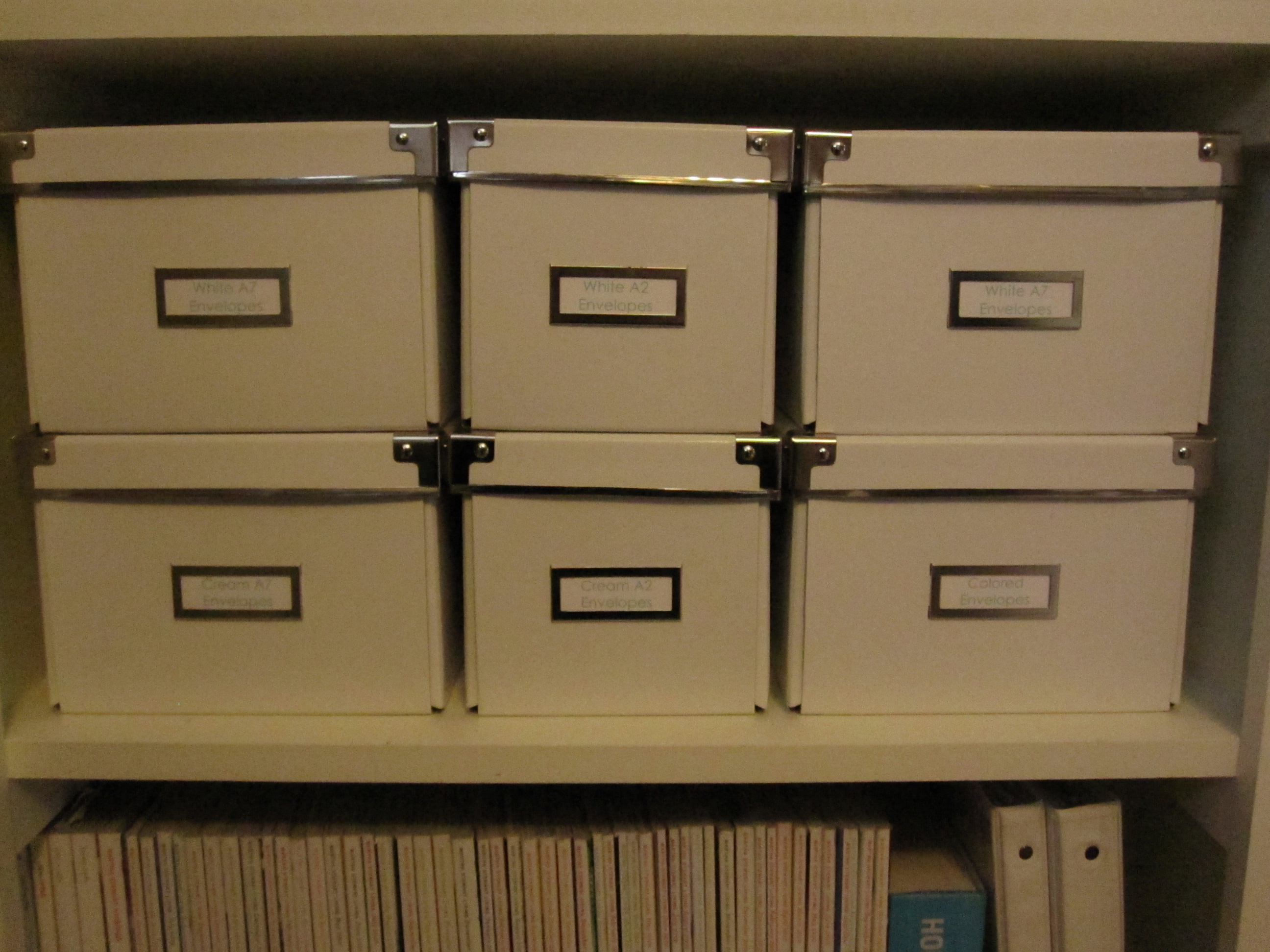
First up, these IKEA storage boxes hold my assorted envelopes. 

The storage boxes to the right hold overflow and odd sized envelopes, ink cartridges, and miscellaneous junk because I don’t have drawers yet.

The large boxes at the very bottom in the center hold 12 inch by 12 inch scrapbook paper.  Below those, boxes store fabric, yarn and thread. 

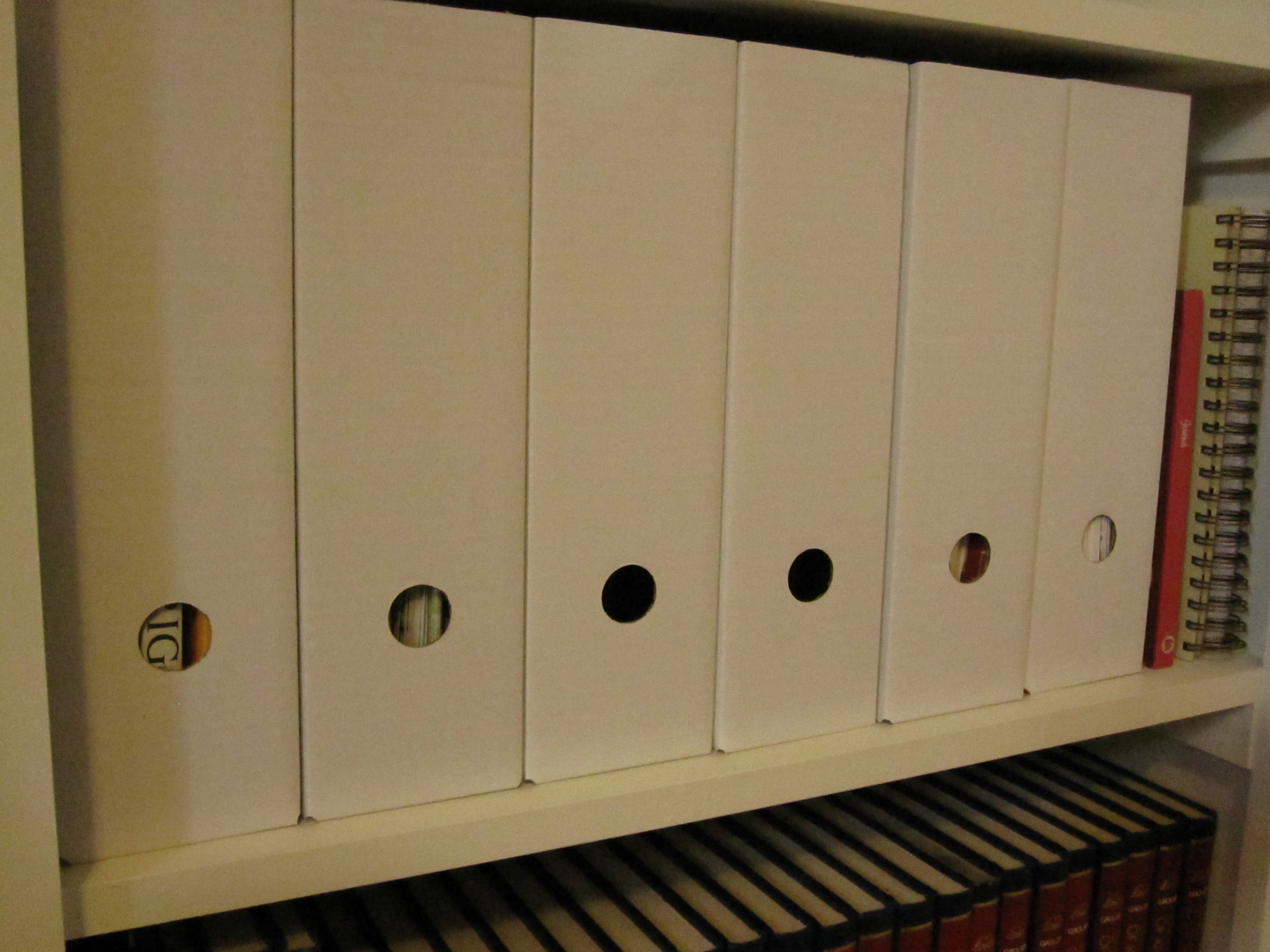
In the far right column, I have a row of magazine files, some empty, some not.

Let’s take a look inside.

These two files have tutorial books, including a trim, origami, and Ben’s workout book.  Another has the boy’s baby books and other baby items like a baptismal candle.

A few more files hold mine and Ben’s baby books and cards from our wedding and showers.  To the far right is a spiral bound scrapbook.

That completes the wall of shelves, but what’s above my desk?  Glad you asked!

To the right, my stock of papers fill a row of magazine files.  I found three-ring binders that look similar to the magazine files at Office Depot a few years ago.  One keeps samples of my designs.  Another is empty but I like to keep it out so I have room to expand.  Helpful hint: The binders also work great to store cds and dvds.  We removed the pages from a four square dvd file and placed them in the prettier file and it’s great!

To the left of my desk I have a few more magazine files (gotta love ’em) storing mailing labels.  Next to those are two boxes for mailing envelopes and files.

Oh, I created simple labels for everything, too.  I know, my OCD tendencies are back, but at least it’s useful!

Above that, I have a shelf that looks purely decorative.

But I’ve got a secret.  I use those pretty marble vessels to store extra paper clips, rubber bands, and pencils.

Pretty sneaky, huh?  That completes our office storage for the day.  I want to know if you have any helpful hints or surprise decorative storage in your home?

P.S.  All the magazine files and storage boxes hail from mother Sweden (aka IKEA).  The boxes are part of the Kassett series and the files are the Flyt $1.99 for 5.  Great price when you need so many and surprisingly durable!

Amanda’s Rules in Use

In keeping with our bookshelf theme, I’m back to share rules (more like tips) I follow that Cobi didn’t mention.

So, what are my rules?

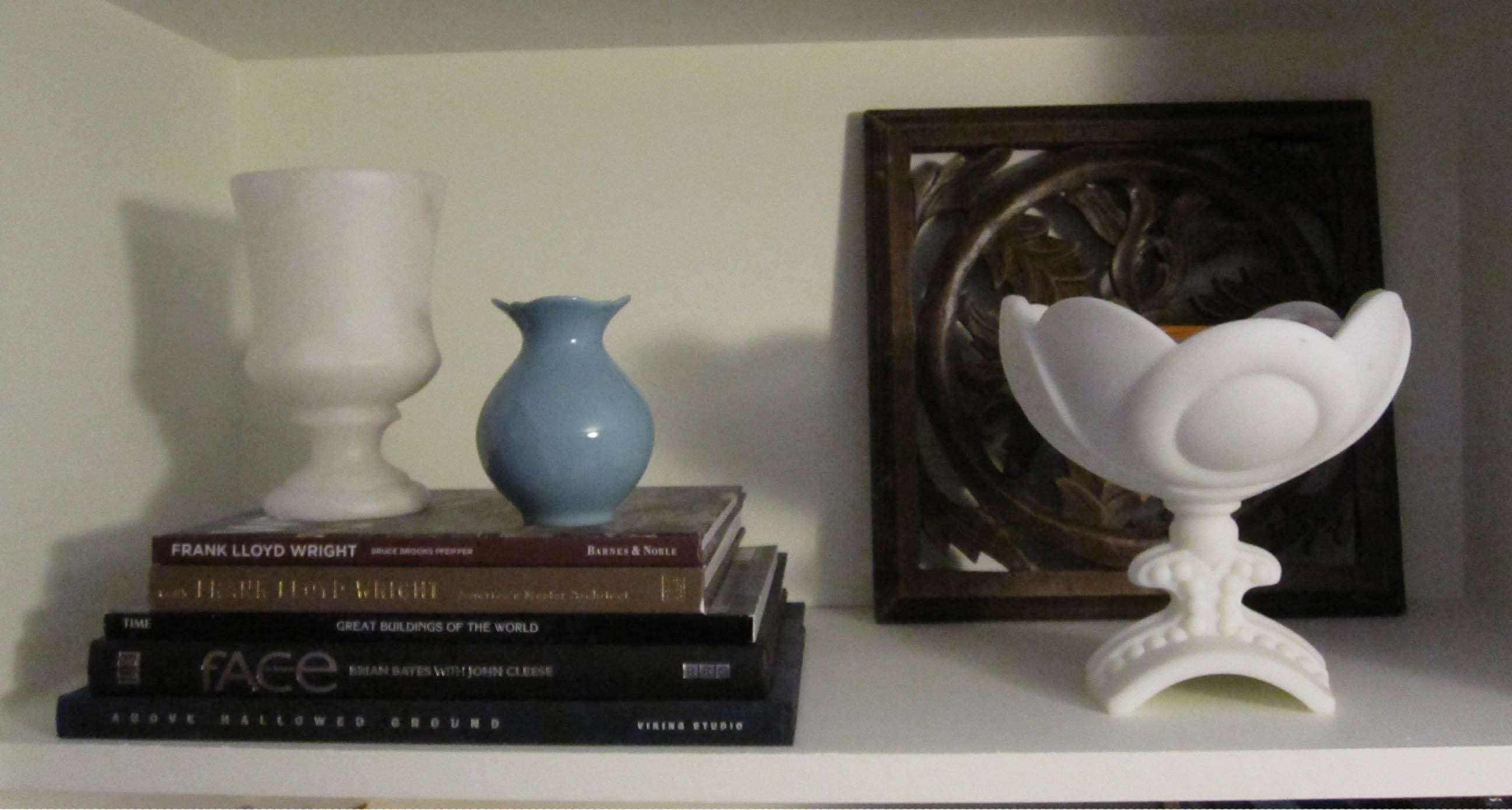
1.  Turn ugly books around.  If you have ugly books, you have a few options to make them fit in with your aesthetic.  The easiest way is to simply turn the spines to the back.  Other options: place said books in a basket, magazine file or create decorative book covers using wrapping paper.

2.  Don’t keep all books in the same direction.  As Cobi said, place some books on their side to create pedestals.  I think it’s more natural to line books along the left side, but you can face the fronts to the right, too.  This will make it easier to balance the shelf and create visual interest.

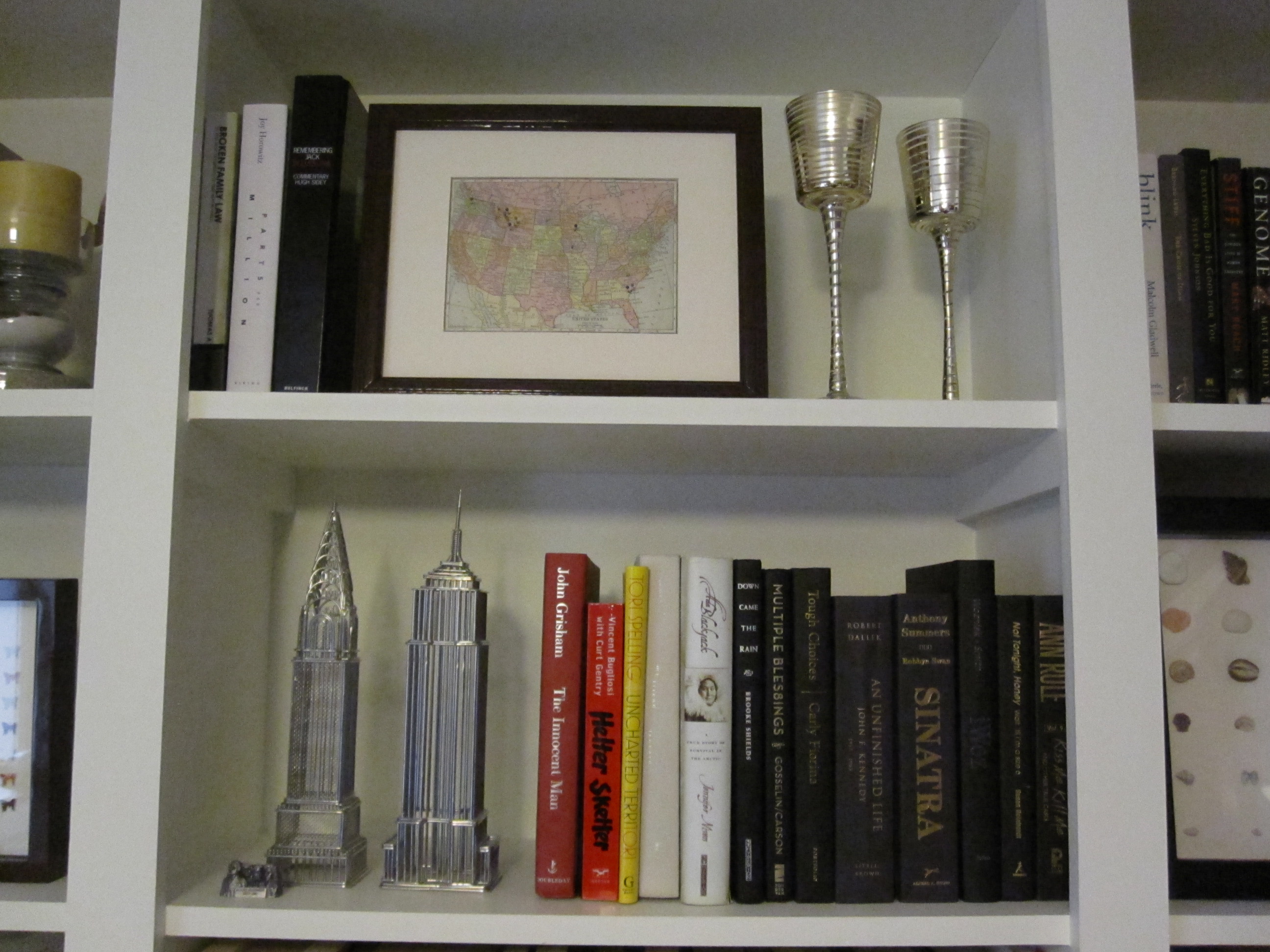
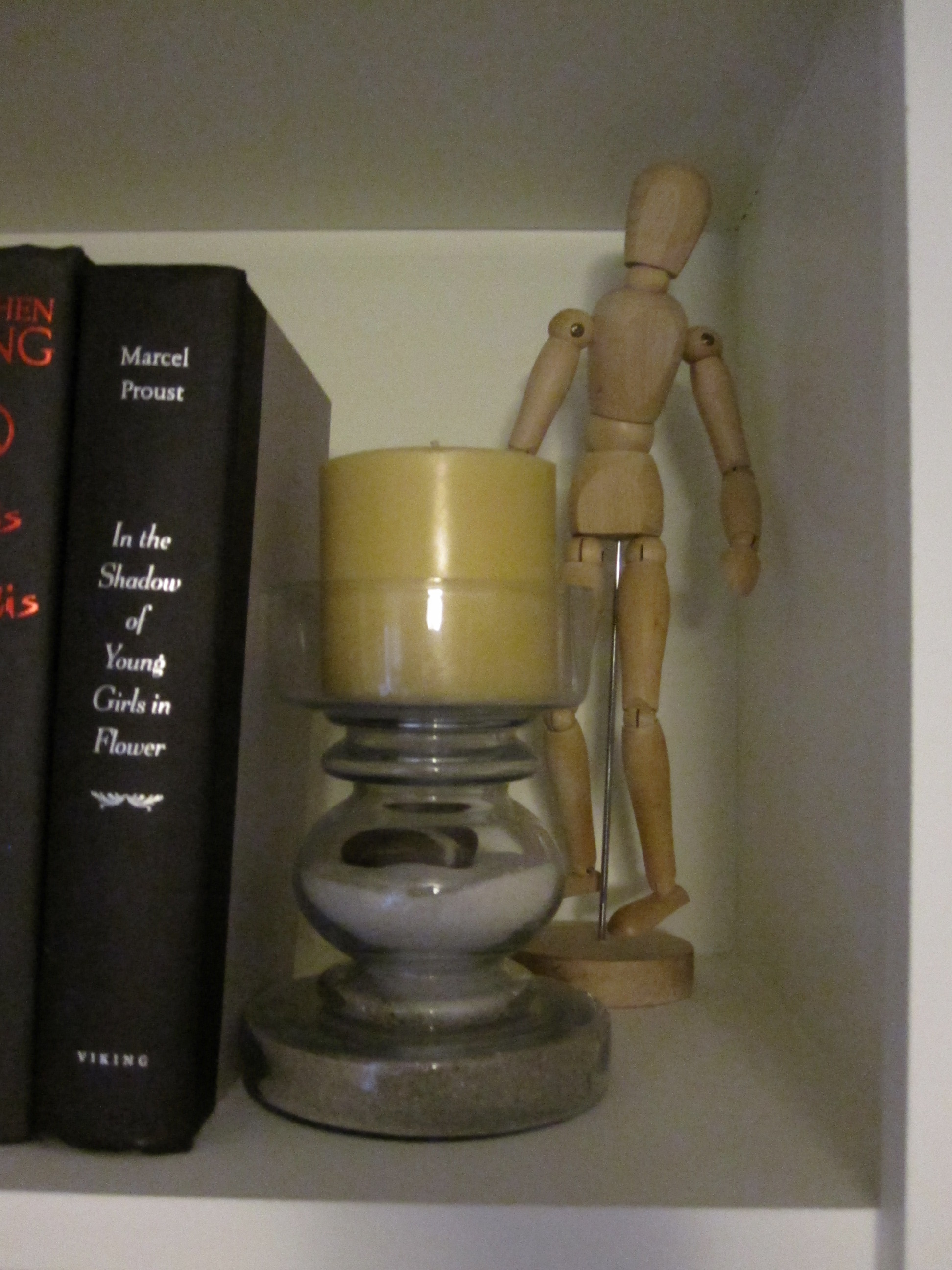
3.  Use decorative pieces as bookends.  Put pretty, heavy objects to good use.

4.  Add art to create layers.  Place small art in front of books or hang art on the back of the bookshelf.

Find that adorable bird printable here.

5.  Hide ugly items behind books and art.  We all do this, why shouldn’t you?  It’s valuable real estate!  If you have ugly items that you need access to (not especially often), tuck them in behind a frame or books.

6.  Display decorative pieces you love or have meaning.  Not every piece will have meaning, but buy items you love.  It’s a bonus if they function.
7.  Give yourself room to expand.  Not your waistline (like I do) but with your shelves.  If you use storage boxes, leave empty ones on the shelves, this way you’ll have a place to put overflow without rearranging everything.
8.  Take pictures.  If you like an arrangement but need to move items around, take pictures before removing everything.  This will give you a reminder if you just can’t get the new arrangement right.
9.  Organize your books!  Find an organization technique that works for you.  My books are sorted by genre (fiction, biography/autobiography, science, classics, travel, history, and miscellaneous).  Then, I group each genre by color and display in rainbow order with white, black, and brown at the end.