Letter Magnets

We have officially started redecorating our boys’ room by adding some pops of sunny yellow, including this magnet board.

I love the magnet board, but not the ugly plastic letters.  Fortunately, I found this great tutorial at Nice Girl Notes detailing how to create pretty magnet letters.  What a fantastic (and cheap!) idea!  Using the tutorial as my starting point, I headed off to Hobby Lobby to buy my supplies.
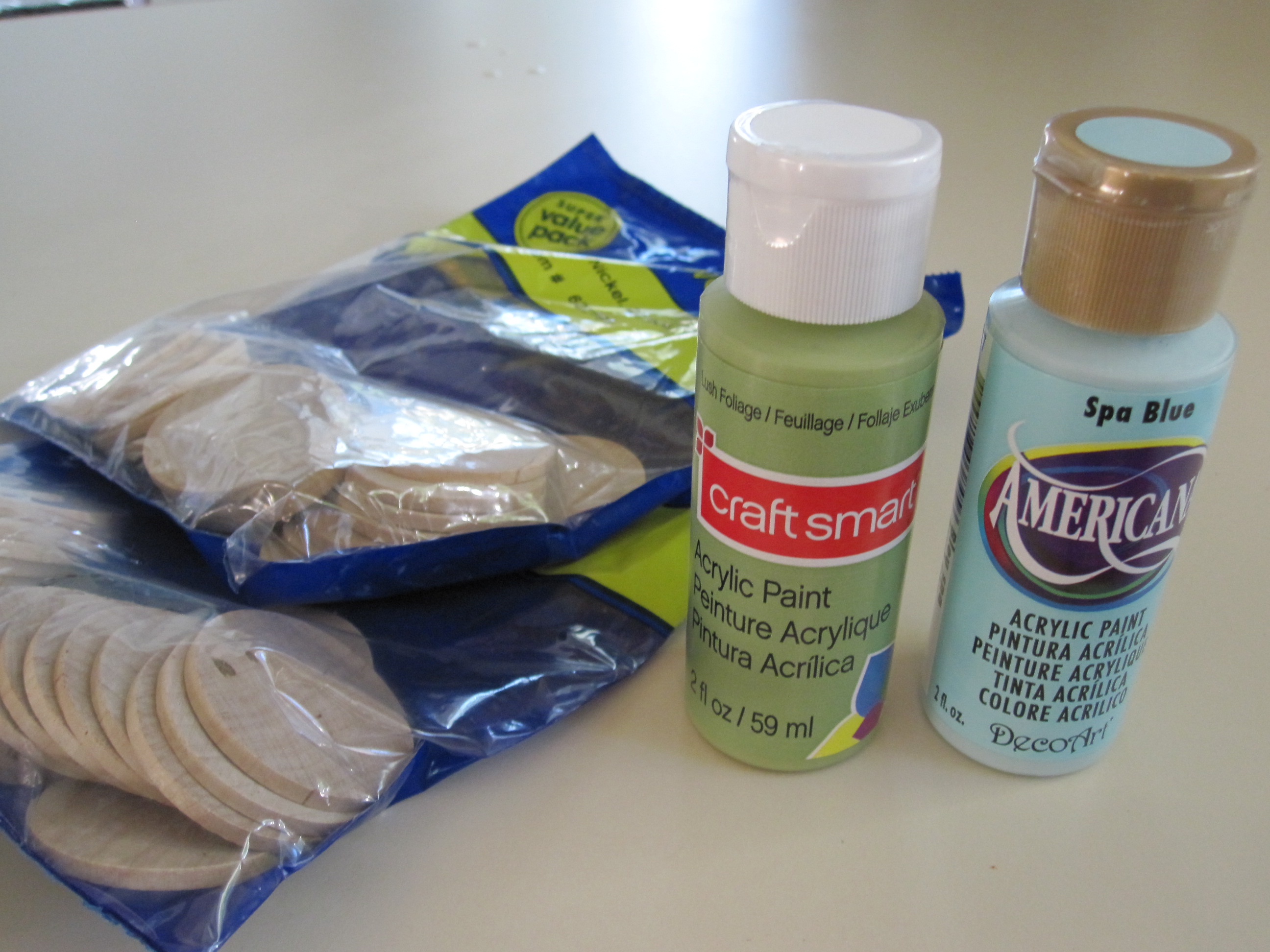
At Hobby Lobby, I found 2 inch round wooden discs for $3.99 per pack of 22.  I chose to use plain green and aqua acrylic paints, rather than spray painting my circles.  I bought 44 discs and decided to make 3 of each vowel, so I removed 15.  Then, I painted the remaining discs aqua on all sides.  The paint dries quickly, so I applied another coat. 

I knew I wanted to incorporate both green and blue, so I made the vowels green, figuring the boys would learn their vowels easier if they were different.  After painting the aqua, I mixed up my green.  I couldn’t find the exact green I had in mind, so I added some white to get the right color.  Once I had my color, I painted all sides of the 15 reserved discs green. 

The tutorial used rub-on transfer letters, but I couldn’t find a font I liked.  Yes, I am very picky.  Instead, I used a pencil to draw the letters, keeping them roughly the same size.  Then, using chocolate-brown paint and a fine tipped brush, I traced over my penciled lines. 

I didn’t have time to look for magnet strips while at Hobby Lobby, so Ben picked up a roll of adhesive-backed magnet from Lowe’s.  Simply cut the roll into 3/4 inch or so pieces, remove the backing and place on the back, pressing firmly to attach.  I considered using Gorilla glue, but the adhesive seems to stick pretty well, so I’ll glue if any magnets fall off. 

Vincent started playing with his new magnets, but quickly scuffed them up.  Luckily, I had a jar of glossy Mod Podge on hand, so I quickly gave the front side of each magnet two coats.  Worked like a charm.

Don’t the new magnets look so much better than the plastic ones?  Better than the looks, this project was cheap and easy-just the way I like ’em.  Even better?  Vincent loves to play with them. 

This is not in the photos, but we had a toy mail box from Target’s dollar department that I glued magnets to.  It’s the perfect holder for the magnets!

Trim: Office

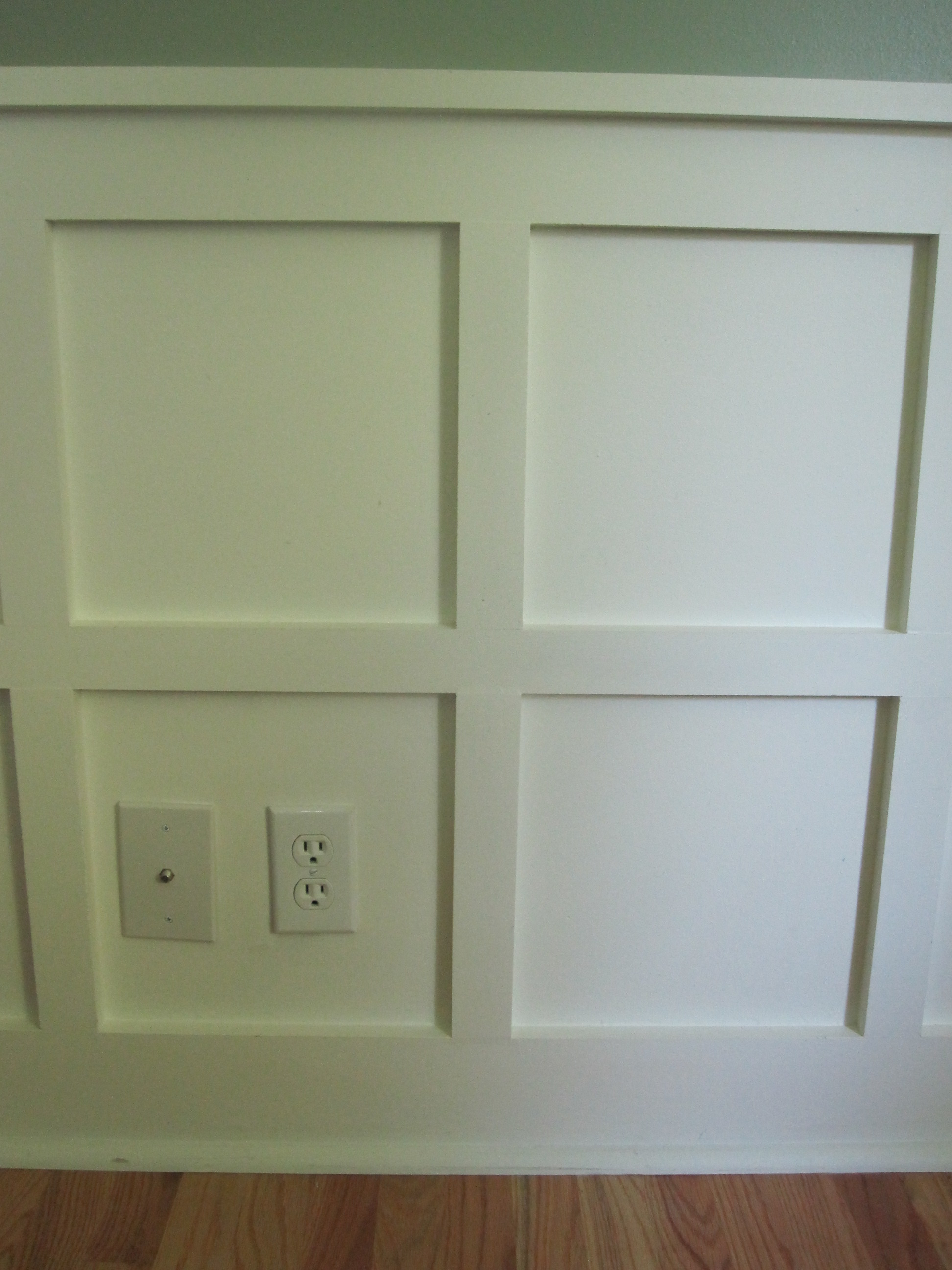
While planning my office, I fell in love with a box pattern so much, that we added it as trim.  The custom cabinets Ben built were already in place, so we wanted to have the top of the trim match the top of the cabinets.

Our cabinets are 36 inches high, not including the Brazilian cherry top, so our total trim height is 36 inches.

After determining the trim height, measure each wall, marking the center.  If you have cabinets, mark the center of the area between the wall and cabinet to make the design centered on the visible area.  Then, mark the center of the height.  The easiest way to calculate the center is to add the height of the baseboard and top trim pieces then subtract that number from your total height.  For example, we used 5 inch base board, 2 inch top trim and a 1 inch thick ‘shelf.’  Subrtact 8 from 36 to get 28 inches.  Now, divide in half and mark.

To create your box grid trim, first install the baseboard.  Now you’re ready to start creating the boxes.

We wanted 10 inches of space inside the boxes, so Ben marked 5 inches each side from his center lines.  We cut 3/4 inch thick MDF sheets to our dimensions, but you can also use square stock trim.

After ripping down the pieces, Ben cut the horizontal box trim 14 inches long to allow the vertical box pieces to butt into the horizontals.  Secure the horizontal pieces to the wall, keeping level.  Once the horizontals are in, add the vertical pieces to complete the box.  After completing one box, measure from the outside of the box to the baseboard and top trim.  Cut several pieces to length, ours are 7 inches on all sides,  nailing centered on the box.  Use the additional pieces as spacers to continue creating the boxes.  Repeat, repeat, repeat.  Then, fill the nail holes, sand, prime and paint both the trim and wall.

Sew it Begins…

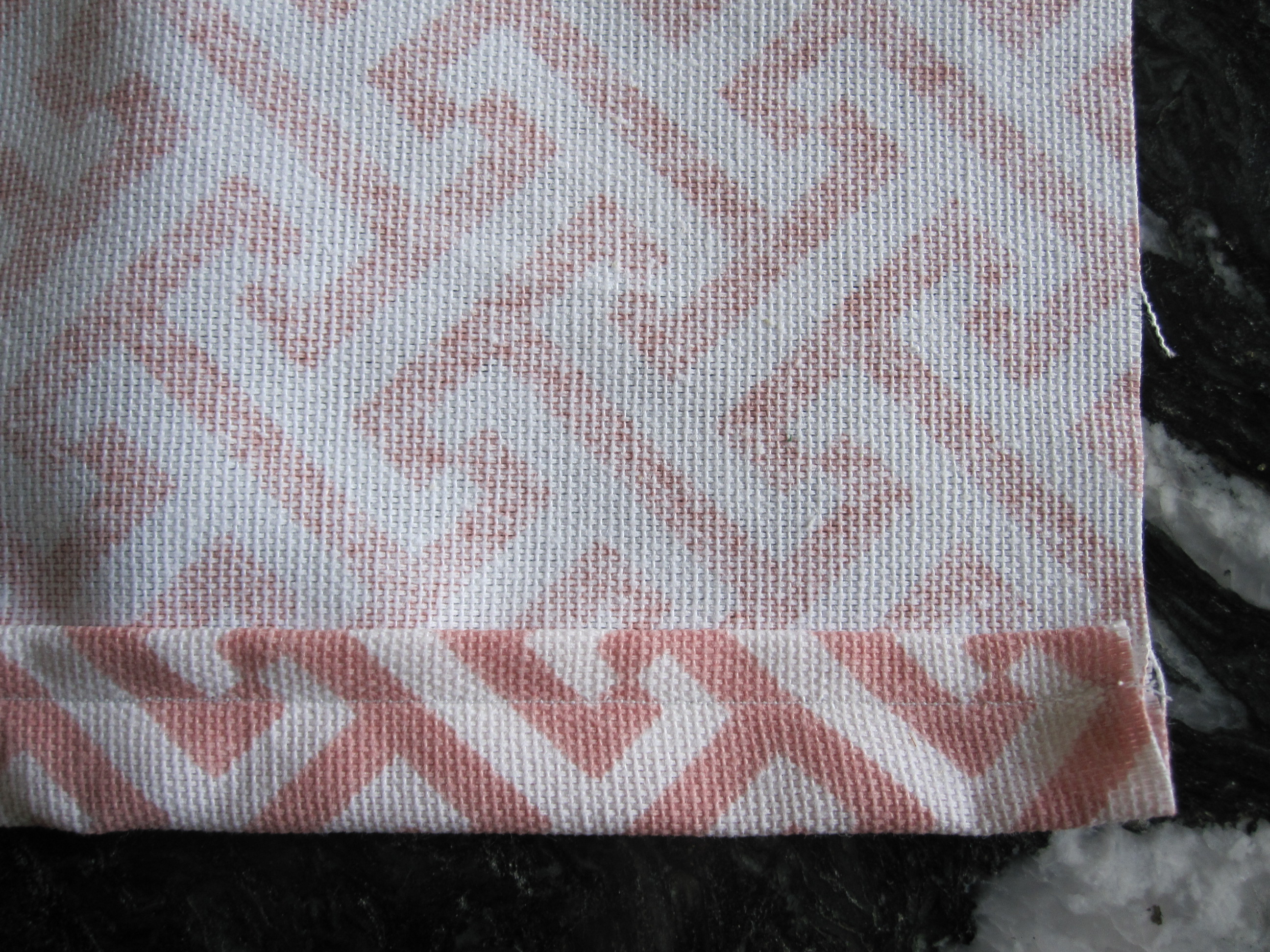
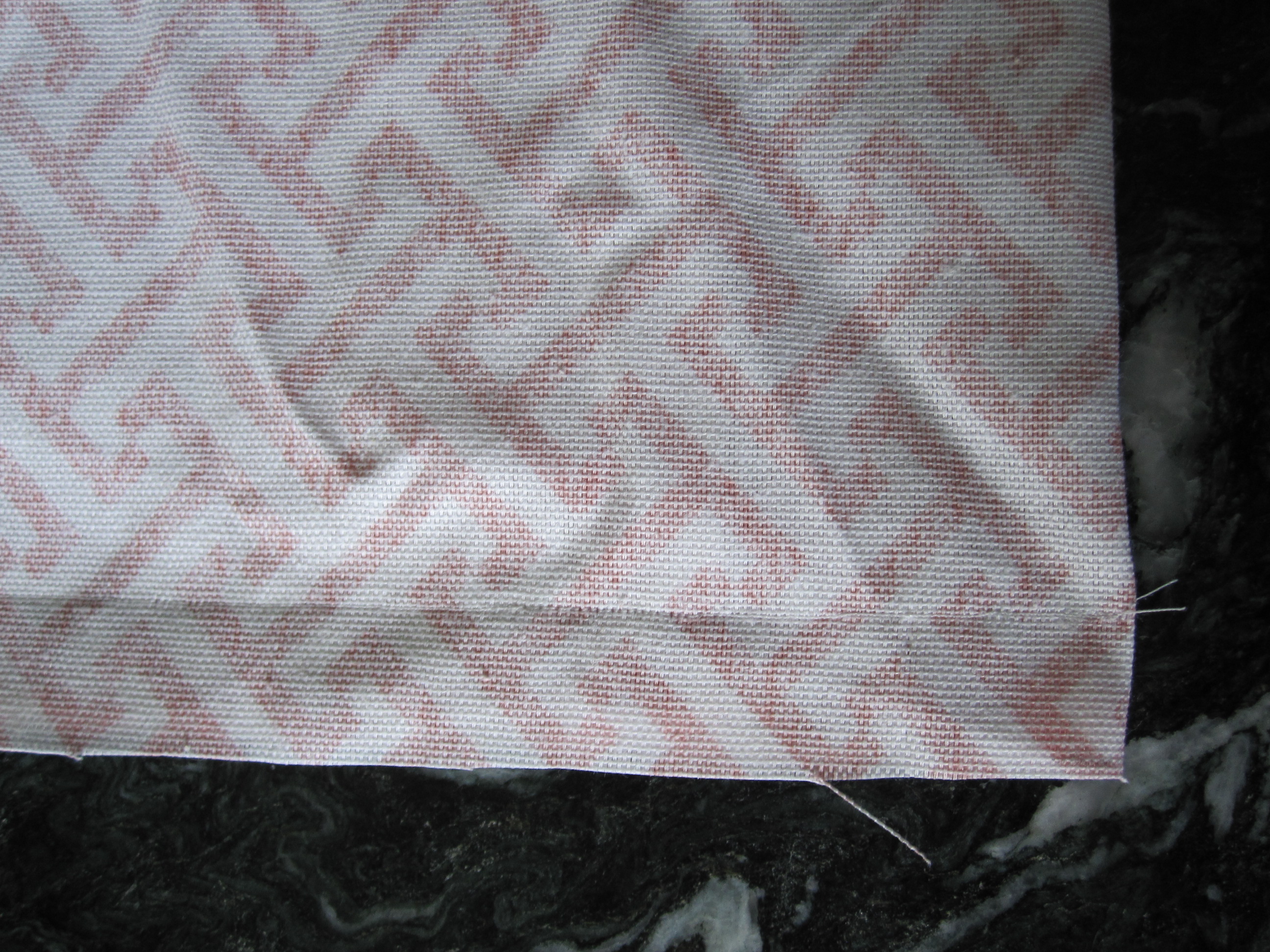
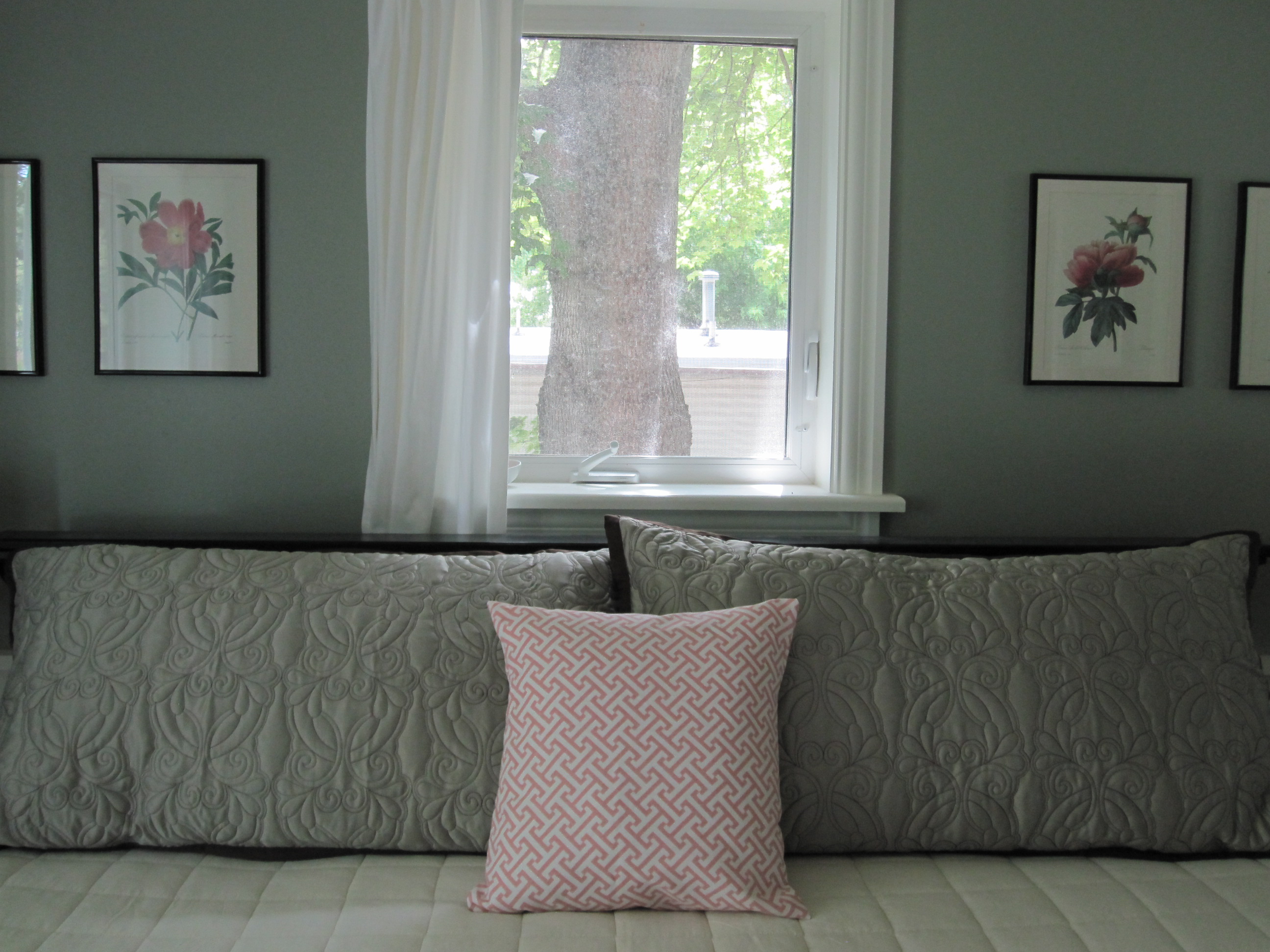
I love patterns and pops of color to freshen up a room.  One easy way to add pattern, color or both is with fabrics.  Pillow covers are an easy, simple and affordable solution.  First,  find a  fabric you like.  I chose this pink geometric pattern for $7.00 per yard from Joann Fabric.  Determine the size of the pillow insert you’ll use; you can also buy inserts from Joann.  I bought a 16 inch square pillow form. 

To make your pillow cover, cut a piece of fabric 1 inch wider than your insert size and 6 to 8 inches longer than double the pillow size.  To make a 16 inch pillow cover, I cut my fabric 17 inches wide by 42 inches long.  

Starting with your fabric face down, fold your short ends over about 1/2 inch and pin to secure.  Then, fold over again, pinning in place.  Sew a straight line across.  Do this to both ends.  Flip your fabric over, right side up. 

Fold one end near the center of the piece. 

Fold the other end over, overlapping the other end about 4 inches.  Measure the distance to make a 16 inch square.  Pin the sides together and sew.

Cut your corners, being careful not to cut your sewn edge, to remove the excess fabric to make sharp corners. 

Turn right side out and you’ve just completed an envelope closure pillow cover.

Trim: Main Bathroom

Before we remodeled our main bathroom, it had pink on nearly every surface.  Even the walls were covered in a metallic pink floral wallpaper.

Before the wallpaper removal began, we planned to have 18 inches of white trim at the top of the walls, a shelf below and lilac paint covering most of the walls.  We thought the paper would be easy to remove becuase it was peeling.  With our trim plan in mind, we began tearing down the wall paper.

It turned out to be far more difficult than we initially thought.  After hours of scraping, peeling and subsequently damaging the sheet rock, we had removed about 18 inches from the ceiling down.  And that was on one wall!  Time for plan B; we opted to install sheets of beadboard to cover up the remaining wallpaper.  A few more hours of scraping and we had the top 18 inches of wallpaper removed from the entire bathroom.

Once we had the paper removed from the areas we knew would be visible, we cut our sheets of bead board from 4 foot by 8 foot down to 76 inches, leaving them four feet wide.  Ben used an air nailer to secure the sheets to the wall, going in to the studs.  Then, we covered the bottom of the bead board with baseboard, hiding the unevenly cut ends and gap between the panel and floor.

To build the shelf to display and store items, Ben cut a sheet of 3/4 inch thick MDF into 3.5 inch,  3 inch, and 1.25 inch wide pieces.  Then, Ben nailed the 3.5 inch cut piece to the wall 77 inches from the floor, checking to keep it level.  He added shims in areas because this piece was partially covering up the bead board panels.

Once the trim was secured, the 1.25 inch pieces were added to provide additional support for the shelf.  Keep the tops of the trim flush with one another.  Cut the trim pieces at a 45 degree angle when approaching doors or other vertical trim.  Finally, the 3 inch shelf was installed on top of the trim pieces.

Then, of course, fill, sand, prime and paint.  This can be modified to any height.  If a shelf is added, be sure the height works for the use of the space.  You don’t want to bump into it.

Trim Terms

We have a lot of trim in our house, so I thought I’d share the technical names of some trim features.  We’ll work from the bottom to the top.

We have baseboard and shoe moulding.  baseboard are the lowest piece of trim, covering the joint between the wall and floor.  Shoe moulding is similar to quarter round moulding, but is higher than it is wide.  Shoe moulding is installed where the baseboard meets a finished floor.

Plinth blocks are a middle ground for door casement and base board to meet.

Chair rail is a horizontal piece of trim that is usually installed 36 inches from the floor to protect the wall from the being damaged by chair backs.

Now, we come to the humble window sill.  I’m sure most, if not all, of my dear readers know what a window sill is.  For those that don’t, the sill is the lower horizontal part of the window opening.  I like for ours to extend 1 inch past our casement.

Casement trim is placed around doors and windows to cover gaps and imperfections. Rosette blocks are a decorative alternative to mitered casement corners.