How To: Update a Room with Trim

Over the weekend, a few readers asked about our trim and how we make it.  Well, it’s your lucky day, because I’m here to do just that.

I’m going to explain my how to with the dining room as my example, but it’s almost the exact same for each room.

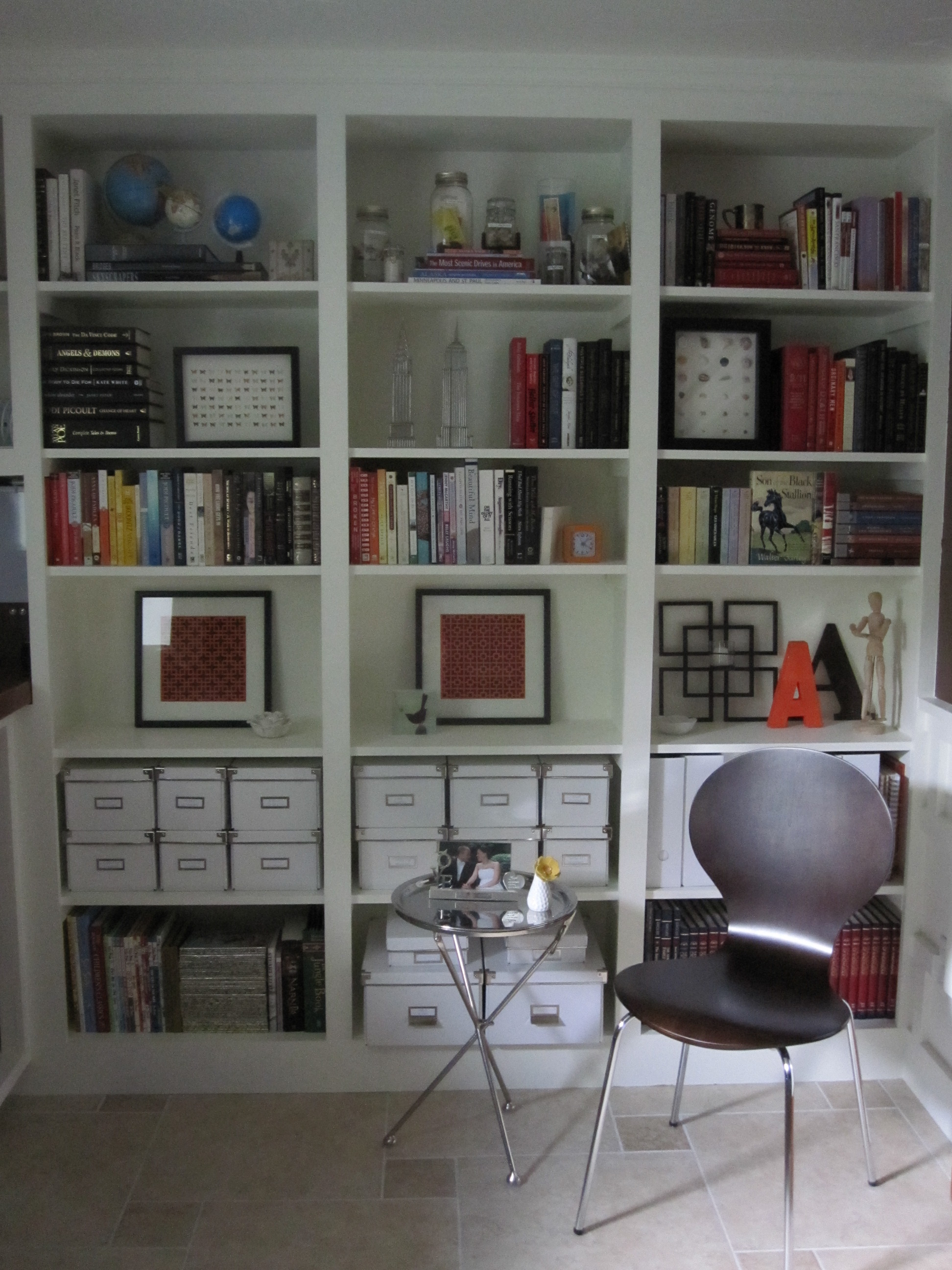
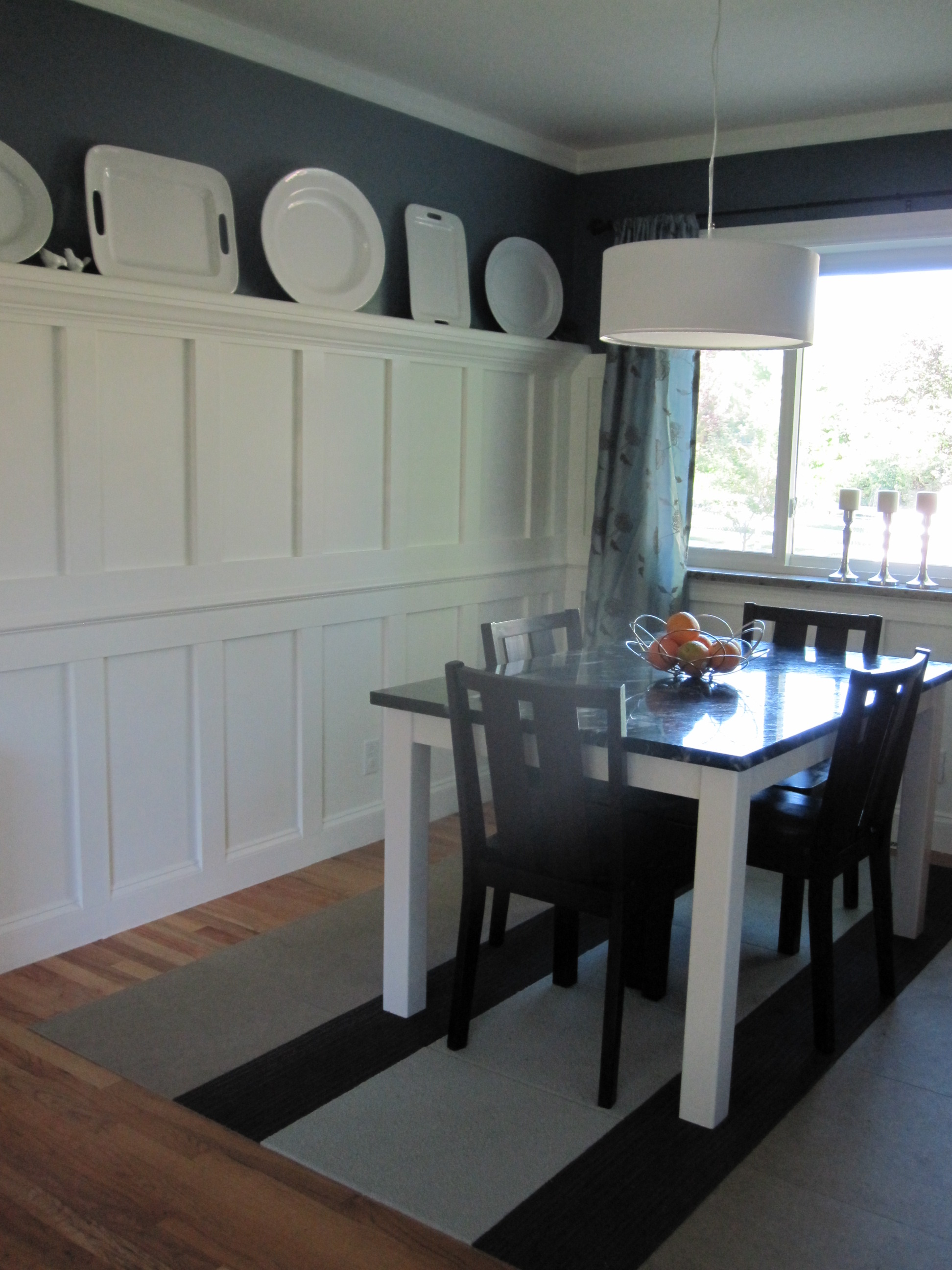
First, determine the design you would like to have.  In our case, we needed a plate rack and that determined the 67 inch height of our trim.  We already had our 5 inch tall baseboard installed, so we left those.  Ben had installed chair rail, so we removed that.  We decided to place the top of our horizontal piece at 36 inches from the floor.  We measured the length of our wall to find the center.  Once the measuring was done, we bought our trim and got started.

Most of the trim we use throughout our house is MDF (medium density fiberboard – pretty much sawdust glued together).  I will note where we have used real wood.  We use MDF for several reasons.  1.  It’s cheaper than wood and we know we’re going to paint it anyway.  2.  MDF is very flexible, especially compared to wood, so it’s easy to work with.  3.  Because MDF is mostly sawdust, it’s a green material.

We went to a local home improvement store and bought several pieces of 3 1/2 inch wide by 1/2 inch thick square style trim.  This trim does not have any decorative cuts, but does have slightly rounded edges.  We also got one piece of MDF crown moulding , 2 pieces of wooden symmetrical trim for the horizontal center, one piece of 3/4 inch wooden quarter round moulding and one sheet of 3/4 inch thick MDF.

As I said before, we left the existing painted MDF baseboard.  We knew we wanted the reveal (the amount on each side of the symmetrical piece) of the horizontal piece to match the width of the verticals.  Our vertical trim pieces are 3 1/2 inches wide, so we doubled that and added 1 1/2 inches for the symmetrical trim spacing.  So, Ben cut an 8 1/2 inch piece from our 3/4 inch thick MDF sheet.  Then he nailed that piece at 36 inches from the floor, making sure to nail into studs.

Ben cut another piece from our MDF sheet for the top horizontal, to be almost completely covered by the crown moulding.  To determine the size of this piece, measure the height of your crown moulding and add 1 inches.  Secure the trim to the wall 3/4 of an inch lower than your final height.  Nail your crown moulding in, making sure the top of the crown is even with the top of the MDF piece.  Cut another piece from the MDF sheet 1/4 inch deeper than the crown moulding and MDF backing.  Secure this piece on the top of the crown, leaving a 1/4 inch overhang, completing our ‘shelf.’  If you choose to display plates or rest other items on top of this, add your quarter round trim.  Keep the quarter round flush with the edge and nail it into the 3/4 inch MDF piece.

After completing the plate rack portion, Ben started installing the vertical trim pieces.  First, he placed one in the very center of the room.  If you can’t locate a stud, angle your nails toward the center of the piece, helping keep the trim on the wall.  Next, place verticals in the corners as shown on the diagram below, leaving a dead space.  This will leave the same reveal of the corner pieces.

Depending on the length of your wall, you can place additional verticals centered between the middle and corners or break it up in to thirds.  Our verticals are 12 1/2 inches apart.  Do this to the entire room and you’re ready to fill and sand about one million holes.  Caulk all the seams and smooth out.  Prime and paint all the trim pieces as well as the wall.  The end result will be a seamless panel look.  Stand back and enjoy the view.

Additional Notes:  Measure the depth of your trim.  It is much easier to create a wall of trim if your depths a slightly different (1/2 inch and 3/4 inch).  If you use all of one depth, you may have uneven joint that will require sanding until smooth.

If you don’t already have baseboard, it may be easier to install square stock.  This will allow butting the verticals right up to the baseboard, rather than notching out the baseboard to accommodate the verticals.

If you have any questions or need clarification, please ask!

How To: Add a Personal Touch

I have already given some ideas on how to add a personal touch to framed photos, and now I have some ideas to add personal touches throughout the home.

1.  Add monograms or your family name.  Monograms are a quick and inexpensive way to make a room your own.  Michael’s and Hobby Lobby are great places to look.  The letters on the picture rail hail from Hobby Lobby and cost $9.99 each. 

I had some scrap fabric lying around, so I made custom monogrammed pillow covers for each of our boys.  You can’t really tell, but the painting in the photo above has their monograms, too.  If you don’t want to spend $10 on monograms, craft stores also have cheaper MDF and paper mache versions, like the ones in my office. 

Just add a few coats of paint and you’ve got a custom art piece.  We also have a few monograms in our living room.  I recently picked up some Power Ball-esuqe monograms from Pier 1.

You could also use monogram hooks in an entryway or bathroom to keep each family member’s items separated. 

2.  Choose prints and art with personal meaning.  I also create custom prints if I am in need of a personal touch. 

I love this bird print we have in our entry way because it shows our little family, wedding date, names and the colors are specifically coördinated to our room. 

Another easy DIY project to inject a little more of you into your space are custom silhouettes.  When I make our silhouettes, I take photos of each person in complete profile.  Kids can be much more difficult, but with digital cameras, just keep taking pictures and eventually something will work.  Then I open my photos in Photoshop and trace the outlines.  Then I print right on to my colored cardstock and cut them out.  Simply tape the silhouette onto another piece of cardstock and frame. 

Don’t limit yourself to silhouettes of your family.  The process is the same for making anything, so choose your favorite flower, tree, whatever and make another design.

Choose prints that have a meaning to you, not just something that looks pretty.  Again, I make my own prints, but my I Love You This Much print began as something I say to my boys.  Other typographic prints could look great, too.  Choose a favorite quote, song lyric or phrase.  Translate a phrase to another language for a less obvious, but still meaningful print, like the Je T’Aime (I love you in French) print above.   A great place to start your search is Etsy because you can talk to the seller and ask to have something customized. 

3.  Spruce up a box store item.  Don’t be afraid to spray paint something to take it from the big box store look to fit your home.  Spray paint frames, sculptures or figurines, even furniture.  It will definitely become more personal with little time, effort and money.

How To: Store Toys

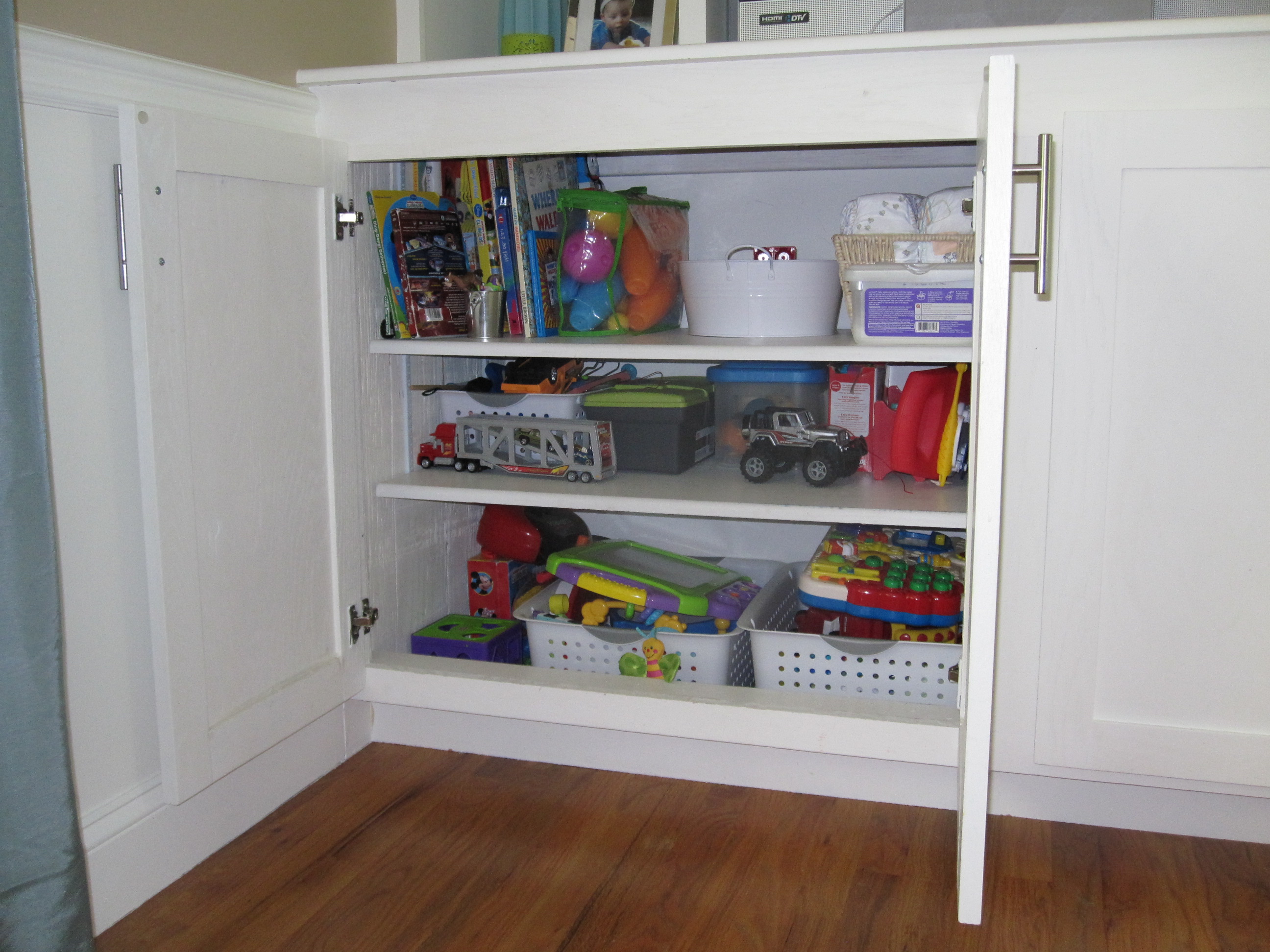
We have two boys under the age of three with grandparents, aunts and uncles that spoil them rotten.  That means we have a ton of toys.  Fortunately for us, we have created custom built in cabinets to hide most of their toys, books and diapers.

I’m still searching for the right size, cheap but durable storage bins to house V’s toys in this cabinet, but for now, it’s okay.

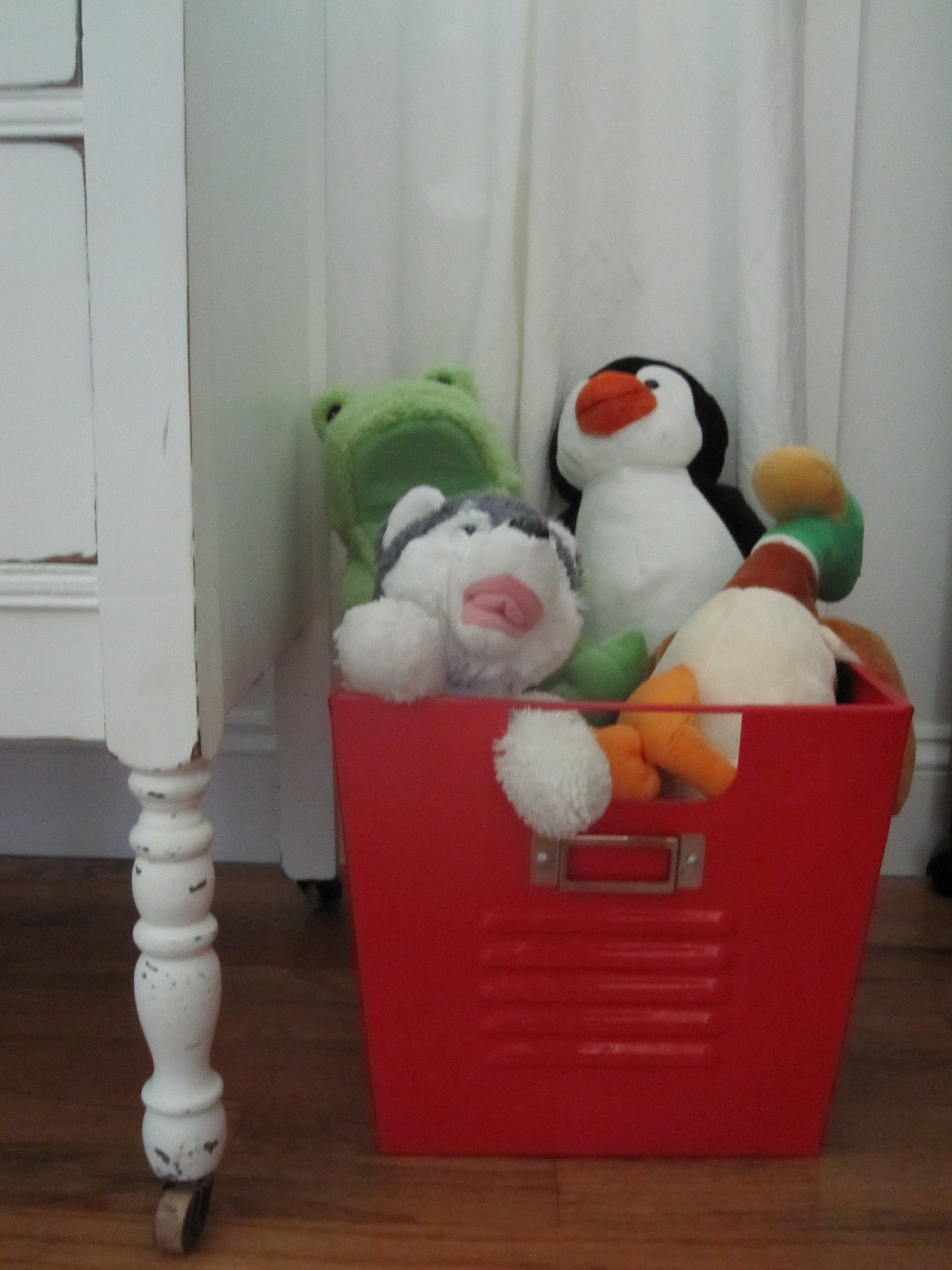
This red metal bin holds up to V’s abuse and it contains most of his stuffed animals.  After all, three-foot tall Mickey and Minnie cannot fit in a small bin. 

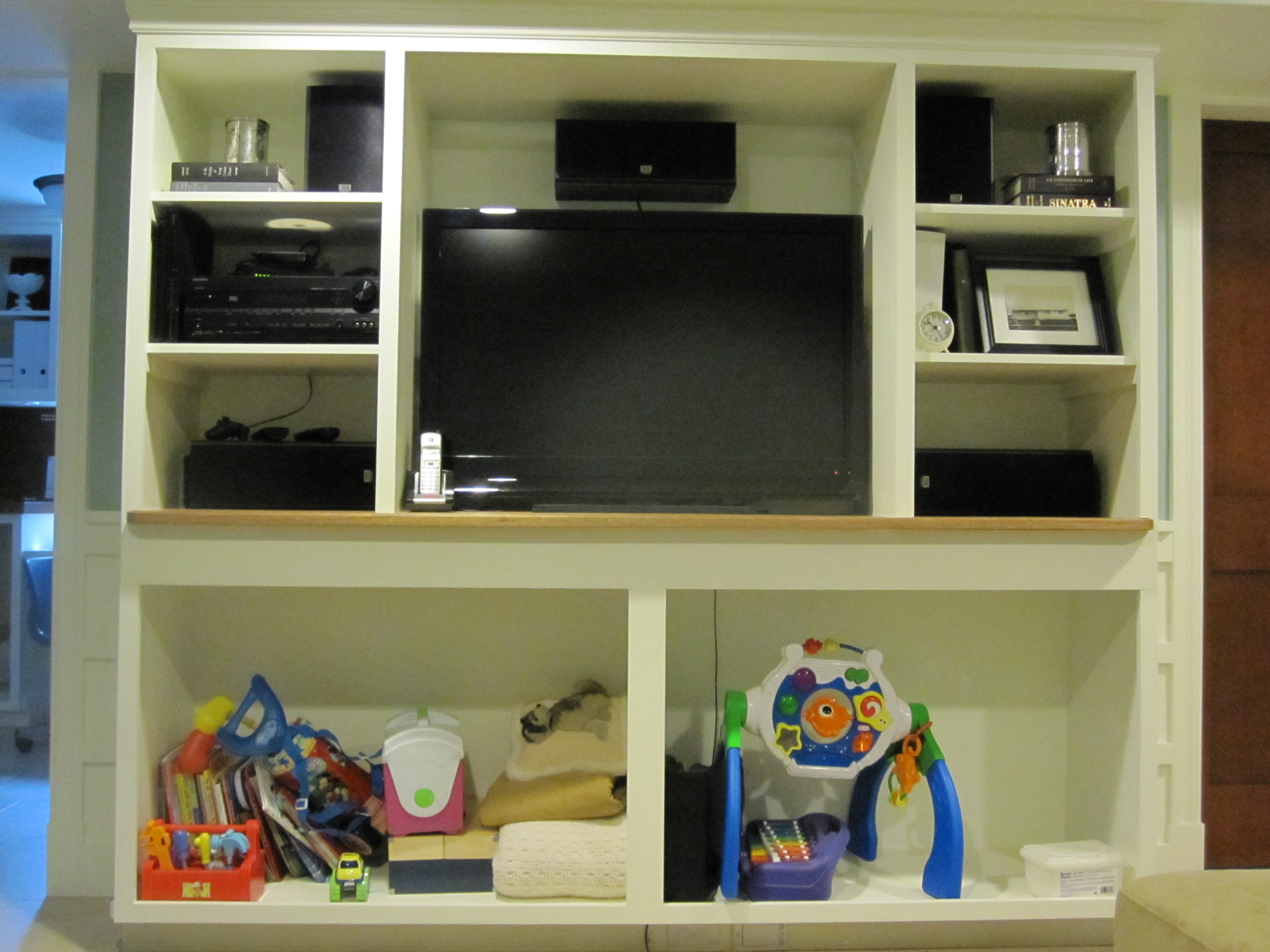
We don’t keep all the toys in one area, as they are hauled all around the house anyway.  We have some toys stored in the Man Cave entertainment center.  Once the doors are finished, the mess will be hidden away, similar to our living room built-in.

V has some larger Tonka trucks, which are stored under Ev’s crib, hidden by the crib skirt. 

Basically, we don’t have a lot of baby/toy clutter because I refuse to keep large baby items like swings, bouncer seats, and exersaucers in the house.  I also go through the toys somewhat regularly and throw out or donate broken or unused toys.  It also helps to send noisy, annoying toys to grandma. 

One major tip I can offer is to use closets and space under the bed.  Keep items in bins labeled by size to organize items such as children’s out grown or too big clothes.

How To: Make a Bird Mobile

When I was pregnant, I found this tutorial on how to make a paper bird mobile.  I decided to make a little mobile to hang above our son’s crib.

I made some changes along the way, so here is the step-by-step on how to create this mobile:

1.  Print the template on plain cardstock or printer paper.  I prefer to lightly trace the template on my colored cardstock, giving me the option to erase my lines after the pieces are cut.  Cut out one set of the template. 

2.  Lightly trace the pieces on the cardstock colors of choice.  For this mobile, I made three sets of each bird using two different colors of green, chocolate-brown and white cardstock.  Be sure to mark the wing slit and hanging hole.  Cut out your cardstock pieces and erase your lines. 

3.  Place your template over a cut out bird body.  Use a cutting board and push-pin to poke a hole to thread your string through.  Use an exacto knife to make a slit for the wing to go through.  Do not make a box, as shown on the template.

4.  Slide the wing through the body and fold up slightly. 

5.  Add a very thin line of Elmer’s glue to each side of the tail on the main body.  Slide the cut tail onto the body.  Gently squeeze the tail and set it aside to let it dry.  After the tail has dried, thread a string through the hole.  Tie a few knots on one side and cut the extra off, leaving one to two feet on the other side.  The length of the string should vary and will depend on the final hanging height. 

6.  Buy or cut a tree branch to hang the birds from.  I prefer a branch with two or three small branches creating a V or W from one main branch. 

7.  Tie one piece of fishing line on each end of your branch.  If you have a V branch, you will have three pieces.  Make the pieces longer than you’ll need, allowing plenty of excess to tie a knot.  Tie all pieces together at the desired height from the ceiling.

8.  Tie each bird onto the branch, varying the height .  Make sure each bird is secured on the branch.  Once all birds are tied on, you’re ready to hang your completed mobile.  Screw a hook into the ceiling, hang the mobile, stand back and admire!


Furniture Feature: Dining Table

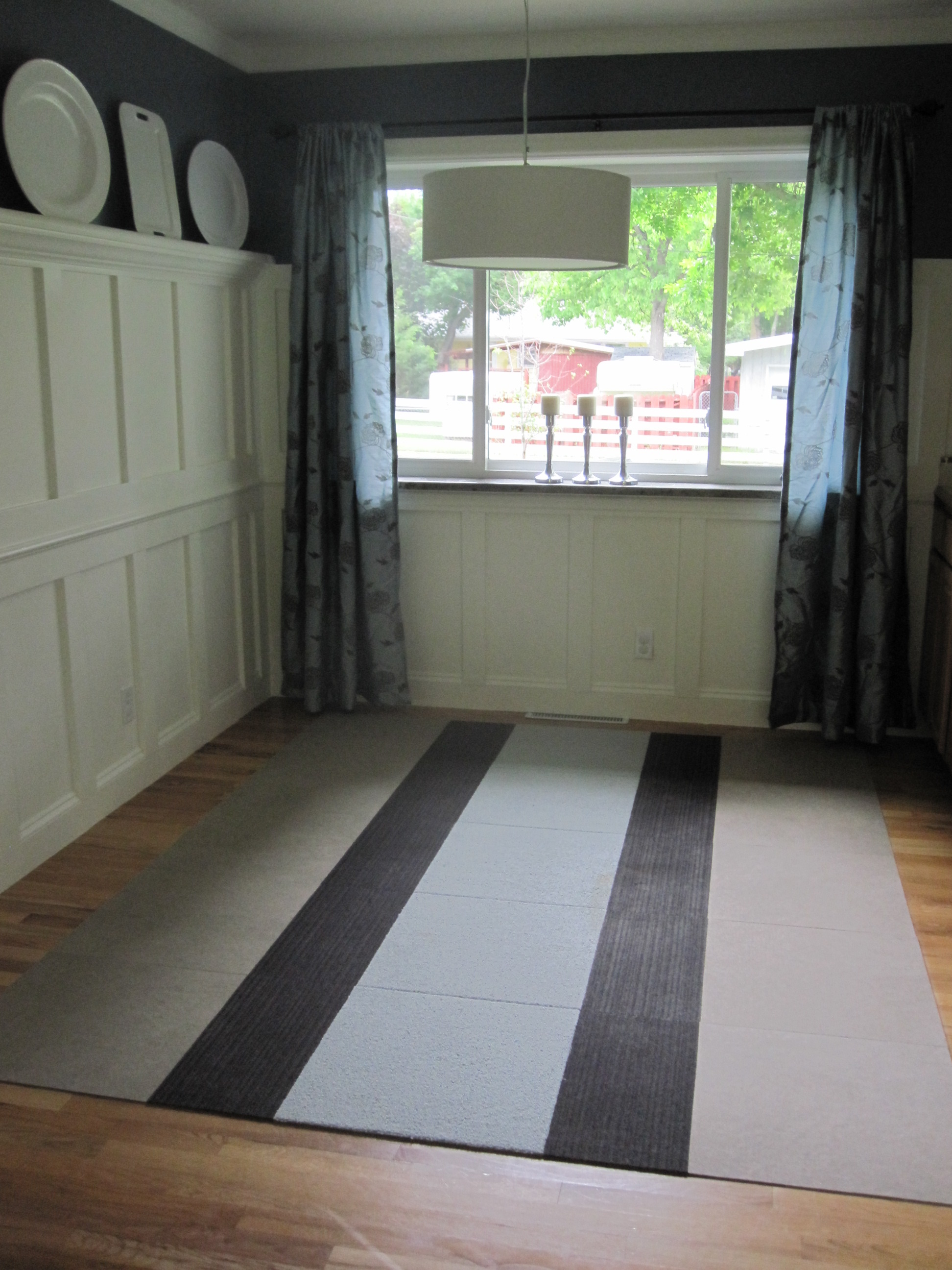
Before we could bring our new table in, we had to remove the old set.  Then, I added a few more Flor tiles to the existing rug.  Because our old table was round, the four square by four square rug was the perfect size.  The rectangular table needed a rectangular rug.  When I order Flor rugs, I always order a few extra squares of each design.  This came in handy.  I cut the dark brown squares to fit with the existing design.  Then I taped them together because I didn’t have extra Flor dots.  After about ten minutes, our ‘new’  rug was ready for the table.

Ben and I carried in the new table base, but the top was far too heavy for me to move.  With a little help from a friend, we had a new table.  Enough talk, here’s the completed table:

The overall size is 4 1/2 feet long by 3 feet wide, which fits perfectly in our dining room.  The chairs tuck under neatly, fitting close the edge of the table, leaving two feet of walking space on all sides.

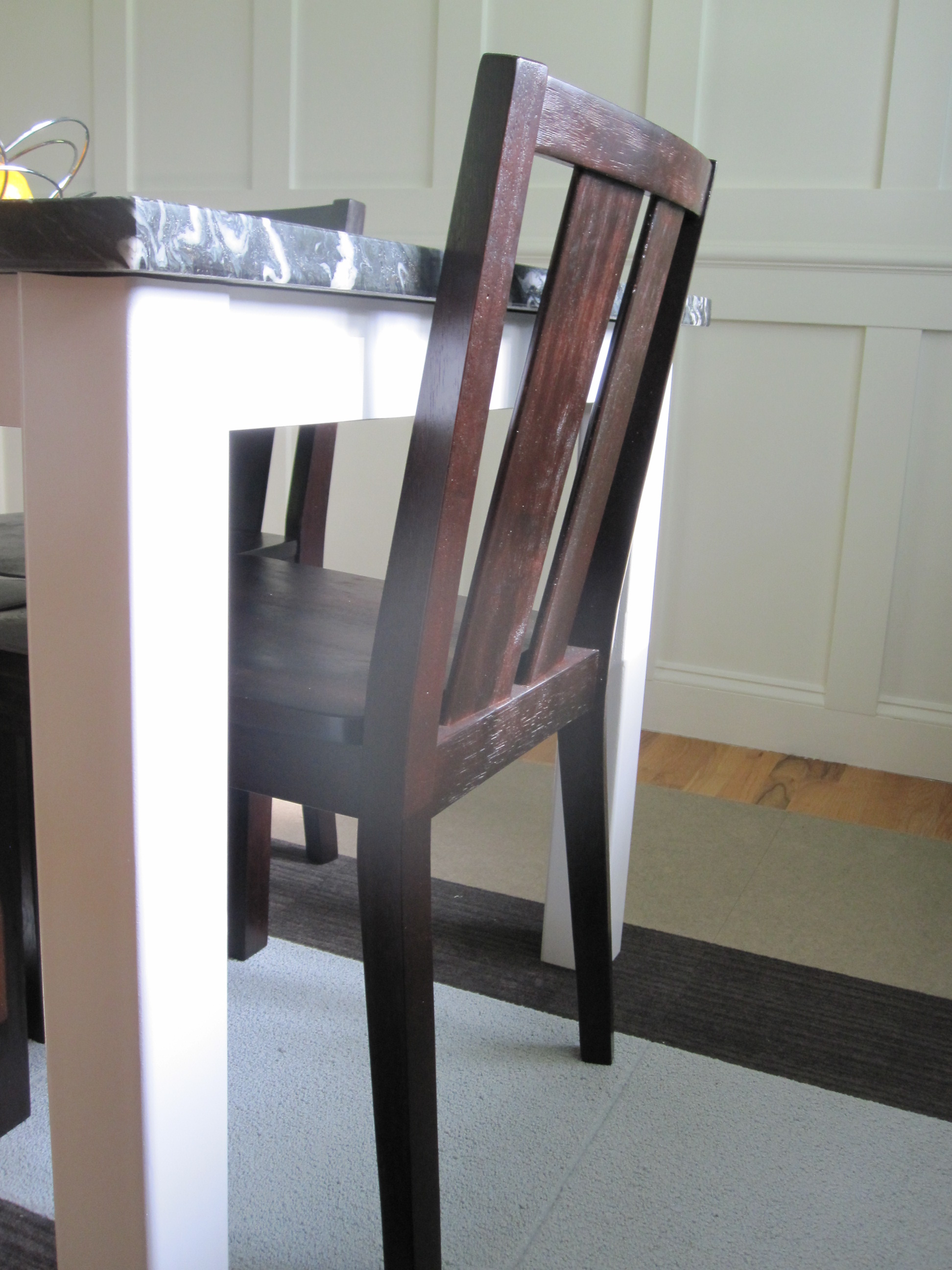
The apron is set in 1/2 inch from the legs, giving the base a polished look. 

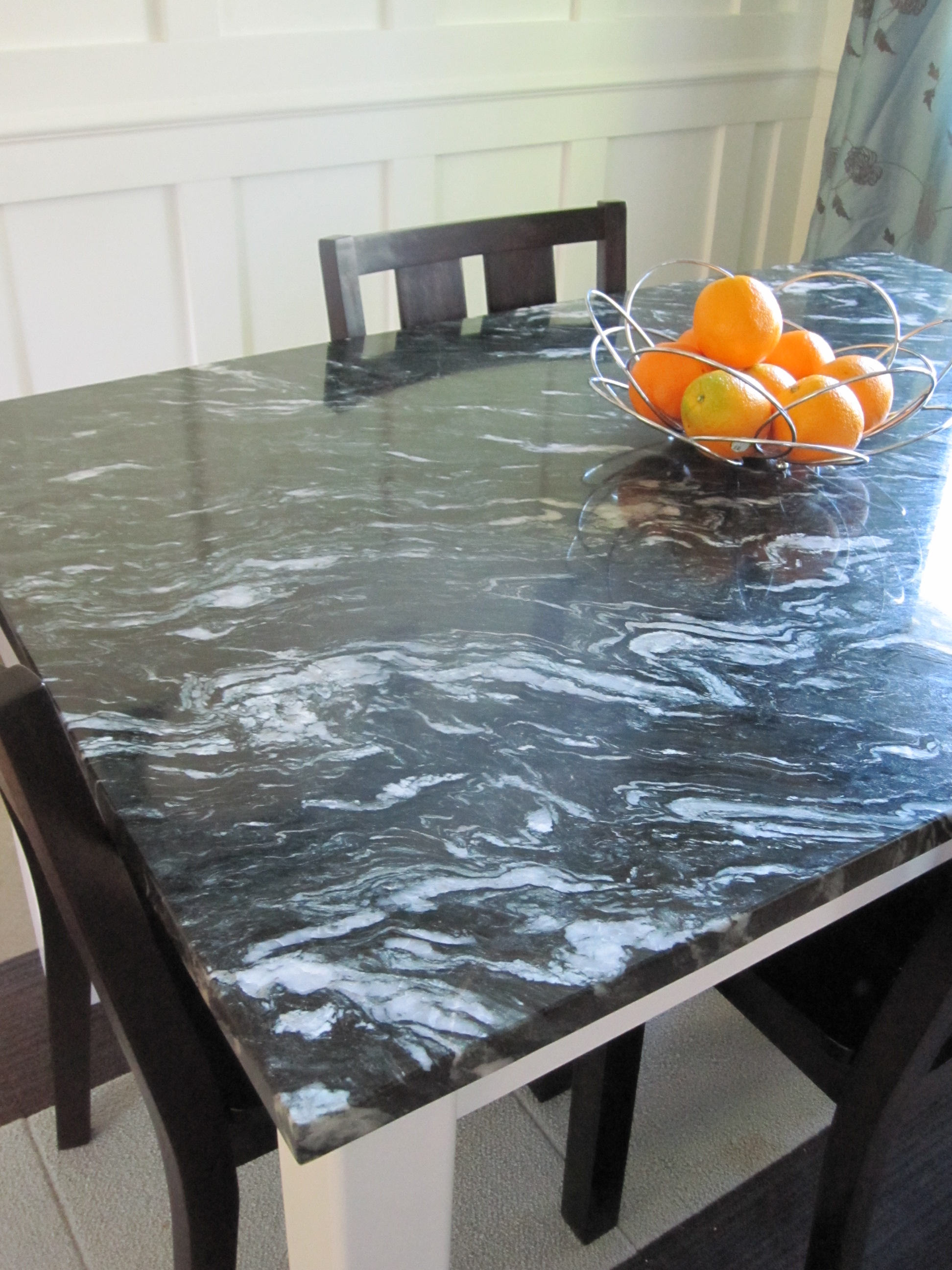
I love the clean, modern Parsons style legs paired with the more traditional marble top. 

It’s a perfect balance of modern and traditional.  The dark wooden chairs are comfortable and stylish, but still add warmth.

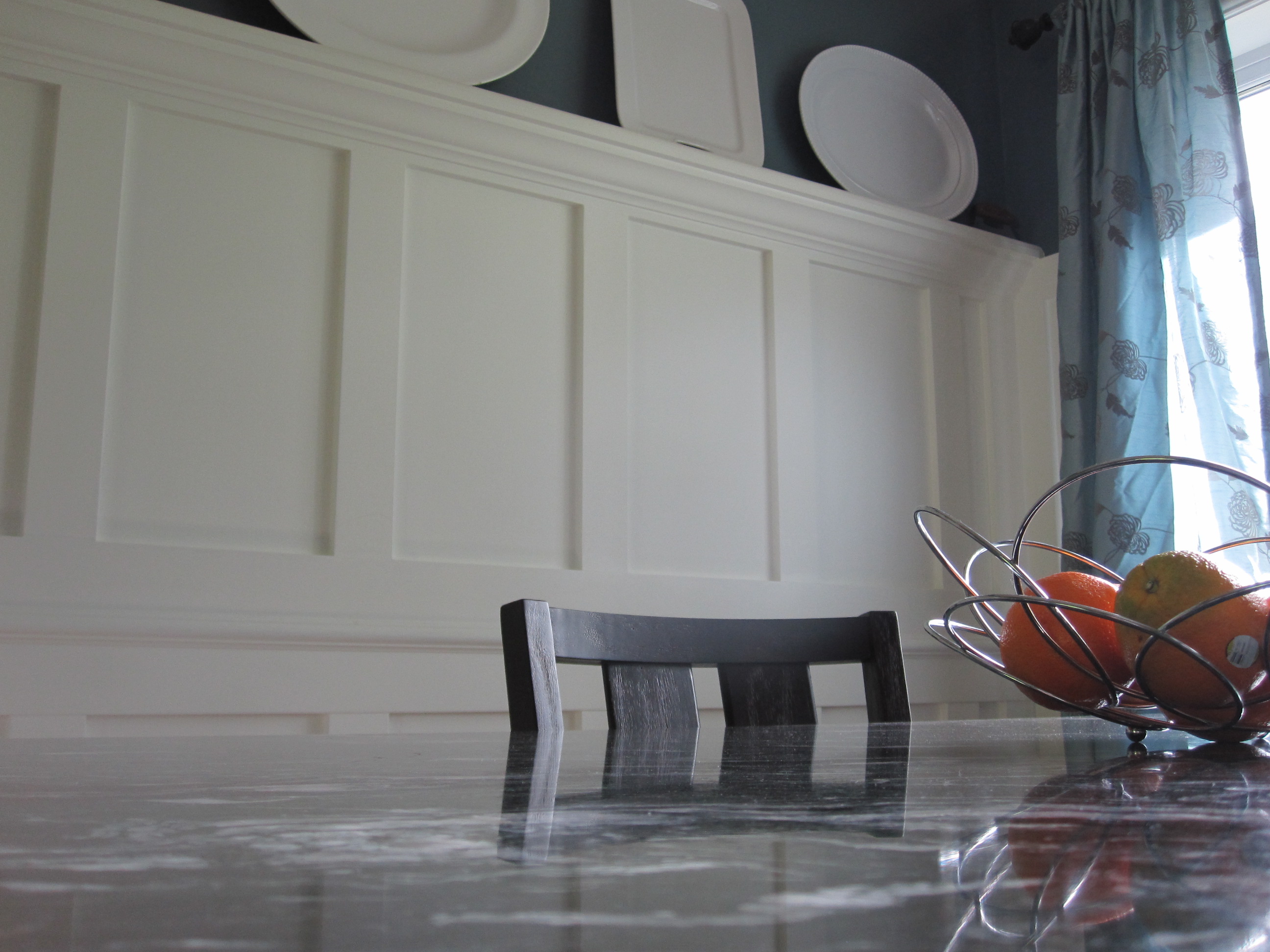
I wanted to show the marble off, so here’s an artsy shot:

I am 150% in love with our new table.  What do you think?  What is your proudest DIY project?