Warmer, No, Hot Bench

I teased you all with the bench refinishing process yesterday.  You’ve waited long enough.  Feast your eyes on a sanded, stained, sealed, upholstered bench that nearly required more labor than my kids.

The fabrics are from Joann, so nothing crazy or expensive.  This way, when I change my mind, I won’t feel bad.  Though, I did choose a neutral fabric for the seat so I could change the pillows out to go with a different color scheme.

I found the ceramic stool at Ross a few weeks ago for $30.99, marked down from $45, but originally $95.  Score for a 68% discount.

The seat is a few inches taller than the cushions, because I used a 3/4 inch thick plywood and added another inch of foam.  One long cushion makes the piece look more like an outdoor bench than a couch, in my opinion.   And, the plywood base is much more sturdy than the sagging canvas.

Surprisingly, the trellis pattern wasn’t difficult to keep straight.  Perhaps because it is a small-scale?  Speaking of small-scale, I want to add another set of larger pillows to beef things up and add comfort.  Maybe 18 inch square ones?

Overall, I think this was a great transformation.  A little time-consuming, not too expensive, but I worth it.  Last night, Ben finally admitted he said he thought the bench was ugly so he wouldn’t have to help with it.  He thinks it looks cute now and said he saw the potential from the beginning.

Just after I finished upholstering the seat and setting it in place, I plopped down to enjoy it.  Then, Vincent sat down with a bag of tortilla chips.


For a more dramatic before and after, how about a side by side?

Now, for a cost breakdown:

Bench: Free

Sander and paper: Already owned

Stain: Left over from another project

Clear Protective Finish: $19.99 for a quart, with tons left over for another project

Cushions: Reused from original bench

Mattress Topper: $12.49

Fabric: $25.79, including two yards for the seat, two yards of vinyl, and one yard for pillows

Pillow forms: Living room forms displaced by new World Market pillows

Grand Total: $58.27  

Not bad, especially when I checked prices of similar benches I liked.  Like this one for $289.00 or this teak Smith and Hawken bench for $649.00.  That is a savings between $230.73 to $590.73.

The process was fairly simple, but time-consuming.  Nothing a patient DIYer couldn’t handle, though.  What do you think of the change?  Was it worth the time, effort and money?

Featured: Southern Hospitality

We hope your Friday is going as well as ours.  Why is our Friday so great?  Because Rhoda at Southern Hospitality featured our home today

We’re thrilled, to say the least.  Rhoda has such sweet things to say, too.  Someone pinch me!  Wishing you all a fantastic, fun-filled weekend!

How To: Make Laminate Countertops

Laminate countertops may not be the most beautiful option, but they certainly are cheap, durable and DIY friendly.  Which is exactly why we chose a laminate top for our laundry room.  To make your own countertop, you’ll need:

3/4 inch thick Plywood, MDF or OSB, enough for two layers.  The top layer must be particle board.

Laminate sheeting (ours was 4 feet by 8 feet)

1 1/2 inch tall by 3/4 inch thick material to cover the edges

3M Fastbond Contact Adhesive

Foam roller to spread the glue

Heavy roller to press firmly into place

To start, create a solid surface of plywood.  Secure two pieces together to create a thickness of 1 1/2 inches.  Fill any holes with wood filler and sand smooth.  Place the sheet of laminate on top of the area and cut roughly to size.  Ben used a router.

Attach your 1 1/2 inch tall edging on all exposed sides.  We used oak, but anything will do.

Then, pour some glue on the back of the laminate sheet and spread in a thin layer with a roller.  This stuff is stinky, so you should wear a mask and/or work in a well-ventilated room.  You may need to let the glue set up for a few minutes.  Read the instructions on the glue.

Then, place wooden dowels every 8 to 12 inches to keep the laminate from touching the top before you’re ready.   Flip the laminate over and start at one end of the piece, pressing into place.  Use the roller to smooth the surface and bond securely.  Work in only one direction to prevent shifting and bubbling.

We placed weights on top, just to prevent any movement.  After adequate dry time, usually 24 to 72 hours, use a router along the exposed edges to clean the edges of the wood and laminate up.  We cut ours to a clean, kid-friendly 45 degree angle.  Run the router along the edges until smooth and uniform.

With the edges cleaned up, fill any nail holes, sand, and paint or stain to finish.

Because Ben installs laminate counters in the apartments, we already had access to all the supplies.  Fortunately, we also got a piece of white laminate from the apartments because the owner didn’t like it.  I don’t love it, because it has a tan cross hatch pattern.

See what I mean?  But, it isn’t noticeable unless you’re super close.  I wouldn’t choose it, but it was free, so it will work.  Fortunately, it is light to help brighten up the small basement space.

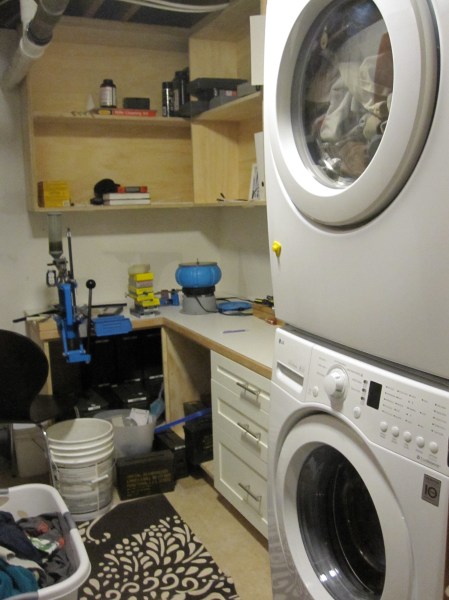
Oh, and here is what our laundry room looks like today.  A total mess.

You can see the installed drawer fronts, but we still have to finish the cabinet doors and shelving.  We had a slight change of plans.  You’ll also notice that we haven’t sanded the sheet rock yet, but paint will go on those walls someday.

Bathroom Business

Not that kind of business, though.  We’ve managed to cross another item off our to do list.  You’ve seen our new cabinet doors and my office drawers.  The office drawers took a little longer to install than planned, so we put off finishing the bathroom and laundry room.  Last weekend, I prodded Ben until he gave in we found some time to finish the bathroom.

Before I share the ‘after’ pictures, I want to give a little explanation on how we install drawer fronts.  First, we measure the width and height to find the center.  Then, either make a template or mark the drawer pulls on the drawer front.  Drill holes in your drawer front, but not the drawer.  Use screws to attach the front to the drawer.

If you’re working on a drawer stack, this allows you to attach everything from the front, make sure all faces are level and spacing between drawers is even.  We use nickels as spacing guides for our drawer fronts.  Start from the bottom drawer to stack the remaining drawers on top.  This way, as long as your drawers are even and square, your stack will be level.  Once you like the arrangement, screw the front in place from inside the drawer.  Remove the screws from the front and drill through the rest of the drawer to install the handles.

Now, we’re ready for the main event.

Remember the before?   Yes, those openings bugged the crap out of me for the past year.

The center is a false front and the ends are functioning drawers.

We chose oil rubbed bronze drawer pulls to tie the faucet finishes together.

Towels and extra toilet paper are stored below on the open shelving, giving the perfect balance of large and small storage.

Yep, lookin’ good, if you ignore the pile o’ tile and a saw in the corner.

What is your favorite type of bathroom storage?  Drawers and cabinets?  All drawers?  Drawers and shelving?  Maybe your have a medicine cabinet for small items and don’t need drawers?  Is your bathroom filled with products?