You Light Up My Life

Over the weekend, we enjoyed windy, gloomy weather.  No work on the roof, but Ben did some work inside.  On Saturday, we ran our usual errands, Ben washed windows, and cut the left over slab of Bubinga to fit the entertainment center.  Sunday, we had high temps in the 60’s, so we took a trip to Home Depot to get various electrical supplies.  Cooler days are better for attic work and we took advantage of it.  First, Ben ran wires for the theater speakers.

Speakers will flank the front living room window for a true theater-like experience.  The wires run from the outside wall, through the attic, and down the wall behind the entertainment center.

While he was up there, he moved the cable from the temporary place to the same box behind the tv.

Though unfinished, that is better than this:

You may have noticed the sconces are gone, too.  Ben pulled the wires completely out because we’ll never have sconces there.  Now we’ve got patching to do.

That’s all great, but I was most excited for the pendants in the main bathroom.  While painting the small linen closet, I realized just how dark that bathroom was.

Step out of the dark ages, we have created light!  Finding lights Ben and I could agree on wasn’t the easiest part of this bathroom reno.

We knew we wanted chrome pendants with hidden bulbs.  Of course the options are nearly limitless, but we also wanted something around the $50 or less price point.  One of our original choices were industrial chrome pendants for $48 each from Lowes.  Currently, the bathroom doesn’t have a ray of natural light.  We will add a Sky Tube, but Ben and I worried the downward direction of the lights wouldn’t fill up the bathroom.

Luckily, using only one rod kept the pendants high enough, giving off more light than I thought.

And we love the look.

The style of this pendant is very similar to this one from Home Depot.  Twenty dollars less each, and I like the style of the Lowes option better.

We’ve got some trim installed, but more to do.  Then filling, sanding, priming, and painting.  And grouting the tub, installing the toilet, getting the sink functional, adding functional items like hooks and such.  But we’re getting there.  I’m getting some of the finishing touches ready.  And you caught a peek at the shower curtain that inspired my revised plan.  Mood board to come soon.

What did you do over the weekend?  Have you found a cheaper version of something that you liked more than the expensive option?  That’s always fun for me.  Usually I gravitate toward the more expensive items.

Stone Cold

Here’s the much requested stone counter cutting post.  Let’s dive in.  Well, not literally because smashing your head into the counter doesn’t sound like fun.

To cut your own stone counter top, you’ll need:

  • A skill saw with diamond blade
  • A right angle grinder with diamond blade and stone polishing pads
  • Clamps
  • A straight edge
  • A hose with running water
  • A GFI protected outlet
  • Saw horses or another system to hold the stone up
  • Protective gear for eyes, ears, mouth, and nose

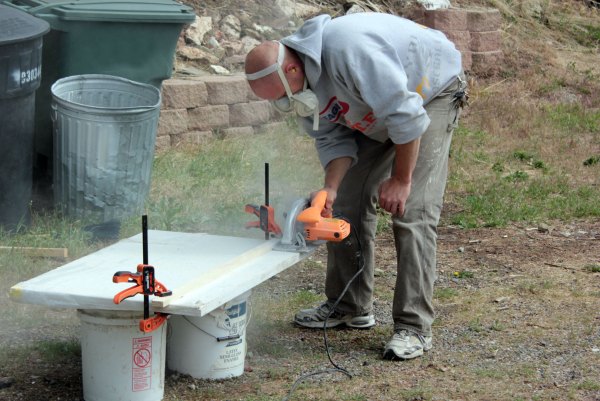
Now you know the ingredients, let’s get to the instructions.  If you need to cut length off your stone, first mark where you want to cut.  Then, measure the guard of your skill saw.  Clamp a straight edge factoring in the width of your guard.
While wearing protective gear, slowly and carefully cut along your guide.

Now you’re ready to start polishing.  Ben asked the local granite companies for their used polishing pads, so ours were free.  To get a new set, check the link above or search ‘granite polishing pads’ to find a better deal.  Here’s what the pads look like:

For a polished finish, the pads work best wet.  Ben clamps a slow running hose to the counter top to let the water trickle over the edge.  Remember, electricity and water are not friends!  Plug your grinder in a GFI protected outlet and keep your plugs out of the water.  Use extreme caution.  Then sand the edges just like you would with a normal sander on wood.  Keep it moving to avoid gouges and slightly round the edge for a factory-finished look.

Polishing didn’t take nearly as long as cutting the sink hole did.  Ben only uses drop in sinks so he doesn’t have to have a nice looking cut, just a place for the sink to go in.  Use the sink template to mark the cut lines.

Take the polishing pad off the grinder and replace it with a diamond blade.

Plunge cut the sink hole slowly and carefully.  You won’t be able to cut through with one pass.  Slow and steady on this.  Clean the dust and water off and you’ve made yourself a stone counter top.

The polished eased edge looks just as good as the granite company, too.

What do you think?  Are you willing to try this at home?  What is your favorite type of counter top?  Granite?  Marble?  Concrete?

Disclaimer:  If you are not comfortable using this equipment, don’t try this.  Use caution and always wear safety gear.  This is an overview tutorial and we cannot be held responsible for injuries.  

You’re so Vain, Vanity

Our main bathroom is taking shape.  Yesterday you saw Saturday’s progress, but on Sunday, more bathroom magic happened.  Ben started working on the vanity.  After finding a remnant piece of quartz for sixty bucks, we nailed down the width of 43 inches.

With the linen closet ready to rock, we could start the vanity.  Right off the bat, Ben and I agreed we wanted an open design similar to the basement bathroom at our first house.  I even made a to scale Photoshop drawing.

Ben had 3 1/2 inch square oak posts already, so we used those for the legs.  For a modern look and sleek clean-ability (a must with two little boys!) we chose the Archer sink by Kohler.  But we had a little problem.  The sink is almost 20 inches wide, our top is 43, and our legs are 7 inches wide.  43 – 20 – 7 = 16 inches.  Divide 16 by 2 (we wanted a drawer on each side of the sink) and you get 8 inch wide drawers.  That’s the outside dimension, now take away an inch for glides and another inch for building materials and you’re left with a 6 inch drawer.  Too little space to make it worth building drawers.  Boo.  On the upside, this made building the vanity a little easier.  Instead of cutting several pieces to make openings for the drawers, Ben used 2 by 6 boards to frame up the top.

To secure the boards, Ben drilled long screws to hole the boards to each other and the studs in the wall.

But not before making sure every part was level several times.

Then Ben nailed the legs to the cross boards, using filler pieces where our floor isn’t completely level.

Tile floors don’t work to hold the leg bases down, but shelves stabilize nicely.  Knowing we won’t have drawers, I adjusted my plans to include two shelves instead.

For maximum stability and strength, Ben cut plywood (not MDF) to size and notched out the post corners.  To cover the ugly plywood edge and add even more rigidity, he tacked on an oak face.  We shouldn’t have to worry about the boys using the shelves as a step stool.  In our humble opinions, the easiest and sturdiest way to support shelves is with cleats; thin pieces if wood which the shelf rests on.  Ben added two short ones to each leg and a long piece along the back wall.

One shelf down, one to go.  Through the power vested in me the internet, I give thee a second shelf.

And a peek at the counter and sink.  Oh look, here’s another.

And I snapped a ton of pictures of the cutting and polishing process for those requesting a granite post.  Check back for that tomorrow.  After a weekend of work, this is what we accomplished.

And a little action at the tub.  Ugly framing covered and a pretty granite sill on top.

Have you ever built a vanity?  Do you prefer the look of an open style or the option to tuck items away in a cabinet?  Who’s excited for the stone cutting post?

Bring it on, Bathroom!

Over the long weekend, Ben decided he was going to get serious work done on the house.  Perhaps start tearing off solar panels and cedar shakes to get ready for roofing?  Mother Nature had a different idea.

On Saturday morning we woke up to a few inches of sloshy, wet snow.  Never in my life have I seen snow on Memorial weekend!  Bad weather turned our attention back to the main bathroom.  Before we could get working, we needed to run errands.  Costco for the week’s groceries, an auto store to get a new car battery for Handy Sammy, and Home Depot for lumber, plywood, sink, and new faucet.  Errands caused us to get a late start, but we did get something done before building.  Grouting the floor tiles.

Ben likes grouting because it is the mindless part of tiling.  Mix, spread over tiles, let it sit a few minutes, wipe off.  It’s like Staples ‘Easy Button’ of the tile project.

One thing to keep in mind when you’ve got small grout lines: wipe off the excess grout in a circular motion.  When cleaning in a circular pattern, it’s nearly impossible to remove too much grout.

Use an old, wet rag to wipe, rinsing occasionally, re-wiping until the tiles are clean.

A slight haze stays on the tile, and that’s okay.  Wait until the grout has completely dried to clean thoroughly.

For cleaning reasons, we decided to use a medium gray grout, Pearl Gray on the floors.  In our first house we used white and it did get a little dingy in main areas.

The long weekend started off with a few sheets of 1/4 inch MDF to cover the glued bead board mess of yore.

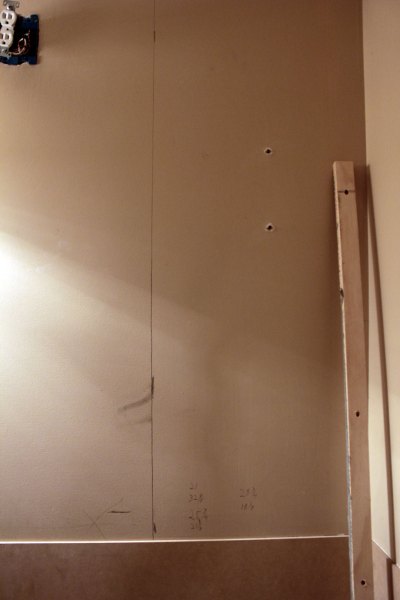
Turns out the 8 foot square bathroom comes in handy for this.  No seams, just 36 inch tall pieces nailed to the studs.  Covers the ugly mess quickly, and this room can benefit from bright white trim.  Ben drilled holes to fit around the sink plumbing.

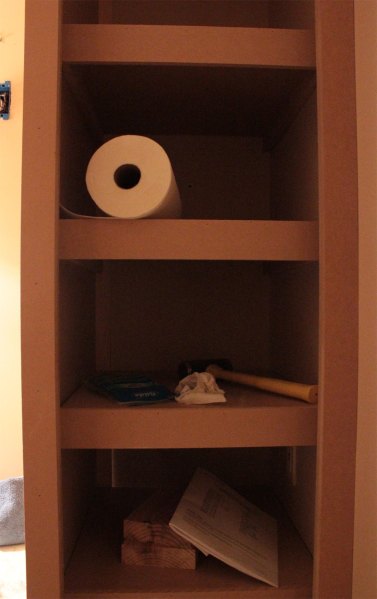
And we’re ready for a linen closet.  Measuring and marking made building easier.

We’re already short on space.  To make the most of the layout, we decided to skip building a 2 by 4 wall.  Instead, Ben built the closet just like he did our fridge surround in our kitchen remodel.  A few strips secured to the wall and ceiling, then a piece of MDF to act as the wall.

See how rough the framing strips look?

Not anymore.  Strips of 1/2 inch MDF cover everything for a beefy, finished look.  And the shelves keep the vanity edge wall from shifting.

The bath tub got a little action, too.  Ben framed up the support wall in preparation for a granite sill.  Still no grout in there.  More trim work to happen, then grout.

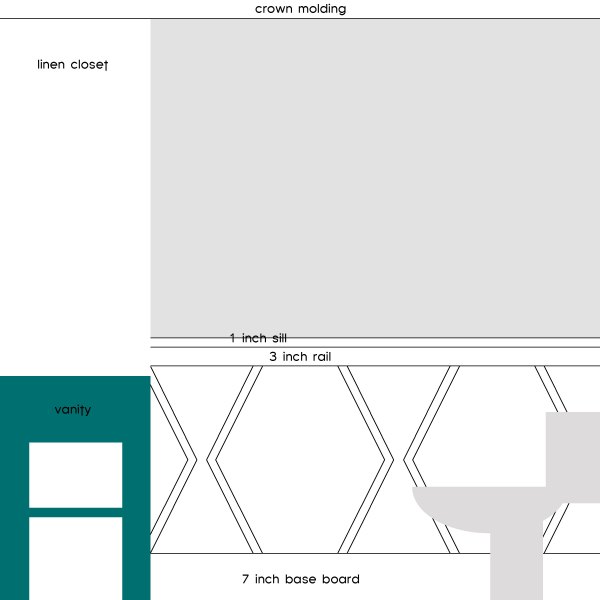
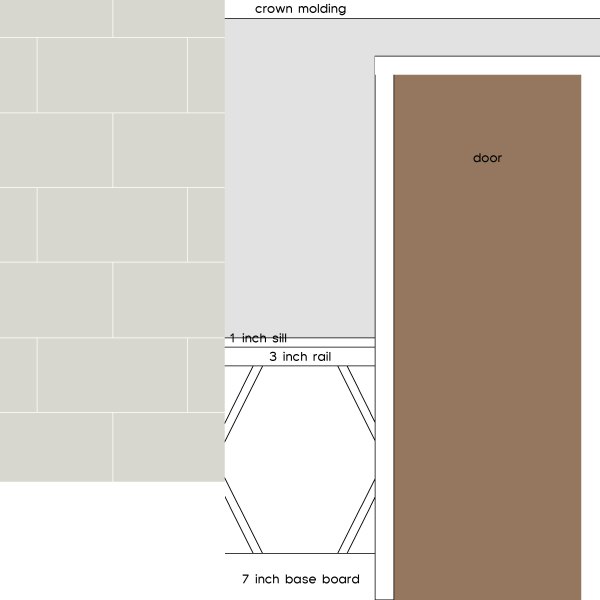
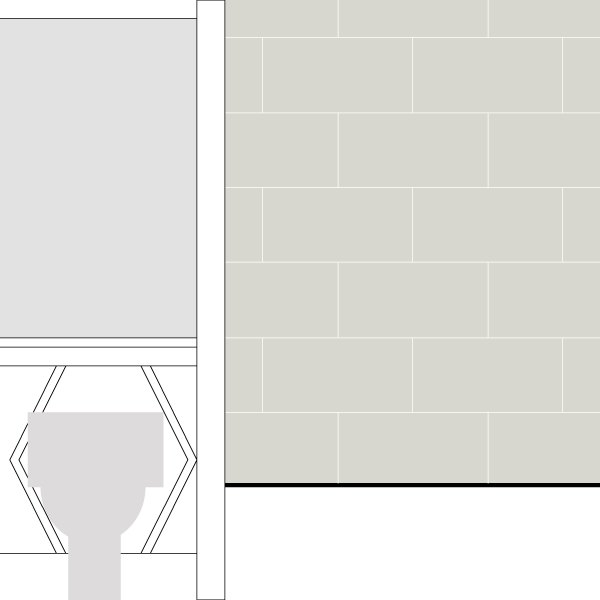
In our first house, we had trim treatments in every room.  Yes, it’s very pretty, but also time consuming.  More finish work and more cleaning.  But I don’t know if I want the wall panels in the bathroom to look as plain and flat.  So, I worked on a few trim designs in Photoshop to see what I thought.  Here’s an idea I tossed to Ben.  The back wall, straight ahead of the entrance.

Looking at the vanity wall:

The entrance wall:

And the tub wall.

We discussed the hexagon idea and nixed it.  We’ll live with the plain, easy to clean walls.  But you got a peek at the vanity design.  Similar to the basement vanity at our first house, but smaller.  Ben made a few changes because we didn’t have enough material for the legs.  You’ll get to see that tomorrow.

How was your long weekend?  Did you get work done?  Or spend time with family?

Tile on the Floor

I’ve said it before, progress on the bathroom is slow.  We’ve got a million and ten projects we’re working on, some more pressing than others.  First removing the water heaters to make room for the geothermal.  Then installing a new dishwasher.  And a whole house fan to keep us cool.  All necessary things that have taken focus off the bathroom.  Such is life, I guess.  In the video tour, you caught a glimpse of the newly installed floor tile.  So here’s how we got to that point.

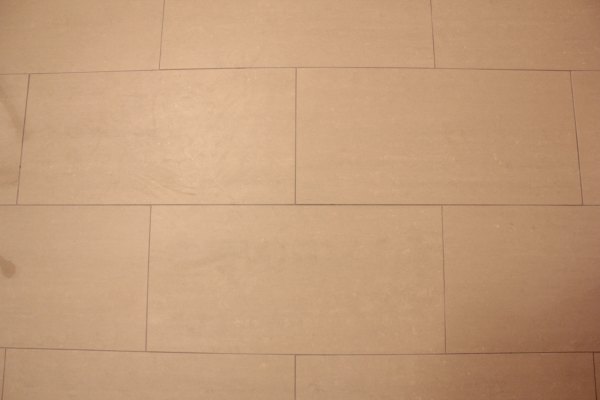
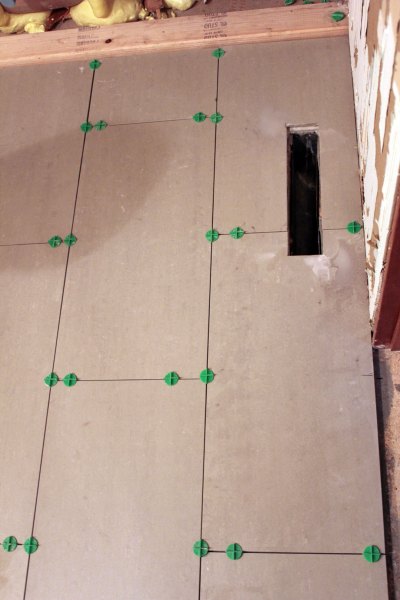
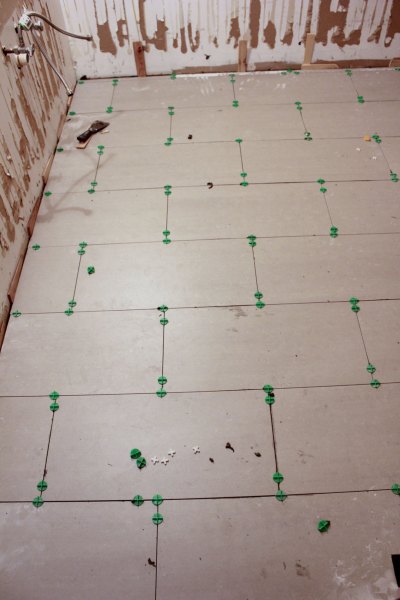
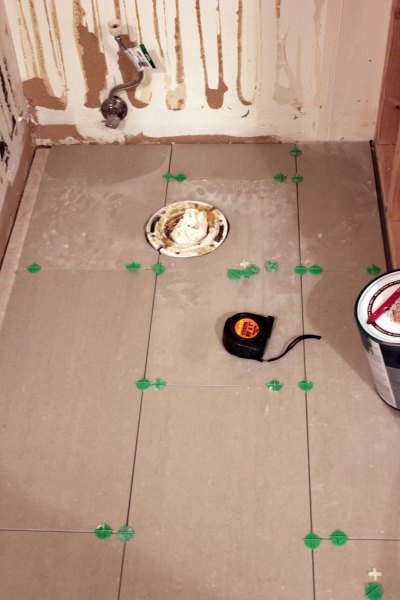
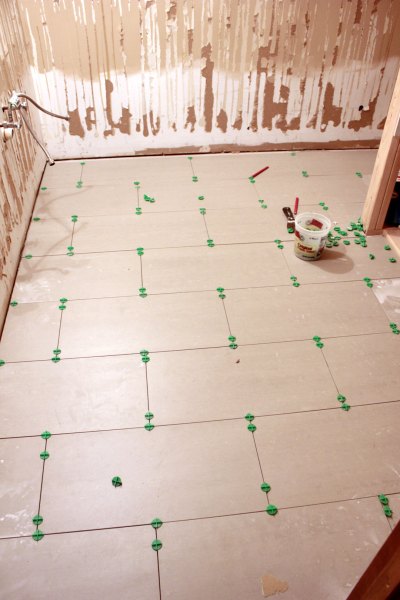
Before we could install the tile, we had to determine the layout.  We knew we wanted a brick pattern and preferred the look of it running parallel to the door.  Then, Ben measured the distance between the wall and the bath tub.  Centering the middle of the first tile on this portion looked best, instead of centering the first tile over the entire room length.

More of the room is this width, not the full 8 foot span.  Ben marked the center of the tile with a pencil, making it easier to line everything up.  After nailing that down (figuratively, of course) Ben measured and cut the rest of his pieces.

Including this hole for the floor vent.

Sometimes tiles are finicky and break while cutting.  Well, not these.  Ben said these tiles are crazy strong and a dream to work with.  A happy Ben means a happy tile job and very little complaining.  And, this is his best toilet cut out to date.

Turns out a paint can is the perfect template.  Knowing this is a small space, Ben pre-cut and fitted his tiles before mixing the mastic.

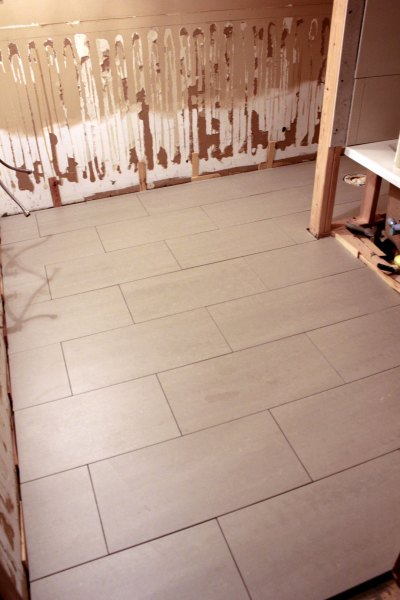
Install was crazy quick because of this.  Seriously, I watched him set the first few, walked down the hall to clean up a few things, came back and saw this:

Sure it helps that the tiles are 1 foot by two feet, but it went fast.

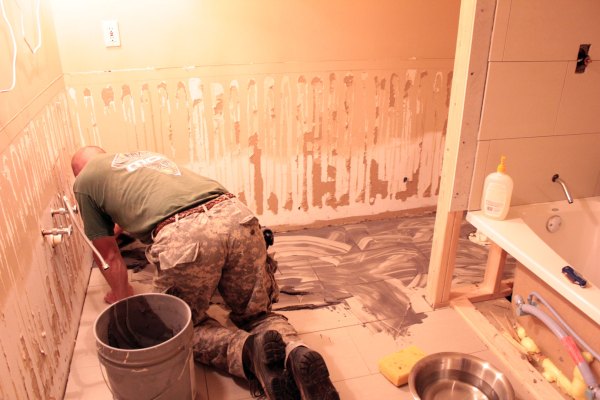
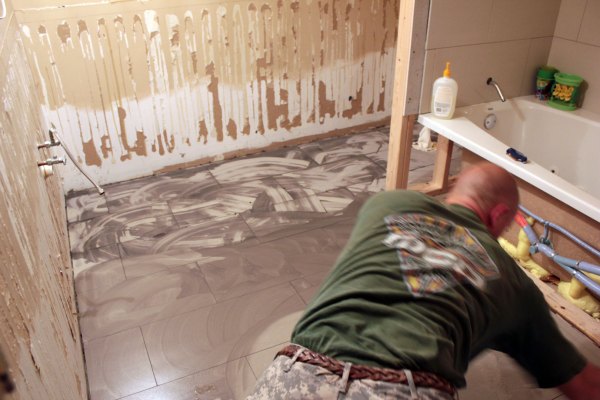
The following morning, V helped me pull out the 1/16 inch spacers and I got to work cleaning the floor.  Wetting the mastic with a rag makes clean up super simple.  Then I used a utility knife to scrape the higher sections of mastic out of the grout lines.

Bring on the grout!  And a toilet, please.