Safety Dance; Safety Book

One month ago, after meeting up with my blog pal Jen and local readers, we offered up a Goodwill Challenge.  I bought a thick hardcover book.

I know, it’s not much of a make over, but I’ve always wanted to make a book safe.  A 15 cent book is a good tester, too.  Jen’s challenge was an even better excuse to get started.

First, I separated the first few pages and the front cover, keeping everything bound with binder clips.  Then I mixed plain ol’ Elmer’s glue with a little bit of water and brushed it all over the edges of the book.  Mod Podge would work for this, too, but I only had glossy and I wanted this to look as realistic as possible.

With the edges glued together, I put a few pencils between the front pages and the glued pages.  To help the pages dry tightly, I popped Ben’s jug of wine on top.  Twenty or so minutes later, the glue had completely dried.

To get started cutting, gather a pencil, ruler and a sharp utility knife.  Draw a border on the front page (I used the text as my guide).  Use the ruler to cut a straight edge, going through as many pages as possible.

Pull the pages out and keep on cutting.

Don’t stop now.  Cut along the edges.

As I cut, my edges got messier and messier.  This doesn’t matter.  It will all be covered up.

After about 15 minutes of cutting, I had removed enough of the inside to fit my iPhone inside and close the cover.

Once you’ve hollowed the book to the depth you’d like, cover the inside edges with the glue mixture.  Spread more glue along the top of the hollowed border and let one page out of the clips.  Set the page down and cut out the inside for a clean top page.  Put something heavy on top to dry.  Now you’ve got a handy book safe to keep all your worldly possessions inside.

I have to admit, after cutting to the iPhone depth, my new camera arrived and I quit working to fiddle around.  And I haven’t gotten back to cutting yet.  But you get the idea.

Now, let’s do the Safety Dance.

Have you ever made a book safe?  Wanted a book safe?  What’s your favorite book?

Oscar the Grout

We’re already shared our crown moulding progress.  Now that we’ve installed and grouted the marble subway tile kitchen back splash, we’re ready to share the details.  Ben likes to use pre-mixed mastic for small jobs like this.  Our tiles are relatively small (3 by 6 inches), so a 1/4 inch notch trowel worked perfectly.  For the most seamless look possible, we used 1/16 inch spacers.  Ben borrowed a wet saw from work to get the job done.  Before grouting the tile, we waited a week to give the tile adequate time to set up.

We had white unsanded grout left over from our bathrooms, so we used what we had.

Before mixing the grout, I taped off the cabinets and counters.  Grouting is a messy job and we wanted to protect everything as much as possible.  Then Ben mixed up some grout in a large stainless steel bowl.  Like nearly everything mixed material in home improvement, you want the grout to have the consistency of peanut butter.

Using a foam float, Ben applied the grout, smooshing it in the cracks and wiping the extra off quickly after.

Be careful not to wipe off too much, though.

For the tighter strips along the window, Ben used his fingers to push the grout in the cracks.  After finishing up the wall, Ben sponged most of the grout off the tile surfaces and the window trim.

Next up, the stove side tile.  Again, the float was too wide to get this tile, so Ben applied it with his hands.

And now waiting for the grout to set up.

Here she is, all grouted and lookin’ pretty.

Here’s my favorite shot, showing almost every kitchen detail:

Everything except the awful soap color.  Why does Palmolive make their soap glow in the dark green?

Any suggestions for pretty dish soap?  Hand soap is easy enough to find.  I like that this pump holds two different kinds, but I’d like something prettier.  But doesn’t the grout make everything look so much better?  And finished?  And preeeety?

Cap and Crown

As I mentioned yesterday, we spent most of our weekend relaxing, but we did slide a little kitchen work in there.  Ben installed the crown moulding in the kitchen on Saturday.  We didn’t want to pull the good crown from the dining room, so Ben cut a small piece to fill the gap between the old crown and the new cabinet.  Then he wrapped around to cover the cabinet:

Remember the gap above the marble back splash?  Before Ben could put crown up, he nailed a filler strip in place.

Then tacked the trim to the filler strip, keeping it flush with the ceiling while covering the gap and a little more of the marble tile.

See how nice that finishes the tile off and makes everything seamless?  Love it!  (And, that’s a peek at the grouted back splash).

To match the other cabinet, we wrapped the trim around the upper cabinets.

For some reason, the small back entrance and stairwell never got crown moulding.

Problem solved.  After a few coats of the same blue paint from the stairs and dining room, everything will flow together.

One of the reasons we chose the vent hood we have is because we wanted the rest of the kitchen to shine.  To make the fan as un-noticeable as possible, we agreed (after some debating) to carry the same trim around the vent hood.

I considered adding different trim and painting the box white, something kind of like this.

But Ben persisted that this was the best way to go.  I have to say, I agree.  White paint on the trim and blue in the middle will give this side a splash of color, too.

Now we need to caulk the cracks and joints, sand everything smooth and slap some primer/paint combo and we’re done.  With the trim.

What kind of vent hood do you have (or like)?  Sleek stainless?  Painted white?

P.S.  I used my new camera to take these pictures.  On my desktop, the pictures look fine, but on my laptop, a strange gradation/solarized thing happens.  Is anyone else seeing this?

P.P.S.  A few more readers took the survey (thank you!!) and I got a few requests to share some Photoshop action.  Consider a post in the works!  Oh, and to the surveyor(?) looking for bookshelf decorating, check out this post, or this one, this one, and this one.

The Big Splash

Warning!  This post is filled with over enthusiastic commentary and gratuitous tile pictures.

Along with installing most of the trim, we’ve finished another item on our long to do list.  Along with the drawer fronts, I think the marble backsplash has made the biggest difference in the kitchen, making it feel more finished.  I guess it kind of almost is finished.

First, take a look at our old back splash.  A four-inch tall piece of oak topped laminate.  Not. Pretty.  And, it didn’t function well protecting the wall from water.  In fact, the laminate covered a piece of particle board.  Particle board and water are not friends.  When wet, particle board swells more than my feet when I was pregnant.

So, we decided to make our new back splash pretty and functional in a wet area.  And that’s why we chose 3 inch by 6 inch marble subway tiles (from Home Depot), taking the tile up to the ceiling.

Before I get to the big back splash, lets take a look at the smaller one behind the stove.  We had to approach this one a little differently.  You see, our floors aren’t perfectly even, so the space between the counter top and the bar top varies about 1/2 inch from the far left side to the right end.  The wood tops are 3 1/2 inches apart.  If we had used the same 3 by 6 tiles, this difference would have been much more noticeable because the cut slivers would vary.  Luckily, Home Depot also carries four packs of 6 by 6 inch marble tiles.  The perfect solution to our uneven problem back splash.

Now for the install.  We started by measuring and marking the center of each wall space and the first tile.

Back butter the tile, line up the marks, and press firmly into place.
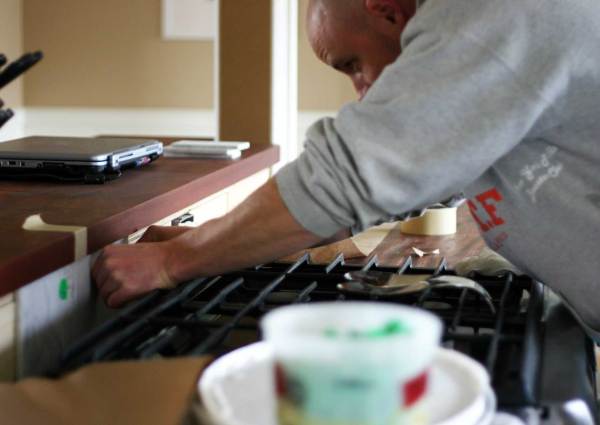
Because our first four tiles tuck behind the stove, we decided to leave them the full 6 by 6.  Then Ben measured each opening, cutting one tile per side, installing, then measuring for the next.

I’m guessing the marble tile cuts like a hot knife through butta because Ben made very nice detail cuts, like these around the outlets.

And he joked the he’ll start carving chess pieces from marble when we finish the house.  Here’s another shot of the tile behind the stove.  Once it’s pushed back in place, it won’t look any different.

Bright and pretty, just the way I like ’em.

Now that we’ve gotten the little ‘splash out of the way, let’s get to the main event; the back splash behind the sink.  Our starting process was similar, but Ben had some cutting to do first.  We agreed the first full row of tile should start at the counter, so Ben had to cut pieces to fit in the lower sink area.
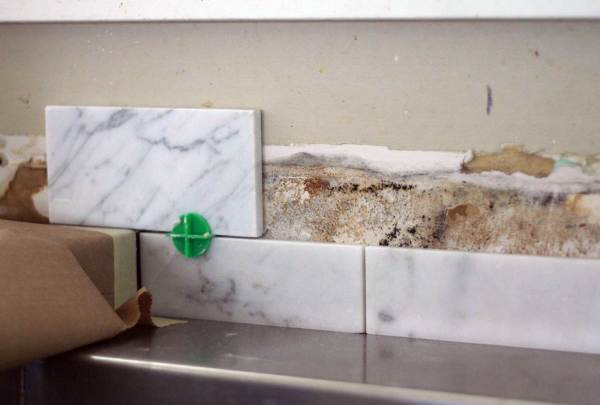
Thanks old back splash for leaving so much ugly junk behind.  That’s why water and particle board are a bad combo.

With the sink row cut, things went up really quickly because Ben installed the full tiles, then moved to the smaller, detailed pieces.  Here’s a little space under the window sill.
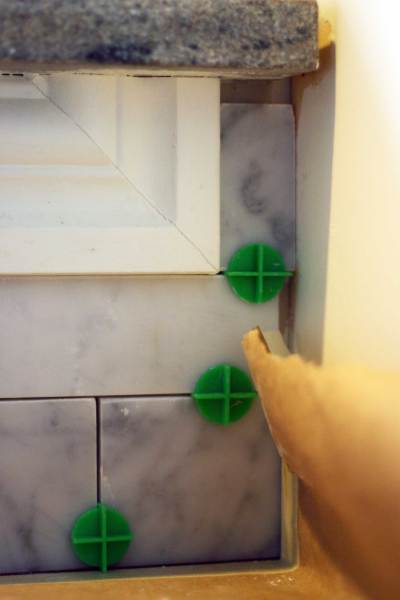
And after, with the tiny pieces stuck forever.
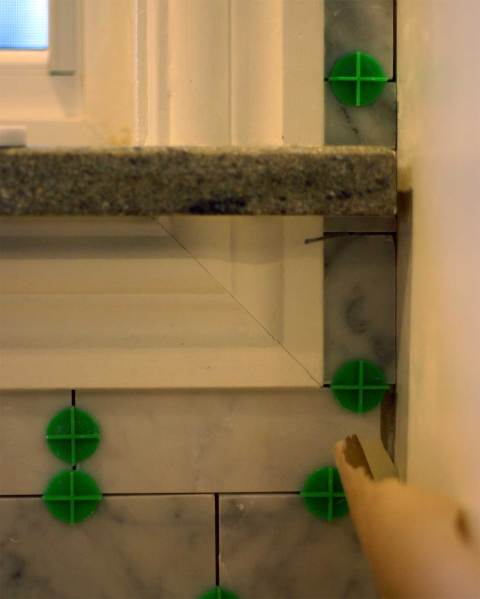
Tons of one inch pieces on each side of the window and we made it to the top.

Instead of back buttering each tile for the part above the window, Ben spread the mastic on the wall.

Putting in some of the final cut pieces.
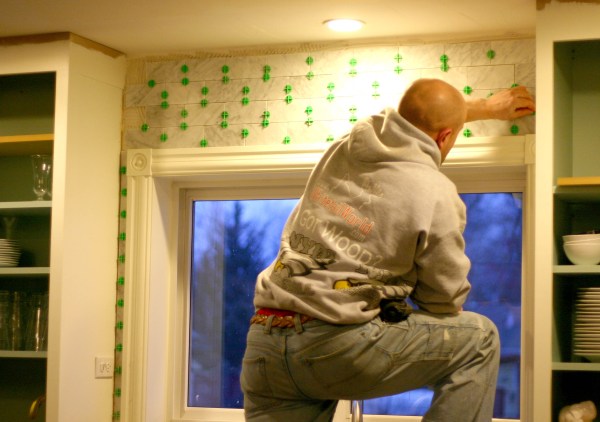
Because we’re putting crown moulding along the tops of the cabinets, we decided we’ll continue the crown across the front of the marble, covering the gap near the ceiling.
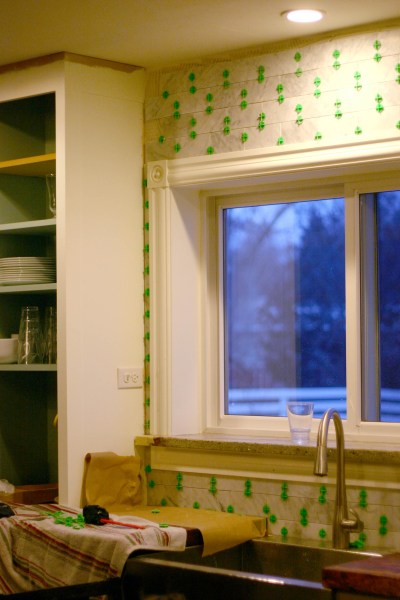
Before going to work the next morning, Ben pulled the spacers so I woke up to this pretty wall ‘o tile.
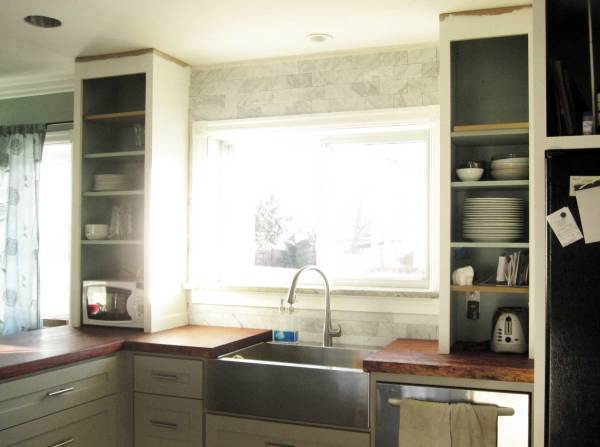
Pretend all the shelves are painted and we’ve got crown at the top, okay?  Oh, and pretend we’ve got doors on the upper cabinets, too.

Is it wrong that I want to stare at it all day?  Maybe I’m turning into a tile stalker.

The blue-gray works so well with the stainless, gray cabinets, and the warm wood counters.  Which is why I love this shot.
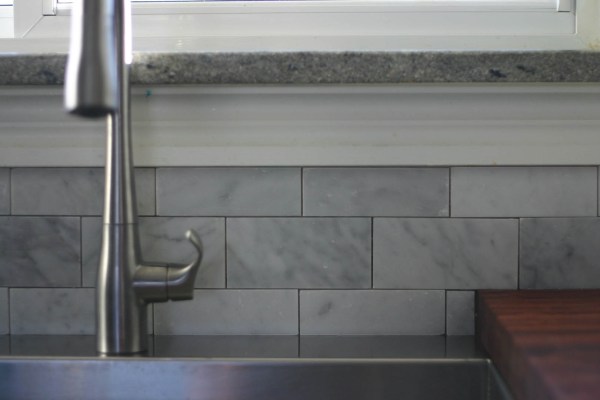
Just a detail shot of the cuts around the sink.

Now, a before and after for added drama.  Before:

After:

Ahh, the magic of the internet.

What do you think?  I’m in love.  Like seriously, in. love.  I’m just visualizing this shot with trim and doors and I have a dopey, just-fallen-in-love smile on my face.

Of course we still have to grout the tile, so we’ll be back to share more info on the install and pictures when we’re done.


Giddy Gallery Wall

I’ll admit, Goodwill shopping wasn’t the only thing Jen and I did together while in Minnesota.  Before heading to Goodwill for the meet up, Jen stopped by my sister’s new house to help with a gallery wall.  Ash wanted us to work on her master bedroom, requesting an asymmetrical gallery wall above these two chairs.

I cut mats and framed the art she already had the night before.  When Jen arrived, she and I started arranging the frames on the floor.  That’s tip number one if you’re planning your own gallery wall.  Lay the frames, with art inside, on the floor to arrange and rearrange until you like the layout.  Before hanging, take a picture of the arrangement for reference as you go along.  From there, you can go about hanging two ways.

The most fool-proof method is tracing the frames on paper, taping the templates to the wall, nailing through the paper and then hanging the frames like we did for our basement gallery wall.  We didn’t do this.  My sister loves free form designs, so we started by hanging the largest frames at the center of the group and working our way out.  Which brings me to my second tip; arrange the largest frames first then fill in with smaller frames.

Armed with a layout Jen and I loved, I eyeballed the placement, asking Jen to stand back and tell me that she thought.  Then, started hammering nails and hanging frames.

Because I wasn’t measuring or using templates, the spacing is slightly different.  Spacing the frames one to two inches apart keeps the grouping of mismatched art and frames unified.  In my opinion this is the biggest mistake made when hanging a group of mismatched frames.  The spacing is crucial to make the arrangement look thought out and planned.  If gaps are four inches or more, it looks like frames were thrown up at different times, so keep the group tight.
A little under an hour later, arranging, chit-chat, hanging, and adjusting included, we finished the gallery wall.  If you’re working on a gallery wall above a piece of furniture, incorporate it in the layout.  See how the center frames dip down toward the lower table?  Not only does that add interest, but working around furniture gives your layout definition.
As you can see, the art in the frames is a variety, but most have a natural element.
Wondering where Ash got the art?  Check out these Etsy shops: Mai Autumn, Siiso, Miles of Light, and our shop, Our Humble A{Bowe}d.
Vincent and Everett painted the abstract watercolors.  See, even kids paintings can look like real art behind a classic white mat and glass.
After completing the wall, we invited Ashley back in to see what we’d done.  Luckily, she loved the layout and that she could build on the design in the future.
For the back row, here are my tips and tricks to create a gallery wall:
  • Arrange the frames on the floor or make templates to move things around before you start pounding holes in your walls.
  • Start with larger frames then fill in with smaller items.
  • Don’t leave too much space between frames.  1 to 2 inches is perfect.
  • Use the same colored frames to unify different styles.  And mats make anything look like art.
  • If hanging by or around a piece of furniture, arrange the frames to follow the furniture silhouette.

That’s the way the cookie crumbles.  I had so much fun chatting with Jen, and I think she even learned a few tricks and tips.

P.S.  One of my 2012 resolutions is enjoying more family fun events and sharing them.  Check out our newest blog and latest adventure.