The Guests Are Coming!

In a few weeks.  But I got in a mood to clear things out, so I focused on the basement.  Last time you saw it, we literally had dropped unnecessary crap stuff down there.

I’d like to say it got better, but it didn’t.  We just added more to the room.  Like 45 sheets of foam insulation.

I can’t move the insulation, but I can organize things and put some of it in a better place.  Like the trash, er, under the stairs.  Yes, the stairs sound much better.  I’d hate to have to part with any of my junk.  Shuffling things around, condensing like items to a single box, and moving it under the stairs took about an hour.  And we have room to flop the two king mattresses on the floor for our guests.  Lap of luxury, I tell ya.

Bulky and heavy items are around the corner because I could barely drag them on my own, let alone across the basement.

Fueled by my desire to condense boxes, I pulled a few boxes of frames up to the main level to get some art on the wall.  First on my list, add some art to the boys’ bedroom.  This big blank wall needed some attention.  Because I can’t paint yet (we’ve got to remove the popcorn ceiling and install new trim first) I decided to hang some art.

Having several boxes of art to choose from, I picked my favorites and started hanging.  I didn’t put too much thought into the placement, just held things up and nailed it in place if I liked it.  It’s not necessarily the best way, but I can always fill the holes when we decide to paint, so I had nothing to lose.  Because this was a ‘slap something on the wall to get it out of a box and make it look like we live here’ effort, I used an easy hanging method.  First, hold the picture up to the wall.

Use a pencil to mark a small line across the top of the frame, and another small tick mark to show the rough center.

Measure the distance from the top of the frame to the hook.  I found it easiest to use a ruler for this part.

Make another mark on the wall, measuring down from your original set.

Erase your top set, pound a nail in the lower mark, and hang your picture.

The less measuring I have to do, the better.  And I didn’t have to make templates, which is nice, too.  Keeping the frames up helped me figure out what I wanted where, while seeing it in relation to the other frames in the group.

And here it is now.

I’ve got to get a pack of Command adhesive strips to prevent Everett from pulling the frames closest to his crib down.  I did strategically place the non glass fronted frames closest to him for safety.

I didn’t stop there.  Armed with another box ‘o frames, I moved down the hall to work on our family gallery wall.  Same process, but I couldn’t hang two frames because we’ll have to take down the ugly sconce.

Sconces are abundant in this house and I’d be happy if we got rid of 90% of them.  A few larger pieces of art adorn the walls, too.  The Savannah cut out map is temporarily in the living room.

I’m working on our city map right now for a matching set.  Of course I’ll have to get a set of frames to go with, but I think the pair will make a nice addition to the empty dining room on either side of the French door.  My sense of size must be off in this house, because all the ‘big’ art from our first house looks tiny here.  Looks like I’ve got plenty of crafting and painting to do.

Have you added art to your walls recently?  A gallery wall maybe?  Large pieces?  Maybe you’ve cleaned out your basement, too?  Let’s share our successes.

Stone Cold

Here’s the much requested stone counter cutting post.  Let’s dive in.  Well, not literally because smashing your head into the counter doesn’t sound like fun.

To cut your own stone counter top, you’ll need:

  • A skill saw with diamond blade
  • A right angle grinder with diamond blade and stone polishing pads
  • Clamps
  • A straight edge
  • A hose with running water
  • A GFI protected outlet
  • Saw horses or another system to hold the stone up
  • Protective gear for eyes, ears, mouth, and nose

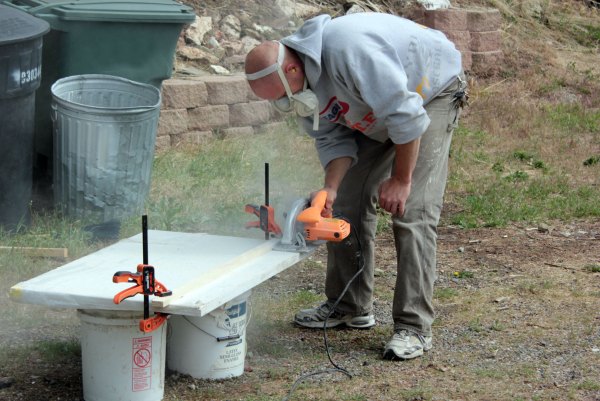
Now you know the ingredients, let’s get to the instructions.  If you need to cut length off your stone, first mark where you want to cut.  Then, measure the guard of your skill saw.  Clamp a straight edge factoring in the width of your guard.

While wearing protective gear, slowly and carefully cut along your guide.

Now you’re ready to start polishing.  Ben asked the local granite companies for their used polishing pads, so ours were free.  To get a new set, check the link above or search ‘granite polishing pads’ to find a better deal.  Here’s what the pads look like:

For a polished finish, the pads work best wet.  Ben clamps a slow running hose to the counter top to let the water trickle over the edge.  Remember, electricity and water are not friends!  Plug your grinder in a GFI protected outlet and keep your plugs out of the water.  Use extreme caution.  Then sand the edges just like you would with a normal sander on wood.  Keep it moving to avoid gouges and slightly round the edge for a factory-finished look.

Polishing didn’t take nearly as long as cutting the sink hole did.  Ben only uses drop in sinks so he doesn’t have to have a nice looking cut, just a place for the sink to go in.  Use the sink template to mark the cut lines.

Take the polishing pad off the grinder and replace it with a diamond blade.

Plunge cut the sink hole slowly and carefully.  You won’t be able to cut through with one pass.  Slow and steady on this.  Clean the dust and water off and you’ve made yourself a stone counter top.

The polished eased edge looks just as good as the granite company, too.

What do you think?  Are you willing to try this at home?  What is your favorite type of counter top?  Granite?  Marble?  Concrete?

Disclaimer:  If you are not comfortable using this equipment, don’t try this.  Use caution and always wear safety gear.  This is an overview tutorial and we cannot be held responsible for injuries.  

Dog Bed

Here’s a super quick, cheap, and easy dog bed.  All you need is a set of standard pillows and pillowcases.

Sewing machine optional, but it makes this quicker.  I promise, those of you afraid of a sewing machine can do it, one straight line is all it takes.  Just pin the pillowcases together along one edge.

I put my factory sewn edges together, but it’s up to you.  Then stitch a straight line 1/2 inch from the edge, all the way down the case.  Put a pillow in each case and you’ve got a dog bed.  I bought new pillowcases for ten bucks at Target and used old pillows we already had.  If you’re buying all new supplies it would cost around $20.  Not too shabby, especially because this is super easy to wash.  Here’s Miss Priss enjoying her comfortable new spot.

If you don’t have a dog, your kids might like this for slumber parties or lounging around.  Just after I stuffed the pillows in, both V and E flopped down, staking their claim.  I might have to make another…

What kind of dog bed do you have?

Earn Your Stripes

I know, I know.  Stripes are a huge trend and I’m the last to jump on board.  But I love the look, so I did it.  Back when we made the offer on the mountain house, I immediately thought of a green wall color with white and gray striped curtains in the boys’ bedroom.  Green because it’s V and E’s favorite color.  And stripes because they’re bold without being girly.  You saw my 20 yard pile of fabric on Monday, and I’m happy to say we’ve got hanging curtains as of last night.

For the past week, we’ve lived with white mini blinds and old hardware from vertical blinds.

The blinds blocked some of the incoming light, but not enough to let the boys sleep past 6:30.  I love curtains, the look, function, and ease, so I decided to make blackout curtains, hoping for precious sleep.  I bought 10 yards of white blackout liner and 10 yards of a plain cotton liner to use as my curtain.  Joann had drapery fabric on 50% off sale, so the blackout cost $3.49 per yard and the cotton liner was $3.99 per yard for a total of $74.80 for four 54 inch wide floor to ceiling panels.  To get started on my sewing endeavor, I first cut the fabric into 7 foot 4 inch lengths.  Once I had four of each fabric, I pinned the manufacturer straight lines together.

Using a known straight edge helped me keep the curtain panels as square as possible.  After I smoothed out the fabric, I rolled my long edges over twice, keeping a one inch margin, to make a clean back edge.

I did this to all four sides, then started sewing.  And sewing.  And sewing.  I was the energizer bunny of the sewing world that day.  Two Everett naps later, I had my four panels ready for ribbon.  Most often, I make a rod pocket when I sew curtains.  But the thick blackout fabric doesn’t bunch much when pulled to the side, so I needed to fix that.  Curtain clips are an option, but I’m too cheap to spend 28 bucks (four packages at $7 each).  Instead, I used white grosgrain ribbon I already had in my stash, not to be confused with a ‘stache; I don’t have that kind.  I cut my ribbon into 6 inch lengths, then pinned the edges over twice to prevent fraying and to add strength.  Five ribbon loops per panel was perfect for my hefty fabric.

One ribbon loop on either end of each panel first, pinning in the corners.

To place my other three, I skipped measuring and folded my fabric in half, marking center with a pin.

Pin first, then sew three strips, the first forward, second in reverse, and last forward.

With those ribbon loops, the curtains became functional.  Finally time for the fun part.  After folding the edges over twice, my 7 foot 4 inch panels became 7 foot panels, which is perfect for 12 inch wide stripes.  A yard stick made quick work of marking my stripes.  Starting from the top of each to make sure the stripes lined up, I made tick marks at each foot.  Just a light line and I started edging with my paint.  Then I realized my paint dried too quickly and it was going to take an eternity this way.  I busted out a roll of plain masking tape and tested the crispness of the line it made.  Lucky for me, the tape worked perfectly.  So I started using the tape for a crisp paint line, running it along my pencil line.

To ensure a tight seal, I used the end of my paint can opener to really press the tape down.

To get my gray stripes, I used a can of Pewter Tankard, left over from painting the inside of the drawers of our first home’s kitchen.  While at Joann buying fabric, I looked at Fabric Medium.  I decided against using it for a few reasons.  1.  I needed a one to two ratio of medium to paint.  2.  Each 2 ounce bottle cost $2.99 and I’d probably need 4 or more bottles.  3.  I’m painting curtains, so a rough texture won’t be a problem.  No one is sitting or sleeping on it.  So I started painting with my plain latex paint and a brush.  Pouncing along the tape line helps prevent paint bleeding, too.

Working in one foot sections, I edged along the tape, then quickly filled in working from the edge toward the center.  It took about 4 hours to tape and paint twelve stripes (three on each panel).  Vincent and Everett colored near by, occasionally stepping over to see my progress and chat.  I painted two stripes per panel, moved them to the floor to dry and started on the next.  I worked through the panels until my first dried and I painted the last stripe.

I finished painting and remembered I couldn’t use the curtains that night if I didn’t have rods to hang them on.  Originally I wanted to use galvanized plumbing, but parts were more expensive than I anticipated.  Each fixed five foot rod would cost about 30 bucks.  Maybe I can find an adjustable curtain rod I liked more under $30.  The boys and I made a Target run, where I found this Umbra rod I liked.  Our Target only had one, so we looked for another simple option.  Then I saw this one with two in stock.  We grabbed them and headed home.

Last night, Ben and I hung the rods after tearing down the old vertical blind systems.  I didn’t bother patching the holes because we don’t have paint to touch up.  That will happen when after scraping the popcorn off and repainting.  Each bracket is 10 inches outside the window trim, allowing the curtains to fully open.  Here are the new striped curtains:

I did some furniture rearranging to make opening and closing the curtains easier.  Neither window is centered on the room, which is annoying.

V’s bed is about 6 inches away from the wall now, and I turned E’s crib, putting the long side along the window wall.

I smile when I walk in there now.  Oh, and the blackout fabric makes the room super dark.  Mission accomplished.  It’s worth mentioning that the painted curtains aren’t soft and supple, but they sure are pretty.  Even Ben thinks they look cool.  That’s saying something!

I really can’t wait to get a few coats of Refined Tan on the walls, but for now the swatch will do.

How about a before and after?

One thing checked off this room’s to do list, about 846 to go.  Are you on board with the stripe trend?  Where have you added stripes to your home?  Which trend are you loving most these days?  Hate the most?

You Say Suspenseful I Say Fenceful

After this post, a lovely reader asked if we could write-up a quick post about our fence and how we made it.  Always happy to answer questions, here it is.

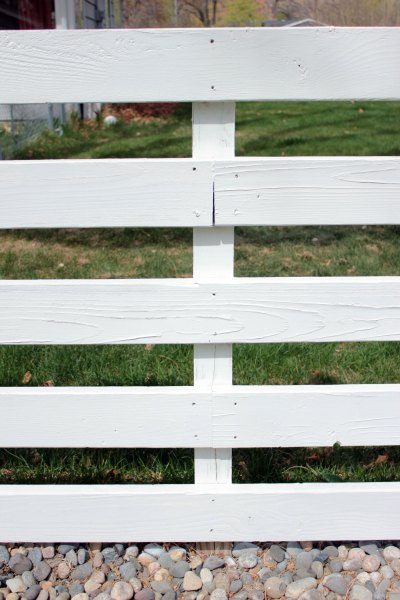
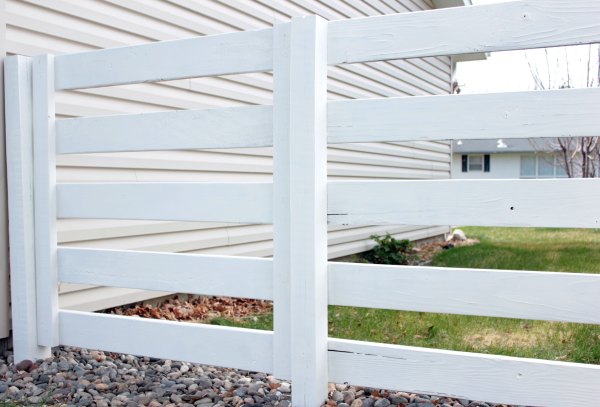
The fence is made up of 4 inch by 4 inch by 8 foot long posts and 2 inch by 6 inch by 16 foot long lumber from Home Depot.  Ben measured eight feet apart, used a post hole digger to make a 4 foot deep hole.  He did this for each post, 22 total on our property.  After setting each post, leaving it 4 feet above ground, we attached the 2 by 6 horizontals.  These are about 4 inches apart, for a total of five high.

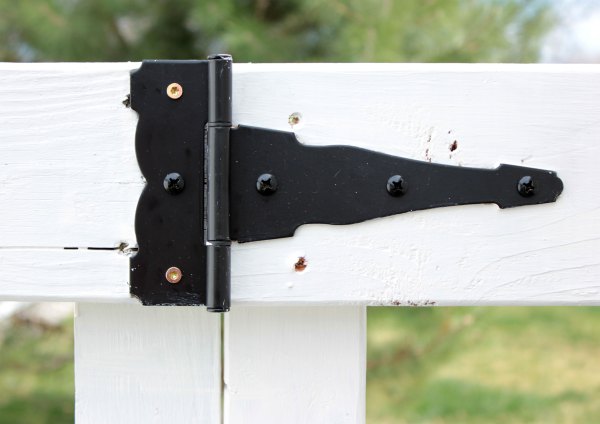
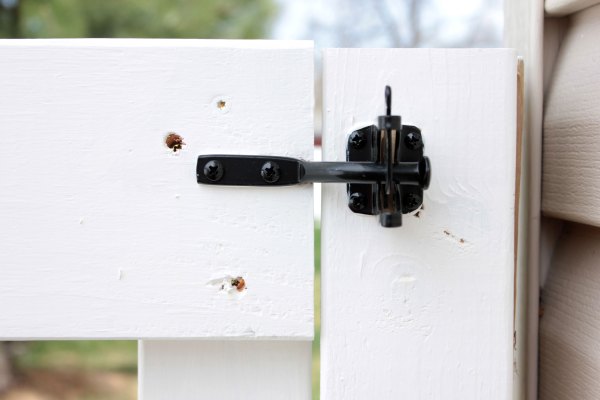
We staggered the seams to keep the fence as strong as possible.  The gate took longer to finish because Ben couldn’t find strong hinges.  But, with the impending closing date looming, we knew it had to happen, sooner than later.  Ben bought a set of hinges and a latch at Home Depot.

To build the gate, Ben cut a 2 by 4 to the match the height of the horizontals.  Then, he screwed five 2 by 6 pieces, keeping the gate square as he went.

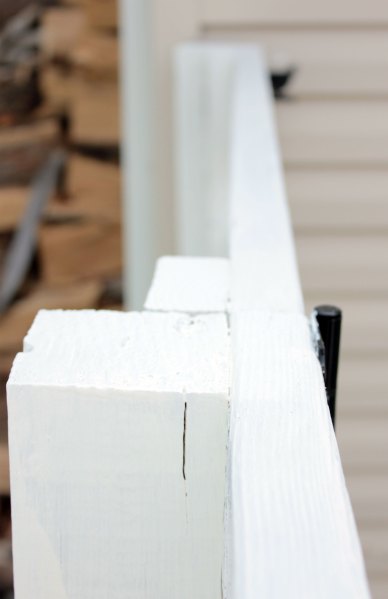
On either side of the gate we have a 4 inch square post and a 2 by 4, which is actually part of the gate.

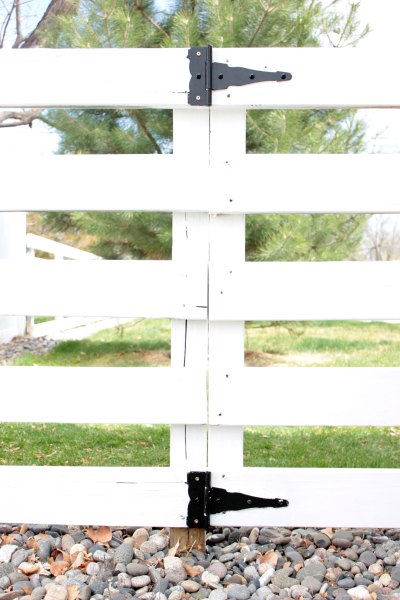
Luckily, the hinges are perfect for the 2 by 6, so Ben installed one at the top and another on the bottom to hold the gate in place.

To protect the fence and keep it looking spiffy, we use Behr’s Solid Color Wood Stain, just like the rest of the fence.  So, that’s the simple fence we have and how to make one yourself.

Previously, we had a chain link fence, which Houdini, I mean Jack escaped from regularly.  We’re happy to report she hasn’t been able to get out of this one.  Also, this style fence can work for smaller dogs by adding 2 by 2 pieces between the 2 by 6s.

What style of fence do you have?  Why did you choose it?  To keep kids and pets in?  To keep neighbors out?