Gray Matter

As we’ve shared, we’ve decided to paint the lower kitchen cabinets a medium grey.  Pewter Tankard by Sherwin Williams because it is warm without being beige.
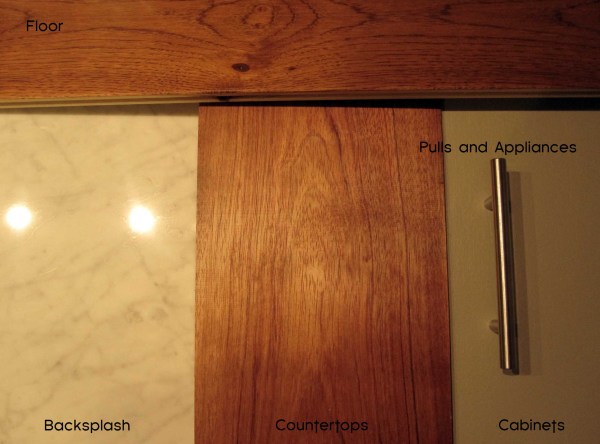
Originally, we thought we’d paint all the cabinets white, just to keep everything light and airy.  Then, we examined the oak cabinets and realized how much grime was actually on the doors.  Partially due to the lack of pulls, but probably more because of two small boys.  So, we decided to paint the lower cabinets grey to disguise the dirt.  We’re also adding sleek drawer pulls.

After installing the face framing, filling the nail holes and joints and sanding smooth I gave everything a coat of primer.

Don’t worry if your primer doesn’t have 100% opaque coverage.  The point is to cover bare material for best paint adhesion and stain blocking.

Then, I finally started painting the cabinets.  For a super durable painted finish, we decided to use Acry-Shield paint by Columbia Paints in an eggshell finish.

Ben used this on exterior doors at the apartment and it has held up wonderfully.  Something super durable also costs more than normal latex paint, and this stuff ain’t cheap at $52.39 per gallon.  We decided to off set the cost by painting a coat of the cheaper Glidden before the Acry-Shield.  That, and we still have two gallons of Glidden paint left over from the drawers.
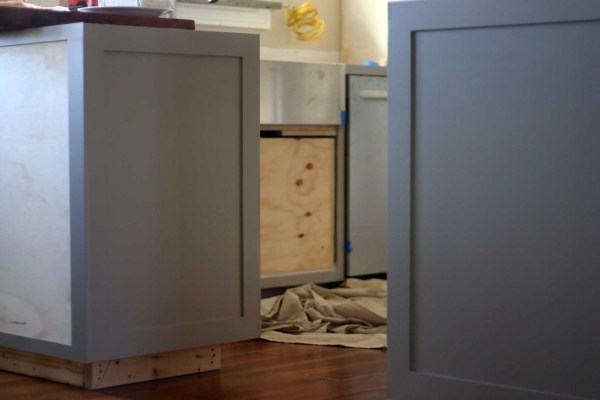
We considered spraying the cabinets before installing, but decided against it because we wanted to add the face framing after for the smoothest finish possible.  And  we should be able to touch up the rolled finish down the road without it being obvious.
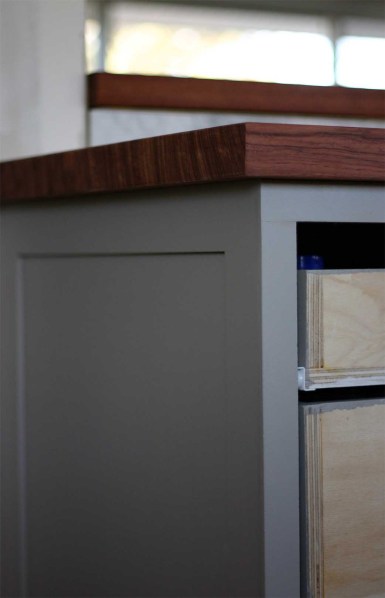
For the record, I love the way the gray cabinets and red toned wood counters look together.  Haa-taa.

Even though we opted for a rolled finish, we still wanted it to look as professional as possible.  To get the smoothest finish, I worked in small sections using a good quality paint brush (we prefer Purdy) to get along the edge of the counter tops and the box detailing.  Right after using the brush, I follow up with a foam roller barely covered in paint.  Glidden paint goes on nicely and has a reasonably long working window.

After painting a coat of cheaper paint as a ‘tinted primer’ I started with the good stuff.  Actually, I tried, but it had a layer of gunk at the bottom that I couldn’t get to mix in.

I took a trip to the paint store and they replaced my old gallon of paint with a new, clump free can.  Back at home, I painted a thin and even coat of Acry-Shield.  It was a slight learning curve.  The paint is slightly thicker and dries a littler faster.  To counter this, I worked in smaller sections and made sure to go over the brushed areas well with the roller.
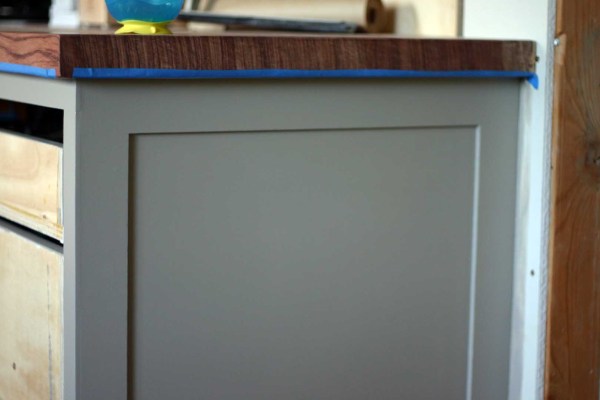
The color matched the Glidden paint perfectly, too.
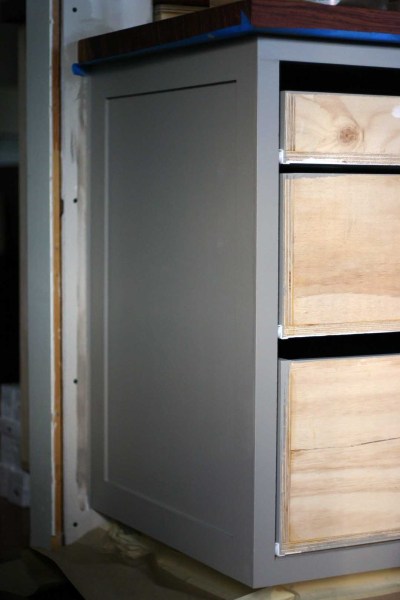
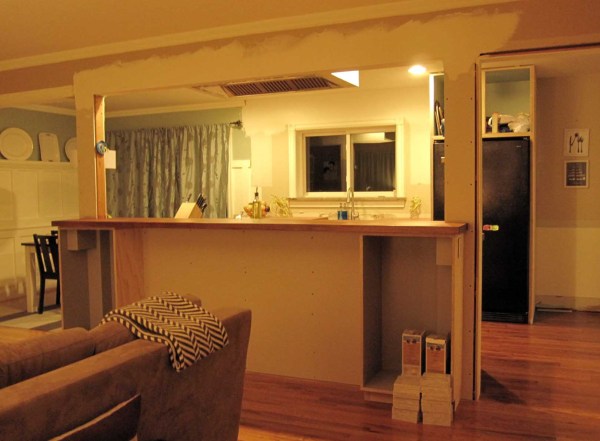
Here’s what our kitchen currently looks like:
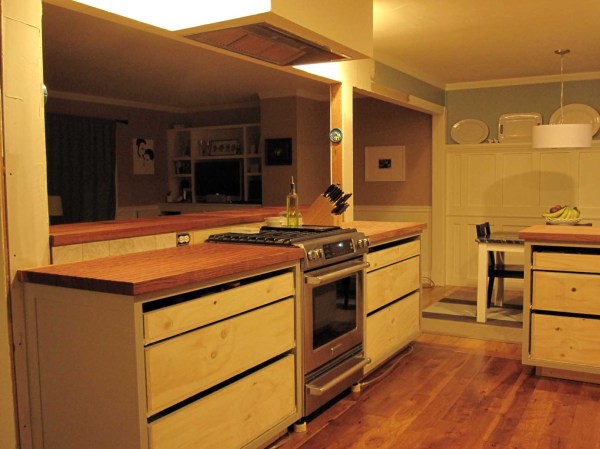
Sorry for the off colored photos.  It gets dark far too early for my liking these days.

You can see our stash of tile and sconces.

I’m glad to be done with that part of painting, but there’s still tons more in my future.  Gotta paint all the drawer and door fronts once they’ve been built (20 drawers and 8 cabinet doors).  And I’ll have to paint the giant refrigerator case.

Floor Plan, Finally!

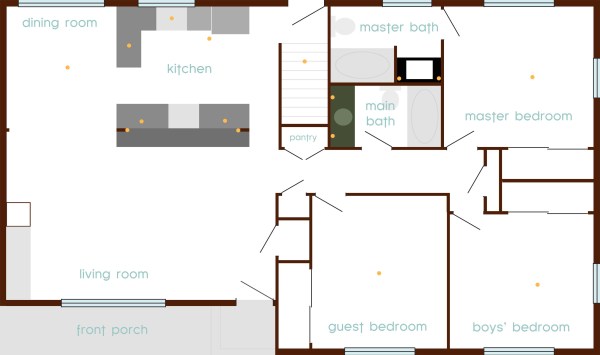
In the 51 year history of our house, we’re only the second owners.  The old couple before us had the house built in 1960.  We’re fortunate enough that they left a few pictures and the original, hand drawn floor plans.  Because we’ve had a few requests to add a floor plan, I thought it would be fun to show you a few pictures of the original layout.  First, here’s the kitchen:

The sink, stove top, and refrigerator are roughly in the same place, but you can see there was a wall oven on the left side by the stove.  Where our peninsula now sits formerly was a wall with 24 inch deep cabinets.

Originally, our main level consisted of three bedrooms and 1 1/2 baths.

The main bathroom is the same, but we’ve altered the master bathroom by closing off a doorway and removing old duct work.  I know the plans are difficult to read, so I made a few digital versions.  Here’s the floor plan when Ben bought the house.

In 1997 or so, the old owners remodeled the kitchen.  They added a peninsula with cabinets above, but that was kind of the extent.  Before I met Ben, he had already closed off the door to the bathroom by the back door and added a shower.  In 2008, we converted the 3/4 bath to the full bath we have today.

As you already know, we’ve been working on renovating our kitchen, which included knocking down a wall.  Specifically this wall.

With the wall down, the whole living space feels open, airy, and modernized.

Our living room (and kitchen) before knocking down the wall:

And after:

Of course this picture is a few weeks old because we now have the new cabinets and counter tops in.

Counter Productive

Counter productive is actually counter productive in describing the progress we’ve made with the counters this weekend.  In fact, we have every countertop installed.  Of course with wood jokes a plenty.  My favorites, “Don’t hit me with your wood” said to Ben while holding the door open for him.  And Ben asking me if I like his wood.  Yes, yes I do.  Vincent even made an unintentional dirty joke telling Ben he “kissed his back door” while waiting to open the door for him.  Bahaha.  It’s a good thing he has no clue what he said.

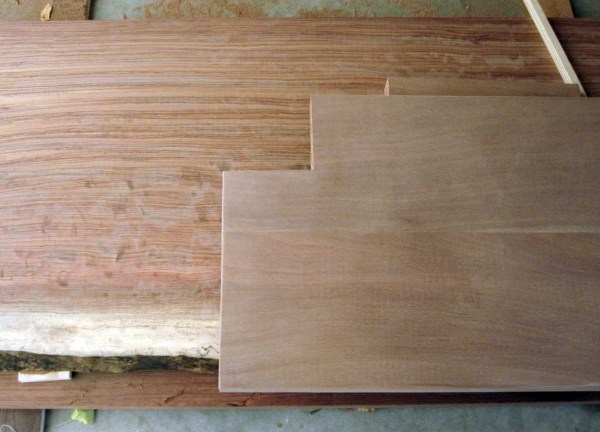
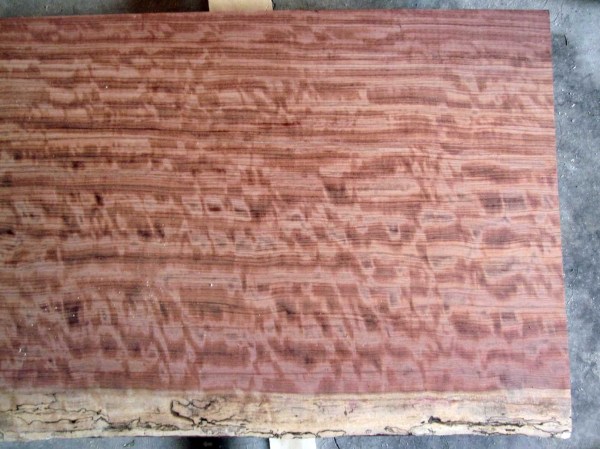
I wish I could say the counter cutting and installation was quick and simple.  In actuality, Ben spent the better part of yesterday (and a few hours on Saturday) working to get er done.  It would have taken a million times longer if Ben hadn’t had the slabs sanded at the cabinet shop on Tuesday.  Speaking of the cabinet shop, Ben picked up the piece for the bar top on Wednesday.  Have a look.

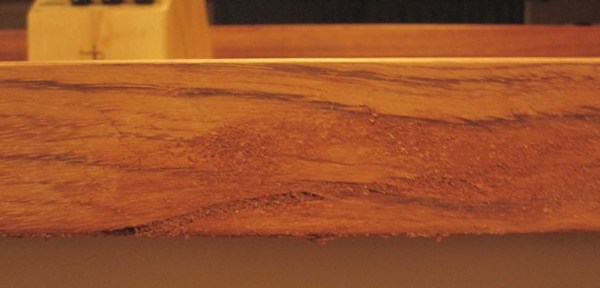
With phase one complete, Ben started phase two, cutting the pieces to size.  I took the picture above after Ben had started cutting the bar top, but you can really see the difference of grain.  Because Ben is so awesome, he was able to get the bar  top in on Saturday night.

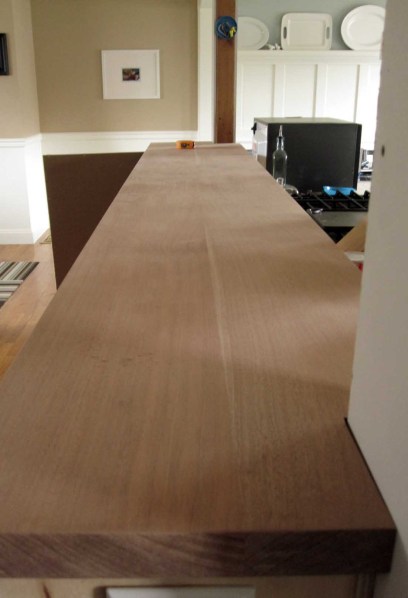
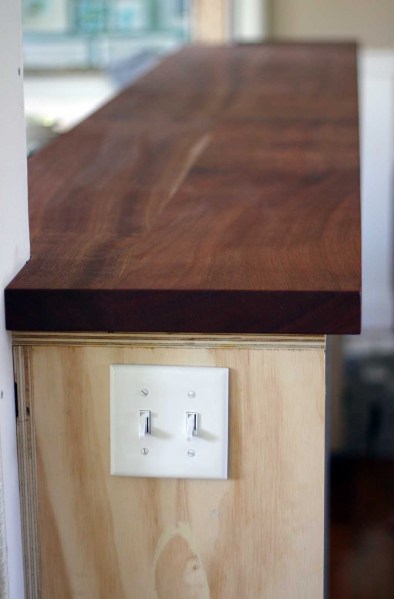
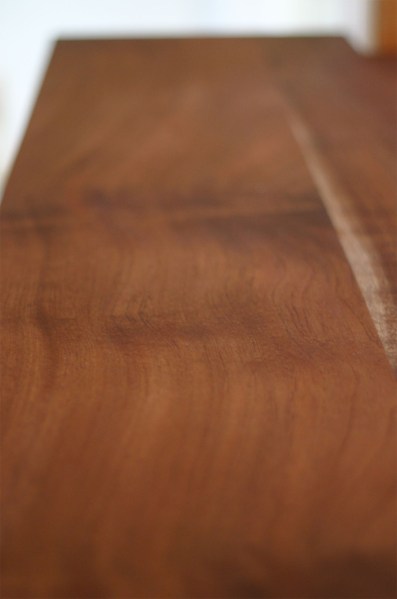
You can bet we wasted no time oiling that baby up.  And it’s amazing how different Sappelle looks with a coat of oil.

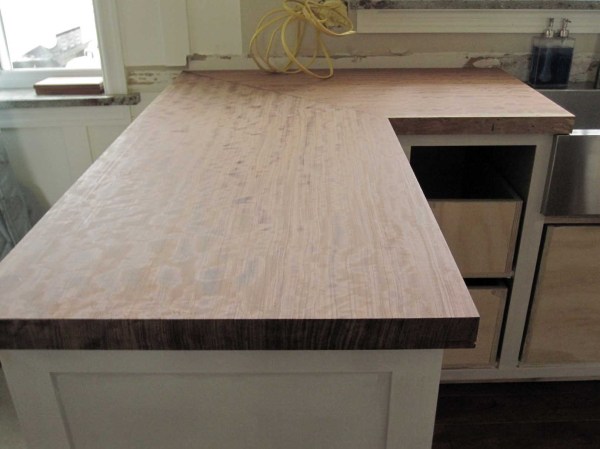
I love how much character the oil brings out.  And how rich the tone is.

There are a few knots, which look great and add tons of character.

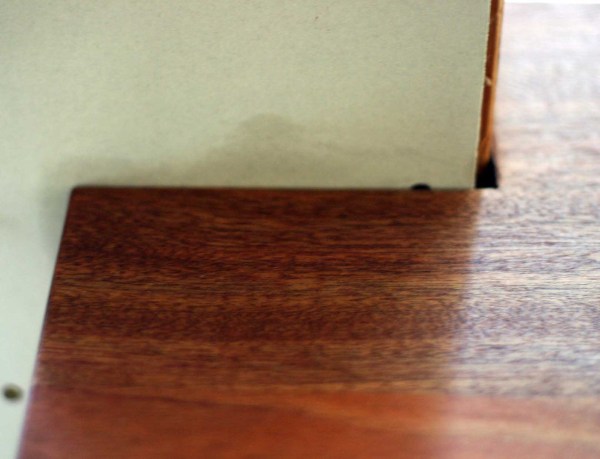
The cuts around the post are snug, which is perfect because some of it will be visible even after installing the trim.

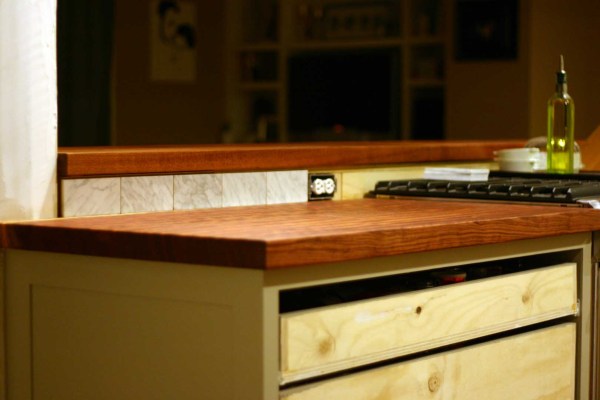
And here she is now, patiently awaiting bar stools to complete the look.

Ben worried most about the 45 degree angle he had to cut for the peninsula seam.  He cut the long side, brought it in to check the angle.

Luckily, it was perfect, so he brought in the adjoining piece.

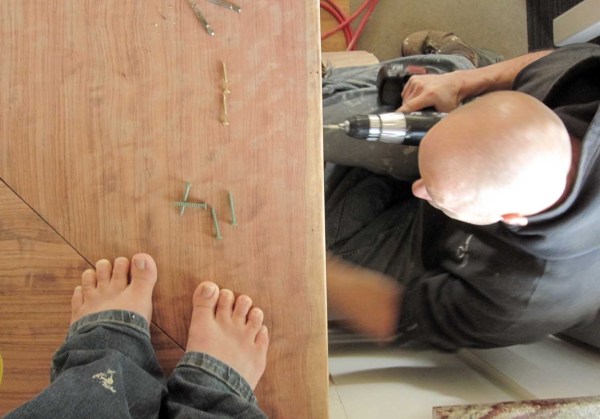
He secured the small piece next to the sink first using silicone caulking along the sink seam.  This piece was the first to go in because we wanted the line against the sink to be straight.  If we had installed the larger piece of the peninsula first, it could have shifted the smaller slab.  Ben did have a slight problem when screwing it in.  Bubinga is a hard wood, which is the reason we chose it for our counters.  Because it is so dense, a few screws snapped off.  To help this, Ben drilled pilot holes with the wood in place, going through the cabinet top and into the counter.  I had the task of standing on a slightly bowed seam to keep the joints flush.

(Don’t mock my Flintstones feet.)  While I was up there, I thought I’d give you a never before seen and probably never will see again angle of the kitchen, with living room and front door beyond.  We hadn’t finished the pieces by the range.

Ben moved onto install the rest of the tops.  The piece above the dishwasher went in the same as the angled chunk to the left.

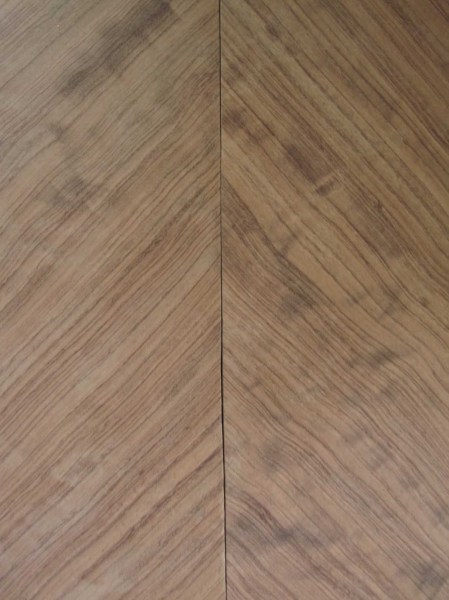
With the two pieces securely in their new home, we worked to fill the slight gap.

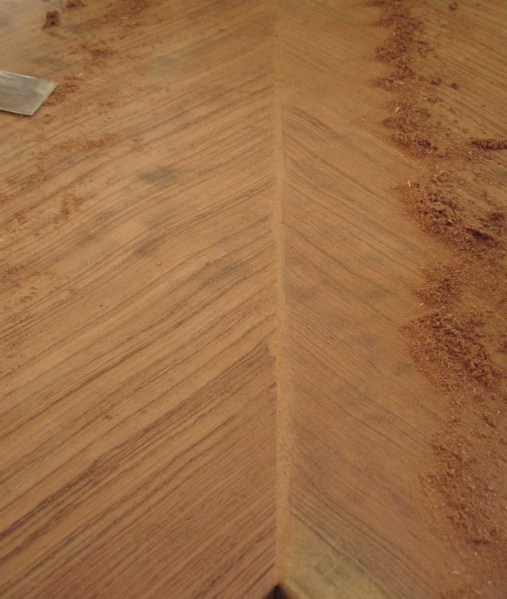
We wanted the filler to be as close of a match as possible, to keep the seam from being noticed.  The guy at the cabinet shop told Ben they usually make their filler out of sawdust and super glue.  We spread some glue into the crack (haha) and sprinkled saw dust over the top, pressing in place.

While it was still wet, we started scraping the excess off and lightly sanded it.

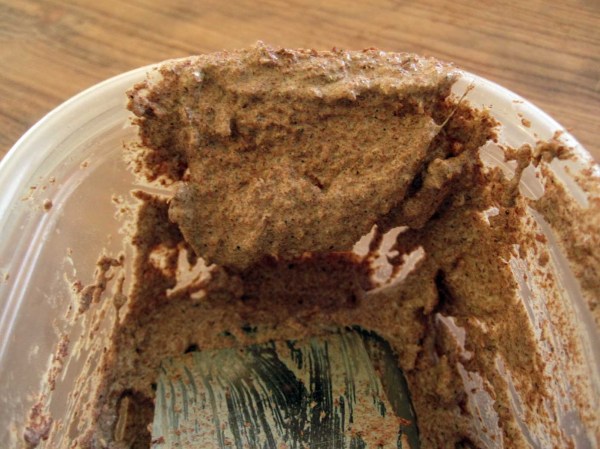
Still not happy with it, so I mixed wood glue and more sawdust in a container until it had a peanut butter like consistency.

A few other pieces had small cracks where the wood had split while drying.  We tested the glue/sawdust mixture here.  Once it’s sanded down, it should blend in nicely.

So, folks at home.  If you need a special colored wood filler, try making your own.

We’re still waiting for filler to dry, which we’ll sand and may have to give another coat before we can oil the tops.  The only piece that didn’t have any areas to fill was this one on the left side of the stove.  Pretty, huh?

But we couldn’t wait until the rest were ready for oil.  Just like the bar top, the oil enhanced so much of the grain and darkened up the color.  The wood absorbed the oil differently.  I think the darker areas are softer, so they drink the oil up quicker.

Once absorbed completely, the finish is even and pretty.  I couldn’t resist putting a few marble tiles against it.

The colors of the counters and bar top are very similar, despite coming from two different species of trees.

This was a huge item crossed off the to do list.

  • Install the new dishwasher.
  • Sand the ceiling and walls smooth
  • Build the five remaining drawers we’ve waited on (we needed to see how things were in place before we could build one drawer in the dining room, the trash can pull out, and the under the sink drawer)
  • Fill, sand, prime and paint said drawers
  • Install every drawer, 16 total
  • Buy the wood for the counters.  
  • Haul the wood slabs to a cabinet shop to have them sand both sides smooth
  • Cut the wood to fit and install the counters
  • Hang the upper cabinets
  • Add decorative face trim to all cabinets for a smooth, pretty, even front
  • Fill, sand, prime, and paint all cabinet faces
  • Build the drawer and cabinet fronts, including two glass front doors
  • More filling, sanding, priming, and painting of the cabinet fronts
  • Install the drawer fronts and hardware pulls
  • Prime and paint the kitchen and living room.  Probably the dining room too.
  • Add lights: sconces, recessed light halos, and the rope lighting
  • Trim out the posts and door frames
  • Add crown molding to the top of the cabinets
  • Decide whether we want to add decorative trim to the vent hood or paint it to match the wall color
  • Install the pretty new marble tile backsplash
  • Put everything back in place and enjoy
We’ll share more pictures and details once we’ve filled, sanded, and oiled everything.
What did you do this weekend?  Have you ever made your own wood filler?  Installed your own counter tops?  Do you get school girl for Justin Bieber excited over home improvement projects?

You Got the Light Stuff, Baby

All you NKOTB fans, that was for you.  For all you light fans reading this, the rest of this post is for you.

Before we started tearing apart our kitchen, we had a single boob light fixture in the center of the room, a recessed can over the sink, and a lame light in our vent hood.

The light in the center cast shadows and didn’t properly light a room in which wielding knives is an everyday occurrence.  So with the soffiting gone-zo, we installed four recessed can lights, each centered over a work area.  One on either side of the stove, another over the peninsula, and one over the dishwasher.  Three halogen lights are built-in our vent hood, so we have plenty of task lighting over the stove.

I had dreams of pretty pendants, specifically these, over the sink and the bar top.

Sadly, that couldn’t happen.  Remember the off centered sink?  Pretty sure a pendant centered over the sink, but not on the window wouldn’t look so great.  Neither would a pendant centered on the window but not over the sink.  That and the pitch of our roof doesn’t allow a larger box that close to the exterior.  So we’re going with a small recessed can over the sink.

But we can still have two or three pendants over the bar top, right?  Wrong.  For some unknown reason, I hoped we’d have enough space below the header to install pendant lights.  Ben built the header to match the dining room, which is made of two by twelves with sheet rock over.

Of course structural integrity is priority over pretty lights.  No pendants for this kitchen, but we need a way to light the new bar.  And I still want pretty lights somewhere in the kitchen.  We settled on pendant lights on the posts and the search began.  True to form, my requirements are based on looks and price.  Pretty yet sleek design, a combination of silver (whether brushed or polished) and glass, has to be 4.25 inches or narrower, and of course, the cheaper the better.

An online search yielded three favorites, all from Home Depot.  First, this frosted glass brushed nickel combo for $37.61.


Then this brushed nickel swivel light for $84.60 each.

I would have rotated it 90 degrees to pivot up and down.  Finally, this nickel and glass beauty for $38.16.

Ben and I agreed that this one was our favorite, so I called our local store to check the availability and they don’t carry this one.  Boo.

Then fate stepped in.  While at Home Depot to buy marble tile for the back splash and a few other kitchen essentials, we took a stroll down the lighting department.  We found sconces we loved for $34.97 a piece.  Apparently these weren’t listed on Home Depot’s website.  But they’re Hampton Bay chrome and glass sconces.

We’re waiting to install the sconces until we’re finished with the counter tops.  In related news, Ben hates the teal door knobs.

He said, and I quote, ” “It looks like something an old lady dealing with gender issues would like.”  I don’t know exactly what gender issues have to do with anything, but it can’t be a good thing.  I’m guessing he’ll also hate these mercury glass knobs from Anthro.  Ben wants something brushed nickel or stainless to match the drawer handles we’ll use for the lowers.  (We bought a ten pack of identical handles from Lowe’s for $31.50)

After hearing great reviews about Top Knobs, I did some research.  I like this simple brushed nickel knob for $5.20 each.

And these matching pulls for $4.70.

Love the look, don’t love the price tag.  Maybe Ben will like the teal knobs more once he learns six cost only fifteen bucks versus $28.20 for these.  I haven’t seen anything else that pumps my tire.

What about you.  Do you hem and haw over finishing details like lighting and hardware?  To me, lights and hardware are the jewelry of a kitchen.  It makes the outfit special and personal.

Got Wood?

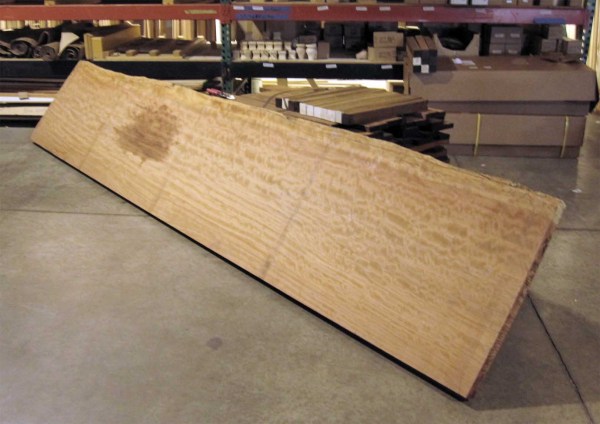
We do.  Big, hard wood.  Lots of it.  (Sorry, Ben’s 15-year-old boy humor has rubbed off on me).  After a week and a half of waiting.  Ben got a call Monday afternoon, but missed it because he was working out.  Yesterday we looked at the slabs and loved what we saw.

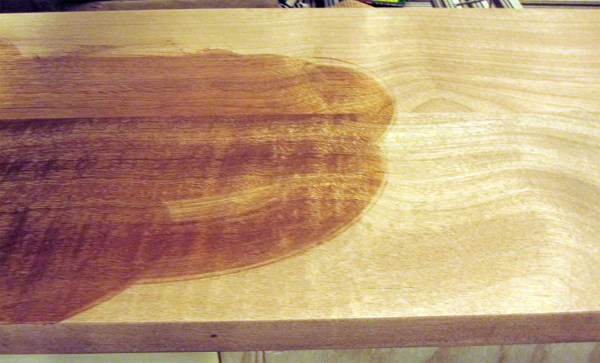
That dark spot is water, but it kind of shows what it will look like when oiled.

While paying for the boards, Ben talked to the clerk about the cabinet shop to do the finishing work.  I guess they refer customers to two shops often, so they delivered the slabs to the shop, free of charge.

Yesterday afternoon Ben went to the shop to help sand everything down to get them ready for install.  He and the shop foreman sanded both sides of the slabs, cut the backs square, squared up the pieces for the bar top and glued them together (more on that in a minute) in about an hour and a half.  The price?  $125, because they did more than we initially agreed on, Ben paid him $160.  And here’s what the Bubinga looks like now.

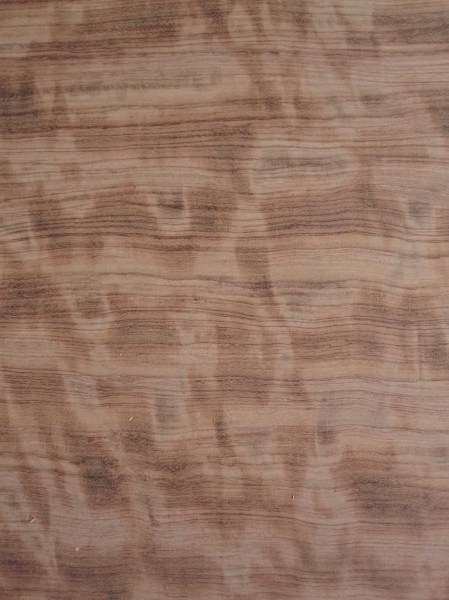
There is a lot of variation in each board.

I can’t wait to see the grain pop once we get oil on it.

One problem though.  We were told each slab would be three feet wide and 11 feet long.  They’re only 27 inches wide, but 13 feet long.  In a way it’s good because we’ll have less waste.  To get cabinet depth counters, we’ll cut two inches off each piece.

The reason the narrower pieces are a problem?  We planned to use the one foot or so wide remnants for the bar top.  Although our counters are only 34 square feet and these pieces have 52 square feet total, the remaining 18 feet are in one large 7 foot by two foot chunk.  And we need a piece twenty inches deep and ten feet long for the bar.  So we also bought two boards of Sappelle (African Walnut).  Each is about ten inches wide and nearly eleven feet long.  Hence the reason the cabinet shop joined the pieces together.  They’re still drying at the shop.  Most likely Ben will pick it up tonight.  Countertop cutting can start soon.

After stopping to check out the wood, the boys and I headed over to Hobby Lobby to look for knobs for the upper cabinets.  Luckily, all hardware is 50% off!  And there’s a lot to choose from.  My mental list of requirements: has to have silver to coördinate with the drawer pulls, glass or metal, not ceramic, must look chic, not cheesy.  Here’s what made the cut.

Faceted glass knobs are always pretty.

But I think they’re a little safe.  I want something fun to add some personality to the neutral space.

Diamond clear glass pulls.  Again, too boring.

These square ones are pretty, but they only come in clear glass.  Boo.

I looooved these pale pink bubble knobs.  Too bad there wasn’t a blue or green or something.

Then, I saw these.

The color is fantastic, the small bubbles and decorative plate add personality.  With 50% off, each knob is $2.50; we need six.  I think they’re perfect for the kitchen, but we’ll have to see what Ben thinks.

Are you on board with the wood counters?  (Pun intended)  Have a favorite door knob?  Often make jokes a teenage boy would?

P.S.  We’re Fresh Faces and today we’re sharing a recap of kitchen progress.