

That’s the second question people would ask right after asking when we’d start working on this space. We knew the pool wasn’t in functioning condition when we bought the house, and hadn’t been for at least a couple of years. The above photo showed the pool from the best angle, below, you can see the corner where the liner had started to pull away from the wall.
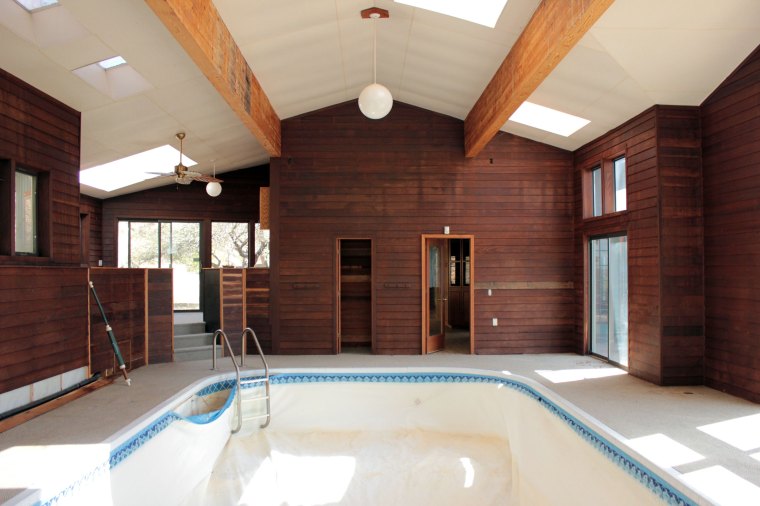
However, neither photo above showed the gross reality lurking just below the frame; several feet of stagnant water that had dripped in from the leaking roof filled the deep end.

Most had been drained, but that moldy green line showed the previous level. Be thankful you can’t see the giant bugs and dead mice. The old liner had seen far better days, thus prompting a tear out removal.

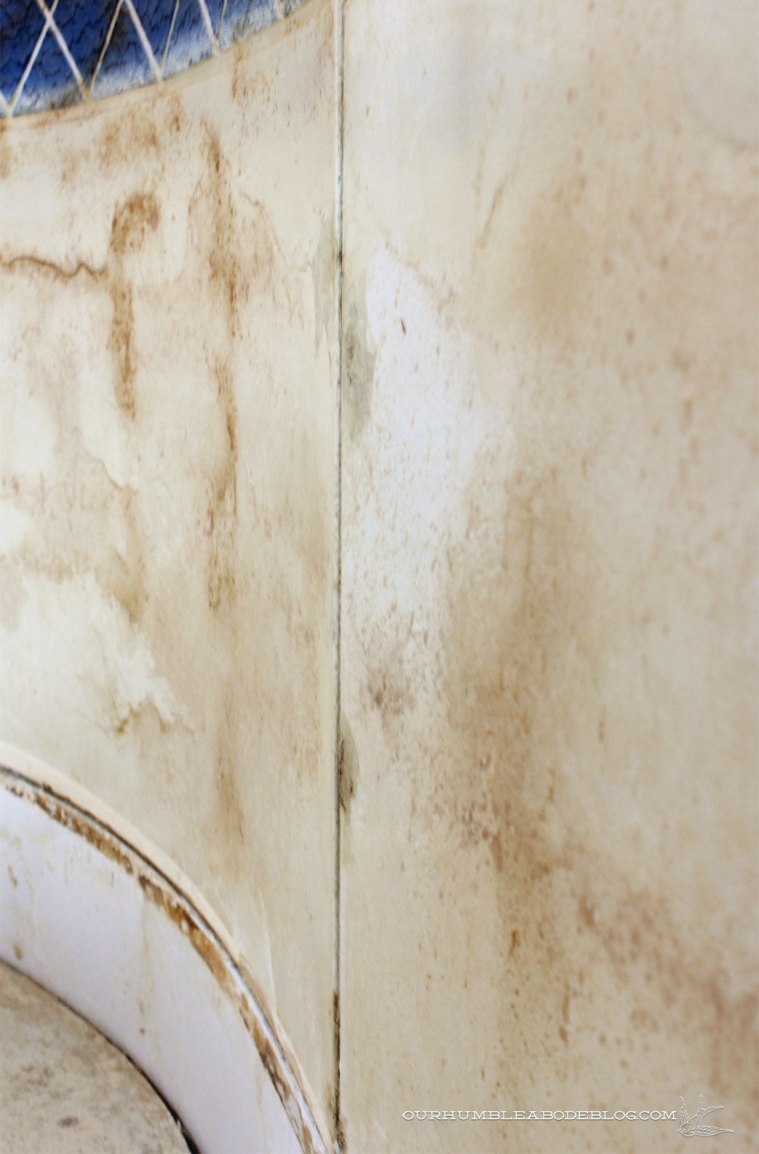
The photo above, taken after removing the liner, better shows the condition of the pool structure. Pools kind of fall into two categories, lined versus unlined. This pool was designed to have a liner, but the original was a partial version and started two and a half feet from the top, leaving the rest exposed.

At the time of replacement, the previous owners chose a full liner, hence the band with screws along the top edge. Based on the gaps between the upper panels, it’s safe to assume the structure settled, panels shifted, and were no longer water tight so a full liner was the best option.
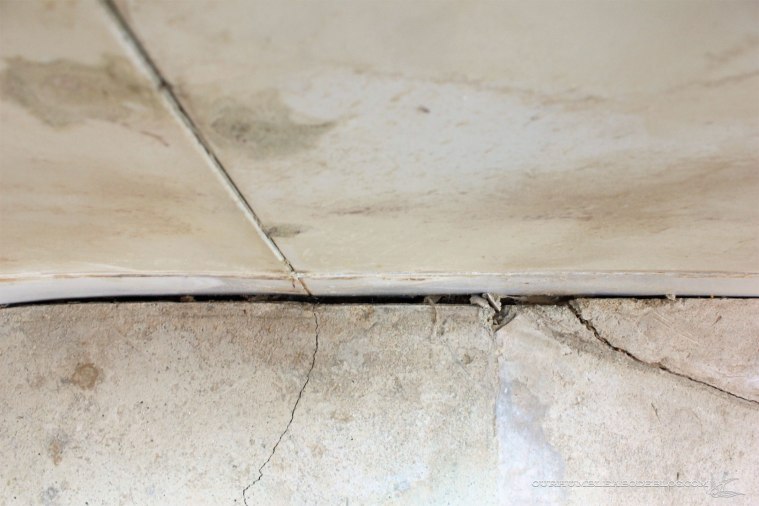
Not only are the side panels a problem, the base of the pool has gaps from the wall.
So, are we actually keeping the pool? It was always our intention to keep the pool, but that hasn’t stopped us from considering alternative uses. Family and friends also like to toss out suggestions-a theater, home gym, etc.
Ultimately, after nearly five years of consideration, nothing has made more sense than a pool. Yes, it clearly needs work to get it functioning, but we can justify it for future use. We’re still figuring out our best route for use and longevity, but a full liner seems to be the best option at this point. The rest of the room will get finished first-ceiling, walls, floors-to keep the pool clean and safe until work finishes.


 Having a ceiling peak of 15 feet, plus a 9 foot deep hole to work over, we needed scaffolding. Rather than renting and spending the same or more money, we built a temporary structure to make working easier. Step 1 of 3,286 complete. Then, Ben tore off the old sheets, exposing the structure. Step 2, check!
 Those exposed beams are such a cool structural element, but the leaking roof had streaked and stained both. A thorough sanding brought them back to life. Steps 3-9, done!
 Once the beams were finished, Ben started prep work to install the tongue and groove pine boards. First, two by 4 boards were secured perpendicular to the trusses followed up by new light boxes to adequately light the entire room. Steps 10 and 11. Next, he cut pieces of rigid foam insulation to tuck between the boards for a higher R value and covered with a thin plastic sheeting-12 and 13 are done.
 Board by board, we’ve been installing pine planks. Let’s say that was steps 14 through 20. Below, the center had just been finished, minus the insides of the skylights.
 Due to the ceiling trusses dipping down and rising up unevenly, we decided to install the boards perpendicular to the beams. This makes the unevenness far less noticeable, unlike a long run that accentuates any discrepancies. It’s hard to see the ceiling from below with the scaffolding in the way, but it’s looking great already.
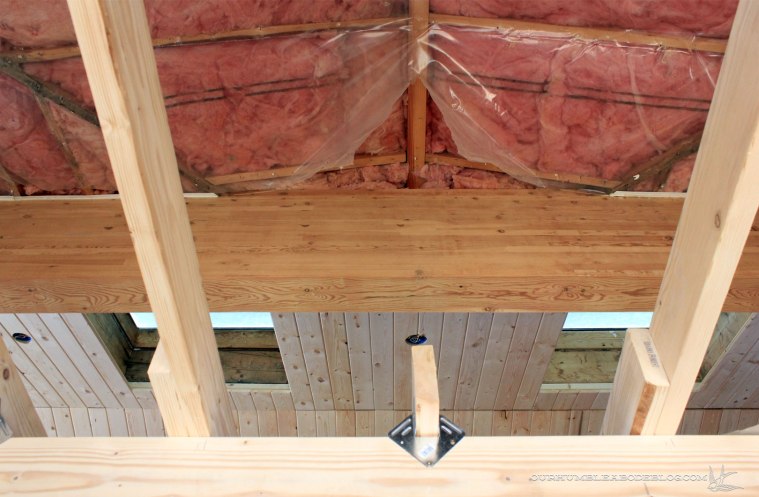 The strips on either side of the beams still need work, the skylights will get boxed in, and trim will go up to cover the gaps, so it’s not a quick process. It is, however, 20 steps in the right direction.






 ourhumbleabodeblog.com