I Just Dyed in Your Arms Tonight

After hemming and ironing longer than I would have liked, I finished the curtains yesterday.  And I’m now convinced I need to invest in a higher quality iron.  Apparently, the ten-dollar one I have isn’t fit to iron curtains, hence the hours of ironing.  But let’s start at the beginning.  As I pointed out yesterday, we needed a way to take the curtains down without removing the rod.  Why?  This might explain it.

Rather than going the conventional rod route, Ben and I agreed it would look cool to use galvanized pipe for the living space.  Once attached to the wall, it will be difficult to remove just the rods.  The living room window is 125 inches wide, which means we need a looooong curtain rod and extra wide curtains.  When looking for 144 inch rods, its slim pickin’.  Target didn’t have anything longer than 120 inches.  Home Depot had 144 inch rods, but all are more traditional looking that we wanted, like this one that was $45.  However, our Home Depot doesn’t carry that same rod in a shorter length.

So I called Ben while shopping to see what he thought of pipes turned industrial curtain rod.  Luckily, he was down for it.  We discussed the sizes available and came up with three flanges, three 3 1/2 inch nipples (I can tell men named these parts), two 90 degree elbows, and one tee, all 1/2 inch diameter per window.  The larger living room window needed 72 inch long pipes, while the shorter dining window was fine with 60 inch pipes for the rods.

Using a flange, nipple, and tee in the center of each window gives an extra support and allowed us to use two shorter lengths of pipe.

Ben was apprehensive about using drop cloths for the fabric, but I told him it would be okay, so he trusted me.  I walked out of Home Depot $163.76 lighter (dang pipes are expensive) with curtain and rod material in hand.  Now the pressure was on.  I actually had to make these look good.  A quick stop at Joann fabric for three boxes of black fabric dye and I was ready to get to work.  The process of sewing wasn’t difficult, just time-consuming, including a ton of measuring.

With the top, sides, and snaps done, I decided to dye the panels before ironing and hemming the bottoms.  I really wanted a medium gray color, but Joann had light gray and black dye.  Black was my best bet to get a mid saturation, so I mixed one and a half boxes of powder dye with a huge bucket of hot water.  I’m not sure how many gallons, but trust me when I say it was huge.  Then I soaked each panel, one at a time until the colors seemed uniform.  Because I was alone with the boys, I didn’t time anything, just left each panel in a while until it seemed to reach maximum saturation.  Then into the washer for a short, cold wash and a toss in the dryer.  Quite pleasantly, all panels seemed to match and didn’t have uneven spotting.  Success!

And here are the washed, measured, sewn, tabbed, snapped, dyed, hemmed, and ironed curtains in place.  Looking lovely, if I might add.

Each panel barely grazes the floor.

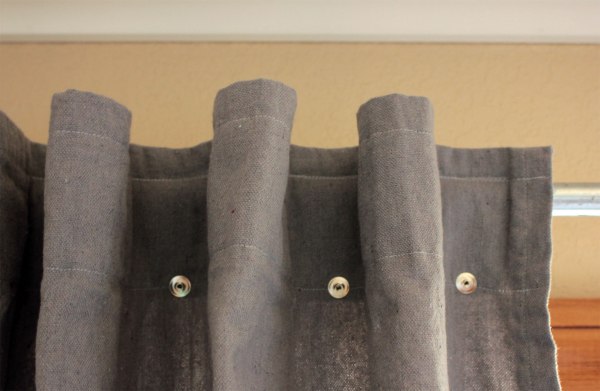
Back tabs are the shiz.  Look how nicely the panels bunch and hang.
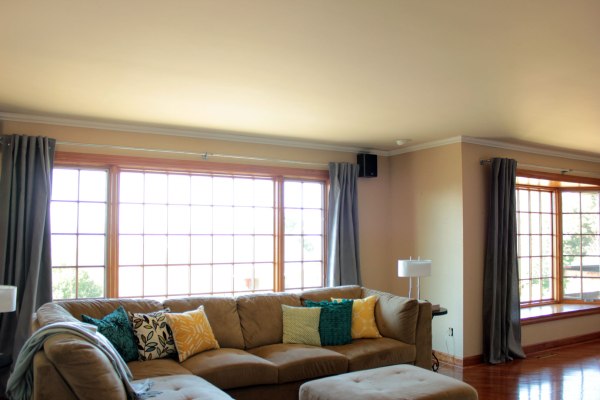
But there is one small downside.  Even though the drop cloths are marked 9 by 12 feet, they’re actually about 8 1/2 by 11 1/2 feet.  Straightening up the edges and adding about one foot of rod length makes the large window panels look short when closed.  Oh well, the window is covered and that’s what really matters, right?

The dining panels are perfect though.

You can kind of see that I didn’t make panels for the French doors out to the deck.  When we replace the windows (which will probably happen next summer), we’re changing things up.  No more door there.  Muhahahaha (that’s my evil villain laugh).

Now if we could just get a dining table.  And a light.  Ha.

Can you tell I’m excited about the new curtains?  I’m loving the warmth they add to the room.  Just makes it look lived in.

Mission accomplished.  We’ve got (pretty) curtains.

And here’s what it cost us:

For living room:  $33.90 for two 72 inch long pipes, $2.24 for one tee, $18.72 for three flanges, $3.12 for two elbows, $4.38 for three 3 1/2 inch nipples, $21.98 for a 9 by 12 foot drop cloth, and $2.29 for one box of fabric dye for a total of $86.63

For dining room:  $27.40 for two 60 inch long pipes, $2.24 for one tee, $18.72 for three flanges, $3.12 for two elbows, $4.38 for three 3 1/2 inch nipples, $21.98 for a 9 by 12 foot drop cloth, and $2.29 for one box of fabric dye for a total of $80.13

If I had bought two standard curtain rods, I would have spent 90 bucks on rods, so basically four curtain panels cost about 75 bucks.  Not too shabby.  But I’m not completely done yet.  I think I’ve decided what I want to do, so I’ll be back with more details when I actually get around to that.

Do you have odd sized windows to work with?  Have you used pipes for curtain rods?  Drop cloths for curtains?
Sewing Curtains is Sew Not Fun

I don’t know why, but I’m not a fan of sewing curtains.  No wait, I do.  Large pieces of fabric, lots of measuring, even more pinning, and ironing are all involved.  That’s not to say I don’t like the result, it’s just getting there that I don’t love.  We decided to leave the curtains with our first house, which means I’ve sewed curtains recently.  Until this weekend, we have been curtainless in the living and dining rooms, moving our heads to escape the glare of on the tv.  Nothing like a Lost marathon to light the fire to get these done.  Oh, and I finally formulated a plan to cover our ten and eight foot wide windows.

It all started with a trip to Home Depot, where I bought all the curtain supplies.  Ben and I decided on a less conventional rod system, which meant I had to figure out a way to hang the curtains without removing the rod.  More on that later.

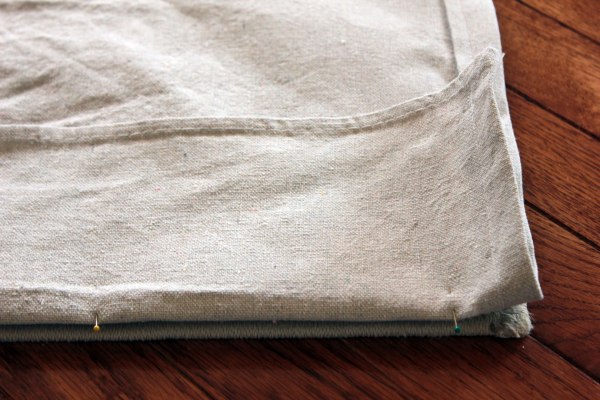
Anyway, this started out with two 9 foot by 12 foot canvas drop cloths, washed with vinegar added to soften the fabric, and cut in half to make four 6 foot by 9 foot panels.  I always start by sewing the sides of curtains.  After doing that to all four panels, I got started on the tops.  Here’s a little trick I like to use to make sure things are as square as possible.  First, I line my hemmed edge along a rug.  Then, I pull the top over enough to fold it over. Starting at the center, I carefully fold the fabric over, keeping the edges of the fabric flush with the edge of the rug.

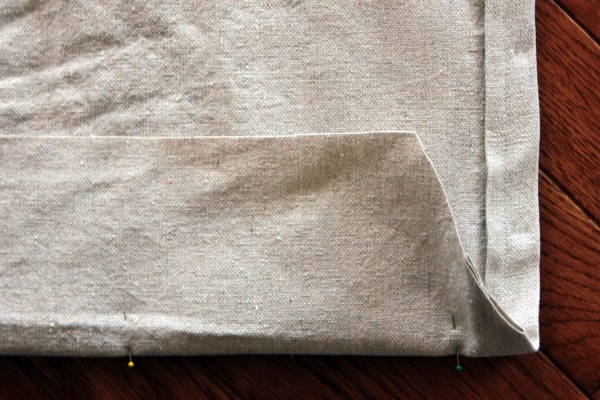
Then I cut off the excess fabric, including angling the corners to cut the bulky seams.

For a clean, finished edge, I fold the fabric over again, using a line in the rug to keep this even, too.  Of course a measuring tape would also work.  Haha.

Here’s where the easy removal without taking the rod off comes in.  I considered buying curtain clips, but decided not to because I didn’t want to buy five or more packages to work with the extra wide panels.  Instead, I started by sewing ribbon tabs, just like I did for the boys’ curtains.  Of course the tabs aren’t removable, so I sewed only the top of each.

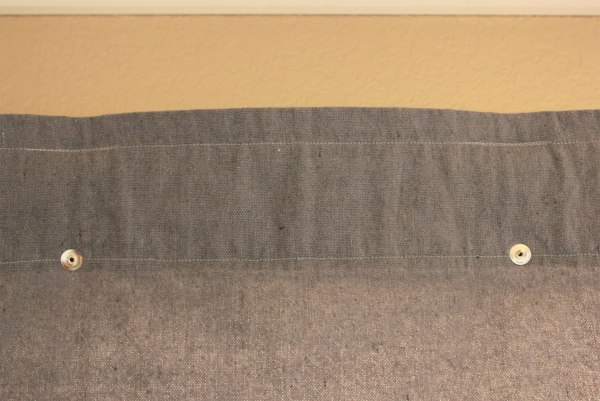
Ben has heavy-duty snaps left over from his leather working days, so I used those on the bottom of each tab.  Each snap consists of four pieces;  two posts (on the left and right), a male, and a female piece (real names, by the way).

After punching a hole in the ribbon tab, I poked the post through, then set the female end on top.  Several taps with the setter and a hammer pushes the post down, clamping the female piece in place.

To mark the other piece, I folded the ribbon back and made a dot where the snap sat.

I found the easiest way to make the holes in the fabric was with an eye hook, screwing it through.

The post goes on the outside of the curtain, with the male piece on top.  Tap it in place and snap together.

I’m really impressed by how strong the snaps are.  Seven hold up the weight of the curtains just fine.

I actually like the ‘studded’ look the snaps have on the front of the panels, too.

Just a little dose of edge/industrial.

Now that we’ve got them hung, I need to measure and hem the bottoms.  I suppose I should iron the panels while I’m at it, then time for a full reveal.  Guess I know what I’m working on today.

I’m Board

Oh yes, I know that’s the wrong type of board.  That’s a hint for you.  I’ve gotten a few questions about mood boards, so here’s what I do.  Professional designers probably have a quicker, better method, so if you’ve got tips or tricks, feel free to share in the comment section.

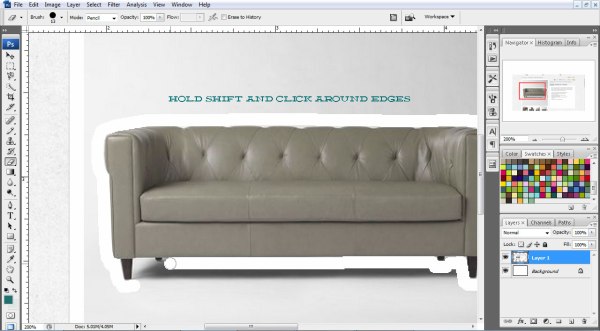
Are you ready?  Here goes nothing.  First, open a new document in Photoshop.  The canvas can be any size and resolution, you can always change it as you go.  I typically make mine 9 inches wide by 5 inches tall at 180 dpi.  Now, find an image of the items you want to add.  To make it easy on myself, I go to a website and take a screen shot and paste it (Control + V) on my canvas.  This automatically adds each item as a new layer.  When possible, use an image against a white background.

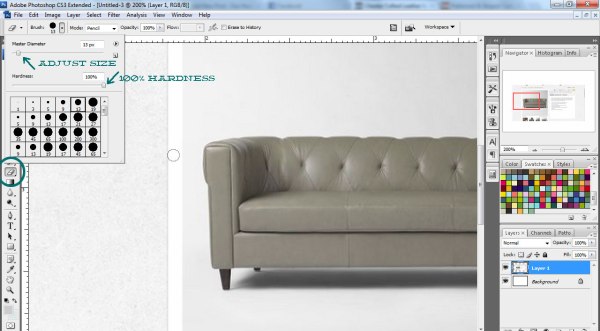
To remove a colored background, select the eraser tool, adjust the diameter, leaving the hardness at 100 percent.

For me, the easiest way to erase a background is using a small eraser tip, holding the shift button, and carefully clicking around the edges.  For straight lines, click once at the far end, hold shift and click at the opposite and it will make a straight line.  To go around corners, follow this same procedure, making smaller clicks to go around.

After tracing all the edges, erase the remaining background with a larger eraser tip.  If you want the item larger or smaller, click the rectangular marquee to make a box around the item.  Right click and select ‘Free Transform’.  Hold shift to enlarge proportionately and hit enter when you like the size.

You’ve made one item!  Go back to another image, screen shot, and paste it in.  Rename the new layer right away so you’re not searching through once you’ve added several items.

Erase the background on this one, too.

After tracing the outline, go back in with a larger brush tip to make this quicker.

Keep on adding items.  If you get an item you want to rotate, select the marquee, right-click, and choose ‘Free Transform’.  While holding shift, turn the item.

See that rug above?  Well, I don’t want it to lay over the couch.  Find that layer and drag it under the rest, making it the first layer.  Now the rest of the layers will sit on top if it.

If you want to add two of one item, select the layer, right-click on it, and select ‘Duplicate Layer’.

Photoshop places the new layer over the existing one, so move it where you want and you’ve got a pair.  If you want to flip it, use the marquee tool, right-click, and select ‘Flip Horizontal’.

For paint swatches, I think this method is the quickest.  First, paste the screen shot of the color.  Use the marquee too to make a square on the swatch.  Push Control and C at the same time to copy, then Control and V to paste the selected square.

Delete the screen shot of the swatch and move your new little box over to fit in your board.

Then you can choose accent paint colors and layer those on top.

It’s up to you if you want to arrange the furniture to look like a room.  Or just group pieces together to get an idea of the elements as a whole.

P.S.  If you’re having a hard time seeing the details, click on the picture to enlarge it.

P.P.S.  All keyboard short cuts mentioned are for PC, not Mac, though they are similar.

Let’s Tango

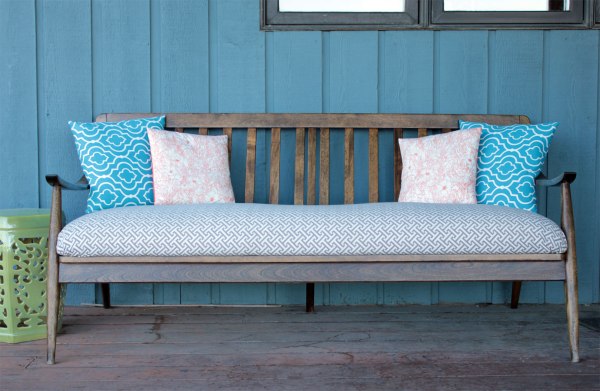
Thank you all so much for your support and encouragement yesterday!  I’m so happy you like the pillows.  I hope to add more as soon as possible in a variety of colors, so stay tuned.  Do you remember when I made new pillows for our outdoor bench?  And at that point I mentioned I wanted to add tangerine pillows.  While sewing the arrow pillows, I kept my sewing machine out to sew a few orange pillow covers.

I bought the fabric at Joann’s about a month ago, not knowing exactly what I wanted to make.

For the back side, I made an envelope closure back in a bright tangerine coordinating fabric.

I’m a big fan of mixing floral and geometric, and I’m really liking the color combo.

These covers are quilting weight cotton, but if they start getting damaged, I can bring them inside.

So that’s the latest little project.  Progress has been slow elsewhere because the roof is taking up so much time and energy.  Hopefully I can knock out a project or two to share soon.

Blue Bench Pillows

Before heading out to Minnesota, I made a stop at Joann’s just to see if there was anything I should know about.  Luckily, our Joann is liquidating their stock because they’re moving stores soon.  So, I stocked up.  Because hoarding fabric is fine, but hoarding cheap fabric is even better, right?  I got a few quilting weight fabrics, a mustard yellow vinyl, a few zippers, and a fun blue geometric print. 

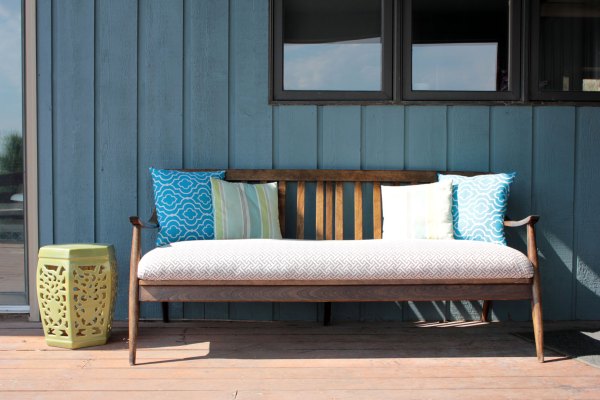
Because the blue was the heaviest, I decided to use it for outdoor pillows.  Ten or so minutes later, following this method, I had two new pillows for our bench. 

Along with the blue, I bought a tangerine floral print, but I’m concerned about using the quilting fabric outside.  The original pillows are still there. 

Certainly, it’s a small change, but I’m liking the new color.  I’m still hoping to add a contrasting color, like orange. 

What’s your favorite orange fabric?  Or your favorite patterned fabric?  Do you lean toward geometric patterns or floral prints?