Honing Skills

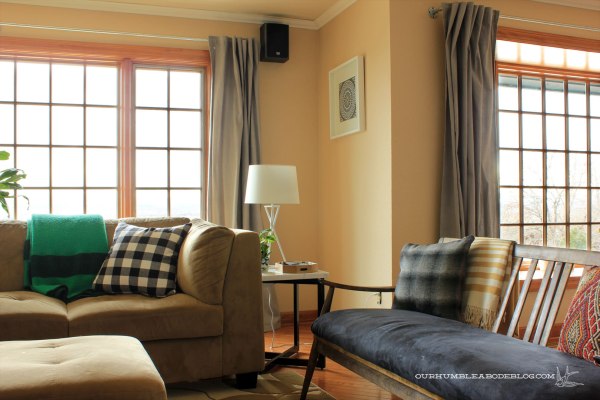
Many times, the little details and changes make a surprisingly big impact.  Like this small change that brightens our living room.

Honed-Marble-End-Table-Top-Left-Side-of-Living-Room

Do you know what it is?  Here’s a hint:

Isosceles-Table-Lamp-Finished-in-Living-Room

And now, look on the bright side.

Honed-Marble-End-Table-Top-Right-Side

This weekend, our weather was incredible.  Almost 70 degree high yesterday, though we might get snow tonight.  Ben took advantage of the nice weather by cutting marble remnants to replace the chipped laminate table tops.  It’s a super dusty task, so it’s best to work outside with a mask on.

Honed-Marble-End-Table-Top-Detail

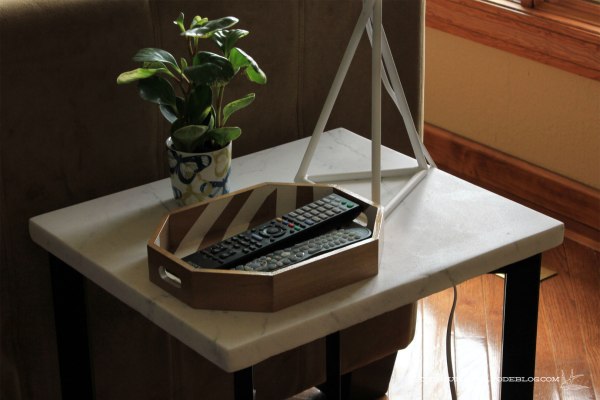
When we bought our hall bathroom slab, the guy tossed in a few scraps of Carrara marble.  Two of which were the perfect size for these tables.  Free pretty marble is free for a reason.  These pieces were chipped, scratched, and had a few starter cuts.  For that reason, I decided a honed finish would work best.

Honed-Marble-End-Table-Top-Sheen-Detail

Ben used a diamond blade saw to cut the rectangles, then a right angle grinder for on the edges, and followed up with sandpaper on an orbit sander to smooth the top.  The honed marble feels a little more rustic and used.

Honed-Marble-End-Table-Top-Right-Side-Overall

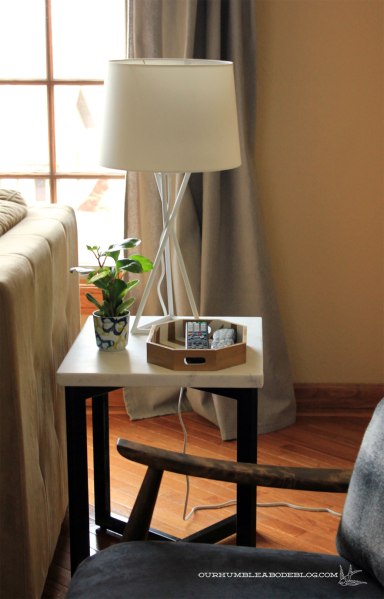
Glad I bought these $15 tables years ago, because the bases are super sturdy and pair nicely with the marble.  Sure beats the peeling fake walnut veneer.

Honed-Marble-End-Table-Top-from-Side

And the new lamps look great on there, too.

Honed-Marble-End-Table-Top-Left-Side

Now I need to finish my patched walls, pick a paint color, and go to town on this room.

Fauxrarra Marble

Winter is still here in full force, which means I’ve been stuck in the house.  A lot.  So I’m forced to keep my self entertained, often involving a project.  Precisely why I’ve painted this table top for the third time in less than one year.  Third time’s the charm, right?

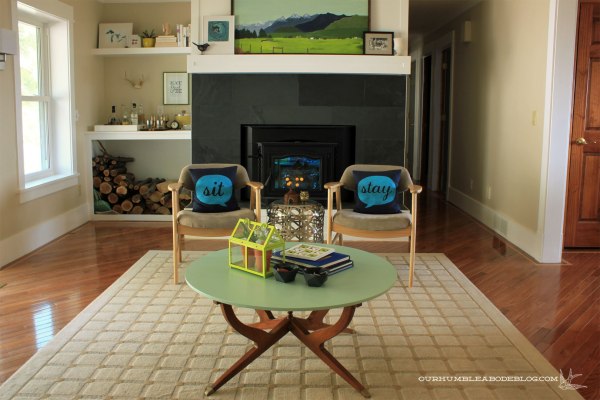
Faux-Marble-Table-Top-Toward-Fireplace

See, as I flipped through the new West Elm catalog, I kept imagining the Reeve Mid-Century Coffee Table in our house.

Then it dawned on me, I already have a similar clean lined, handsome wood, brass footed table.  The big difference?  It didn’t have the beautiful, sophisticated marble top.  Instead it had a bold chevron top.  At the time I painted the stripes, I loved the added pattern.  Now, I’m kind of over it.  Not over it enough to paint over it, oh no, that took too long to do.

Chevron-Table-Top-in-Family-Room

Ideally, I’d have a real marble slab, but I’m afraid the folding base design couldn’t handle the added weight.

Faux-Marble-Table-Top-in-Family-Room

But the other side, a minty green, was fair game.

New-Coffee-Table-in-Family-Room-Toward-Fireplace

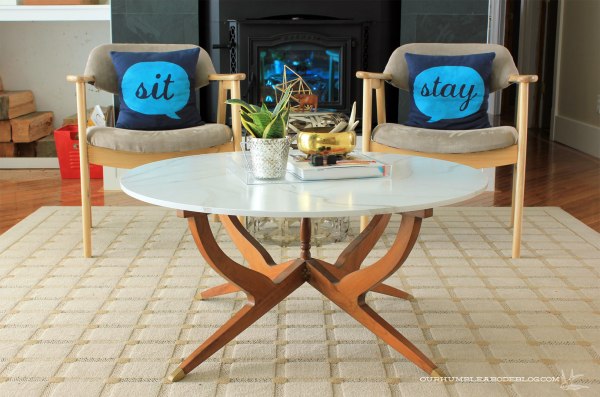
I painted three coats of eggshell white latex on it and then started my faux marble paint treatment.

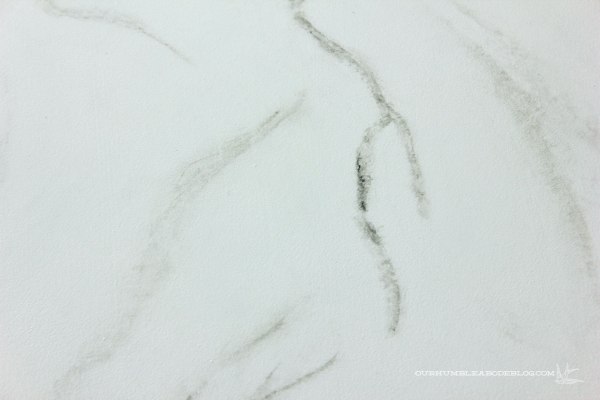
Using a few gray and black craft paints, I watered each color down.  I didn’t measure (and don’t have pictures) but I’d guess it was 1 part paint to 2 parts water.  Super runny and I barely mixed each color, which helped create a more natural variation.  A feather worked best to apply a thin, free-flowing line of watery paint.  Immediately after making the line, I used a 2 inch angled craft paint brush to stipple the paint.  Just after stippling, I followed up with a damp paper towel, blotting to blend the paint and soften the edges.

Faux-Marble-Table-Top-Vein-Detail

Some areas are much lighter and more blended.  A few other veins are darker with black patches.  If I didn’t like how one area looked, I used my damp cloth to wipe the paint away and start over.  Once I finished, I coated the top with satin Polycrylic for a protective finish.

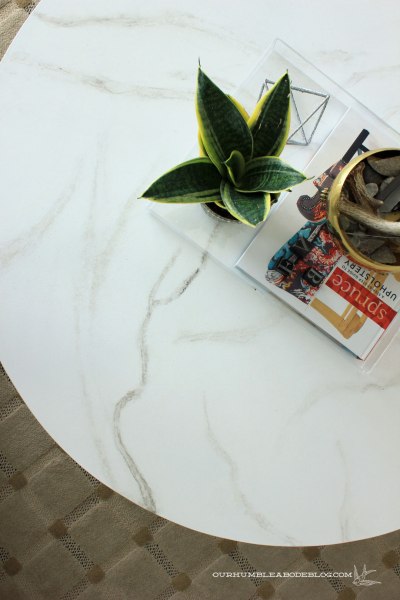
Faux-Marble-Table-Top-Detail

The sides are painted to match.  Carrying the marble paint to the sides helps give a more realistic effect.

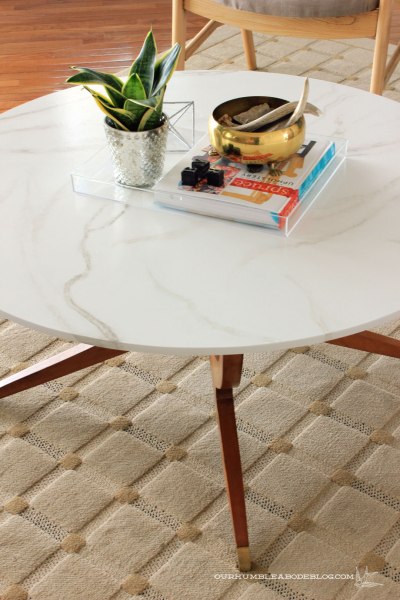
Faux-Marble-Table-Top-with-Legs

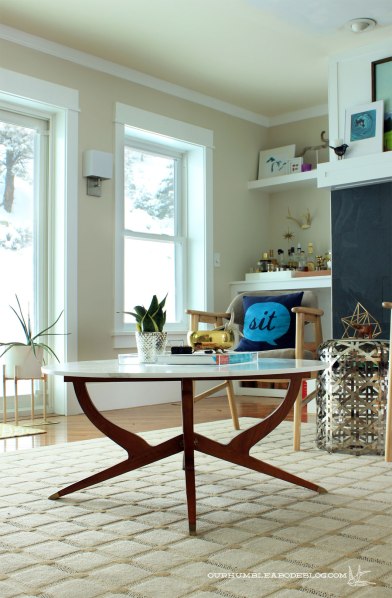
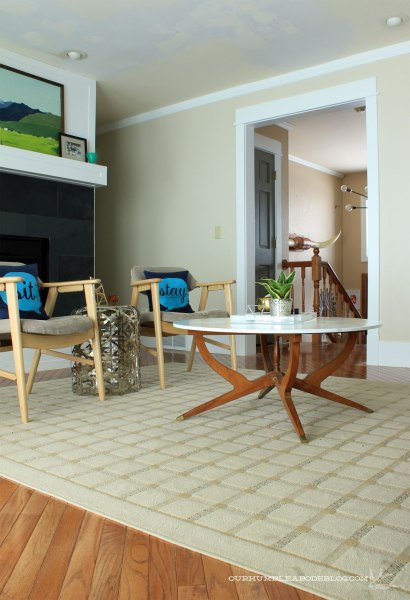
Maybe I just needed a change, but I’m enjoying the lighter, more subtle top.

Faux-Marble-Table-Top-2

I think it balances the base better and lets the interesting leg shape shine.

Faux-Marble-Table-Top-Toward-Windows

Faux-Marble-Table-Top-Toward-Entry

Not a bad result for a free project and 10 dollar base.  What coffee table tops do you like best?

Cart Wheels

The thrifted bar cart has a new home and new purpose.  Miss Scarlett, in the dining room, with the candlestick.

Dining-Room-with-Cart-and-Plants

Okay, actually for me, in the dining room, holding plants.

Cart-with-Plants-in-Dining-Room

When I bought it, only one shelf had glass.  To make the cart fully functional, I had Ben cut a piece of of 1/4 inch MDF and painted it white.

Cart-in-Dining-Room-with-Plants

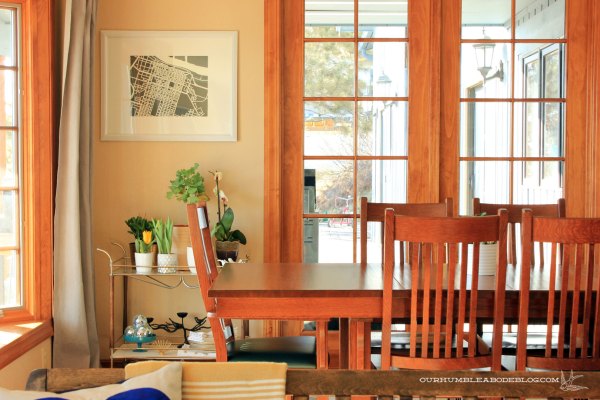
Plants sit on the glass shelf, which is great because it’s super easy to wipe up if I drip water.  This sunny spot is perfect for keeping my growing plant collection happy.  Including the $2.50 orchid I recently picked up from the grocery store clearance section.  It’s not looking good right now (hence the clearance price).  Do you have any tips to help me revive this beauty?

Cart-with-Plants-in-Dining-Base

The new bottom shelf holds napkins, placemats, extra plates, and a few decorative items including mini disco balls.  Having napkins and placemats easily accessible has come in handy at dinner already.

Cart-in-Dining-Room-from-Corner

I’m glad to have a place to corral my plants, while keeping them happy.  And to put this little wheeled dude to practical use in a tucked away corner.

Tangle of Triangle

Going stir crazy this winter, I’ve been looking for changes I can make to the living room.  It’s not terrible, but we have barely touched it.  I’d really love a new sofa, but I’m settling for new lamps right now.  I remember seeing the Isosceles lamps from Land of Nod (now unavailable) months ago, and loved the simple design.

So I recently made a version for about 12 dollars per lamp because I already had the white shades.
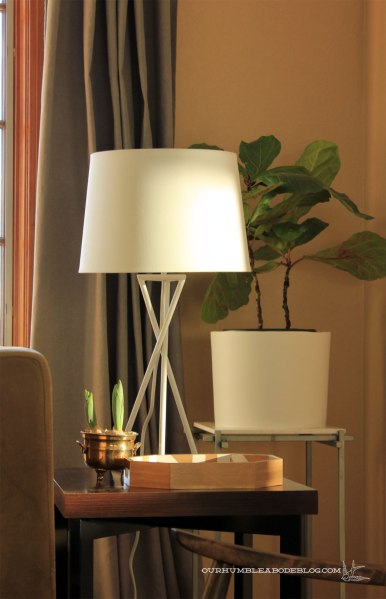
Isosceles-Table-Lamp-Finished-on-Table

At Home Depot, I bought 12 feet of 1/2 inch round wooden dowel for six bucks.  To make the bases, I cut 7 1/2 inch long pieces, with 60 degree angles to form each base triangle.  And another set at 3 1/2 inches to make the top equilateral triangle.
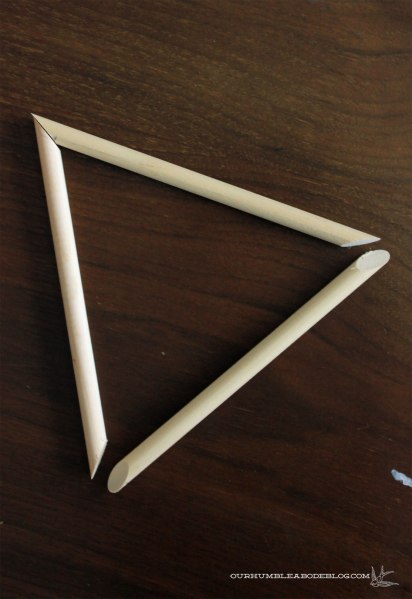
Isosceles-Table-Lamp-Base-Cuts

A little wood glue and tape to hold it in place until it dried did the trick.  To connect the triangles, I cut 15 inch long pieces at a 20 degree angle, though my cuts were slightly off.  But that’s okay, wood filler will make it look okay.  Ben helped my by shooting in pin nails while I held the pieces together to make this:
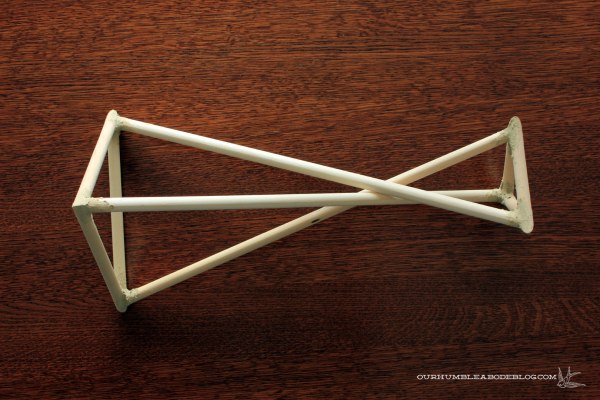
Isosceles-Table-Lamp-Assembled-and-Filled

The triangles face opposite directions, and the connectors swirl around, point to opposite point.
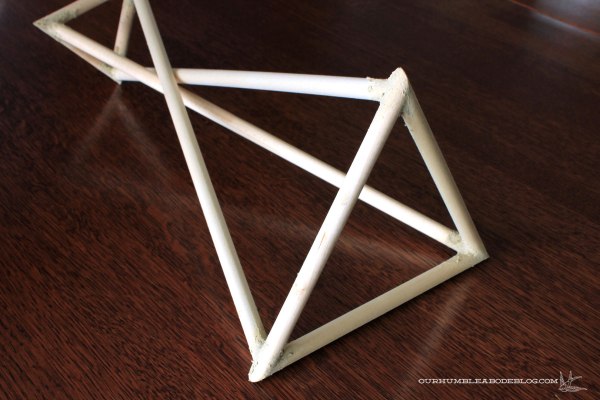
Isosceles-Table-Lamp-After-Filled-Joints

Fill in all gaps and corners, then let them dry.
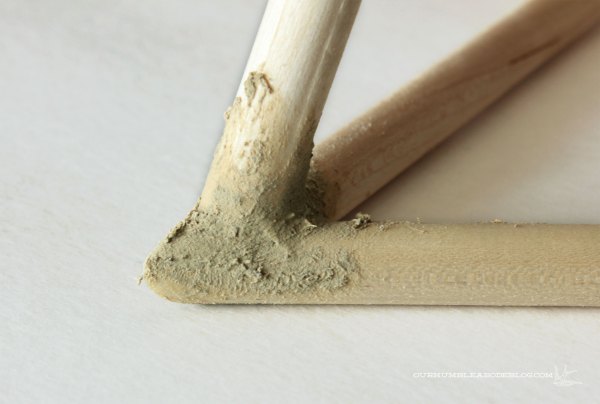
Isosceles-Table-Lamp-Filled-Joint

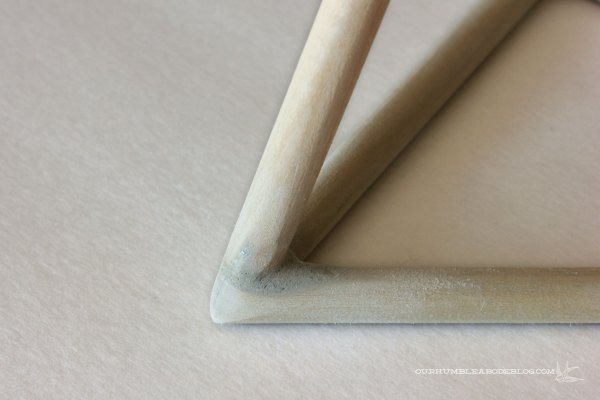
Because I wanted slightly rounded corners, I used 50 grit sand paper to quickly take off the extra base triangle point.  Holding the sand paper at the same angle as the vertical while I worked made for a more seamless corner.  Then I followed up with 150 paper for a smooth finish.
Isosceles-Table-Lamp-Sanded-Joint

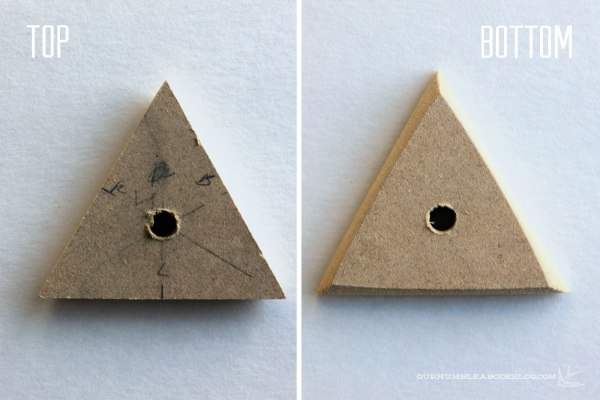
Then, to hold the lamp socket in place, I but two more triangles from 1/4 inch MDF.  The top looks normal, but to fit snugly without falling through, I sanded the bottom to fit the rounded shape.  Before putting the top in, I found the center and drilled a hole large enough for my threaded piece to fit through.
Isosceles-Table-Lamp-Triangle-Top-Pieces

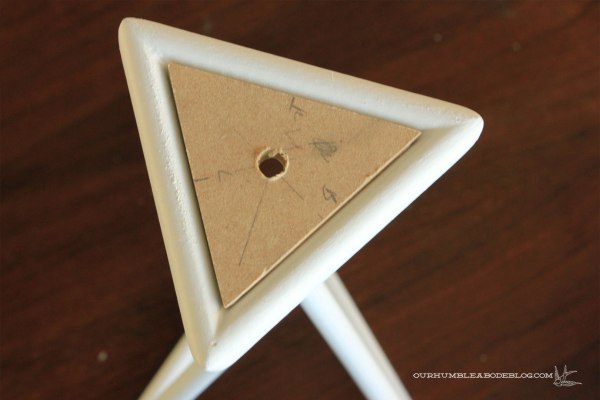
More wood glue holds this top in place, giving the socket a resting place.
Isosceles-Table-Lamp-Top-Triangle-In

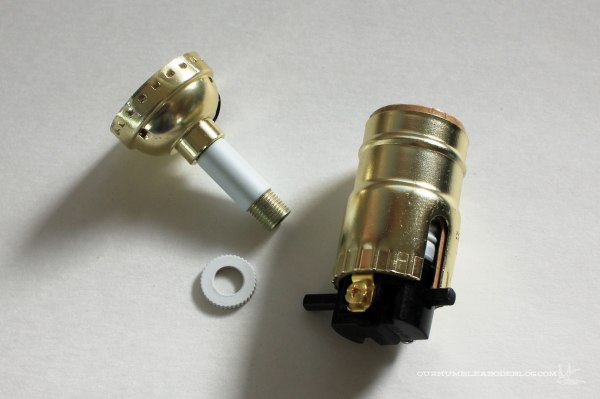
I bought two bottle lamp kits from Wal-Mart for $6.50 each, and used these pieces in addition to the wire.
Isosceles-Table-Lamp-Wiring-Pieces

To cover the threaded fitting, I bought a small chunk of brass tube to make a sleeve.  Once cut to size, I spray painted it white to match the lamps.
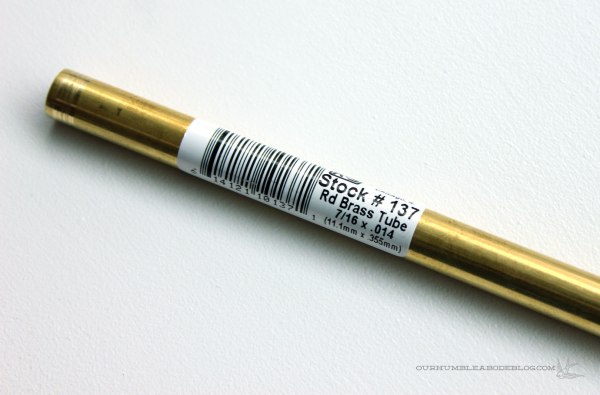
Isosceles-Table-Lamp-Cover-Tube

Then threaded the piece through the hole:
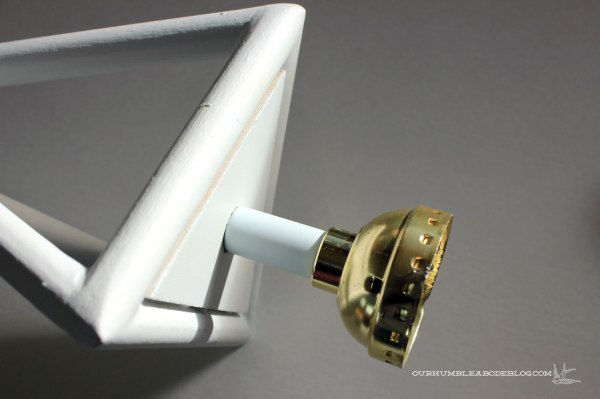
Isosceles-Table-Lamp-Wiring

And secured it with the small flat nut on the underside.
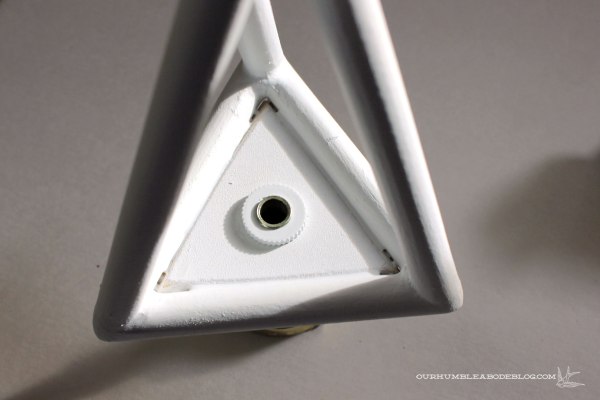
Isosceles-Table-Lamp-Wiring-Underside

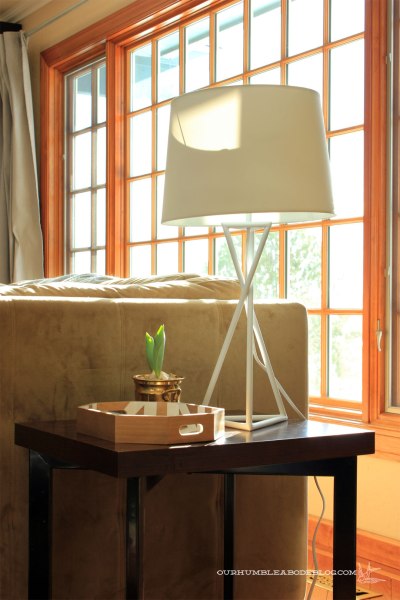
After connecting the wires, I popped the shade on and voilà, a new lamp.  Like the Land of Nod lamp, the cord isn’t hidden, just tucked in the center and drapes along the back.
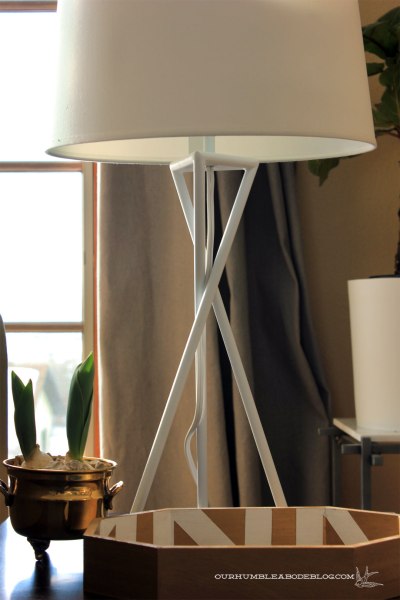
Isosceles-Table-Lamp-Finished-Cord-Detail

Isosceles-Table-Lamp-Finished

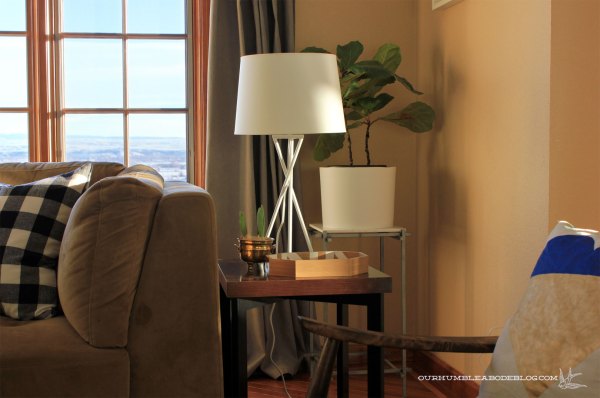
No more clinking of lamp chains from our old lights.  And the taller lamps give have a warm, even glow.  I tried lining the shades with gold fabric, but it blocked too much light, so I had to nix it.  All the gold paper I could find wasn’t long enough to fully wrap around the shade.
Isosceles-Table-Lamp-Finished-in-Living-Room

I’ve got a plan to update those cheapie end tables, too.  White marble remnant in the garage, prepare to be used.  And look how happy my fig looks!  It has already sprouted two new leaves and is working on a third.  Those tulips should bloom in a few weeks, too.  I’m so excited.  Loving all the green in the house during this dark, cold winter.  Anyway, back to the lamps.  If I were to make these again, I’d make the top triangle a little larger to have a wider spread.  But, I’m still happy with the result.

Plumbing Aisle Inspiration

While getting copper supplies for the bud vase, I wanted to make something with basic hardware store supplies.

Copper-Bud-Vase-Hanging-Side

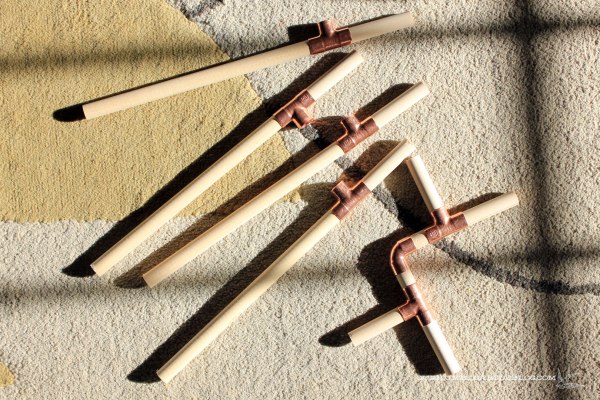
What do you get when you pair 8 feet of 5/8 inch wooden dowel, 6 1/2 inch copper T connectors, 1 90 copper elbow, a two gallon bucket, glue, and spray paint?

Wood-and-Copper-Plant-Stand-Supplies

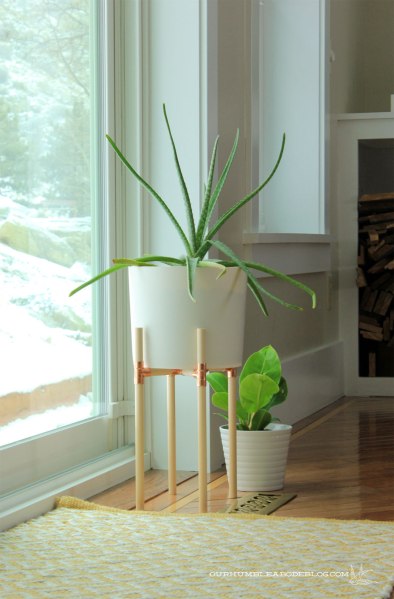
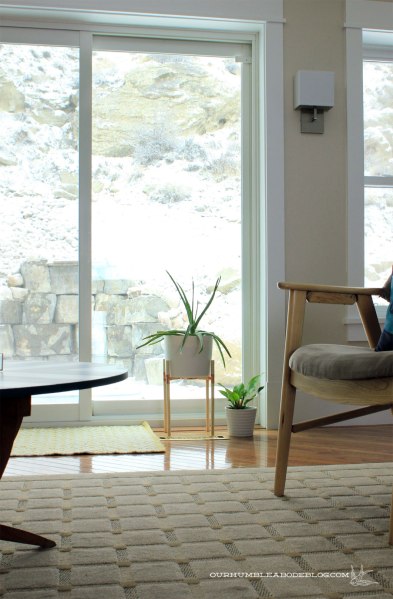
A cute (in my opinion, anyway) planter and stand.

Wood-and-Copper-Plant-Stand-by-Back-Door

That aloe plant is my oldest plant.  I’ve had it for three or four years (the only plant I’ve kept alive over a year) now and it desperately needed a larger pot.  It was looking like a male orca in captivity; confined and droopy.  While priming the bathroom drawers with Kilz primer, I noticed the small 2 gallon bucket would be the perfect size.  Which spurred, the hardware store plant stand.  If you want to know how I made my, read on.

Here’s my cut list:

Two at 1 5/8 inch long, for the base.

Four dowels cut at 2 3/4 inches, also base pieces.

Four at 3 inches, top pieces to hold the bucket in place.

and four more at 10 inches for legs, all cut with a chop saw.

I started with two 4 foot lengths of 5/8 inch dowel and 1/2 inch copper fittings.  The two short pieces (1 5/8) fit inside each side of the elbow.  Attach a T to each end like this:

Wood-and-Copper-Plant-Stand-Base-Start

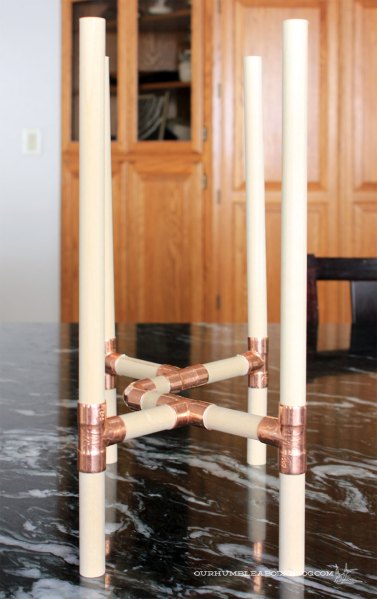
The four 2 3/4 inch sticks go in each hole of the T connectors to make the base.

Wood-and-Copper-Plant-Stand-Base-Assembly

Add the four remaining Ts to the ends for the leg attachments.

Wood-and-Copper-Plant-Stand-Base-on-Bucket

After dry fitting everything, I rolled each dowel end in Liquid Nails to secure the pieces.

Wood-and-Copper-Plant-Stand-Base-and-Legs

And let if dry on a flat surface, with the three-inch pieces down.

Wood-and-Copper-Plant-Stand-Drying-on-Table

While the glue dried, I asked Ben to cut the top off the bucket.  I didn’t want the handle or ridges.  This bucket was thin enough he was able to cut through with a sharp utility knife.  To make the bucket look, well, less bucket-y, I gave it two coats of flat white spray paint.

Wood-and-Copper-Plant-Stand-in-Family-Room

Now, sir Aloe has a larger pot with room to grow.  And I really like the mix of shiny copper and wood.

Wood-and-Copper-Plant-Stand-Finished-Detail

A new Philodendron is keeping it company by our back patio door.

Wood-and-Copper-Plant-Stand-1

This could easily be modified by staining or painting the wooden legs, or making it entirely from copper.  Buy copper tubing and 8 copper caps for the legs and you’ve got a shiny, custom stand.  All from humble plumbing parts and hardware store basics.