Marble Topped Box

Everyone has ugly things that are necessary for life.  Feet, cords and wires, and remotes, to name a few.  Hiding feet is an easy change.  We still (going on two years now!) have to build doors to hide the cords in the entertainment center, but that’s a different project for another day.  That leaves us with remote controls.  Perhaps your situation is different.  Maybe you’ve got a fancy universal remote.  We don’t.  Nope, there’s one for the tv, another for the receiver, and the controller for the Play Station (our dvd player).  Before this, the three squished together in a too small open tray on the coffee table.

Two-Tone-Wooden-Box-Finished-Outside

To give those ugly necessities a home, I built another recessed lid box.  With a twist.  I paired a 1/2 inch MDF base with a marble tile top.

Marble-Topped-Remote-Box-for-Remoted

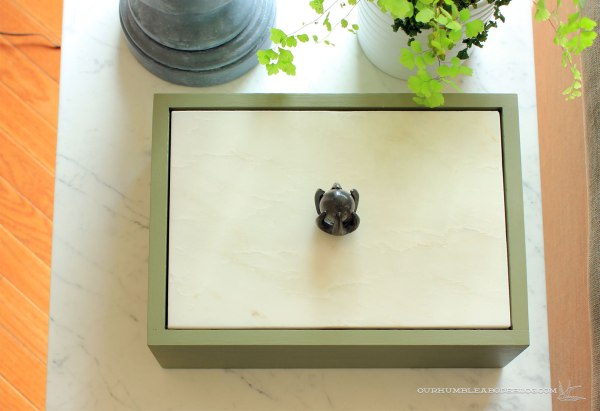
Following the same process, I crafted the simple box, using our remotes as a dimension guide.  Two coats of Tate Olive inside and out for a touch of color.  Then, Ben cut a 12 inch square tile (left over from the master bathroom shower) to size for me and drilled a hole in the center.

Marble-Topped-Remote-Box-Above

A semi creepy pull from Hobby Lobby is a fun accent.  Kind of looks like bird claws, no?

Marble-Topped-Remote-Box-Detail

Hobby Lobby knobs come with the bolt attached to the pull.  Sometimes it’s nice, when turning knobs into towel hooks, but other times, it just adds another step.

Marble-Topped-Remote-Box-Knob-Bolt-to-Cut-Off

After securing the knob with the washer and nut, I used a hacksaw to cut off the rest of the bolt.  Voila, a chic remote house.

Green = Green: Free Stump Coffee Table

You may be right!  I may be crazy.  But it just may be a lunatic you’re looking for.  To quote my longtime BFF (not really) Billy Joel.

Often times, I’m not actively searching for specific items.  However, if I see something that I can’t stop thinking about, I feel compelled to get it.  Such is the case of this giant slice of starting to rot cottonwood.
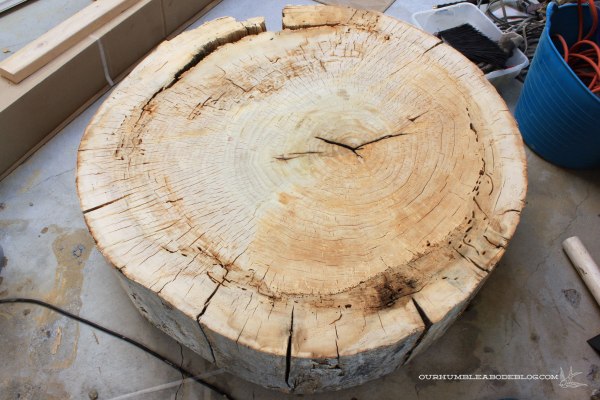
Stump-Coffee-Table-Sanded

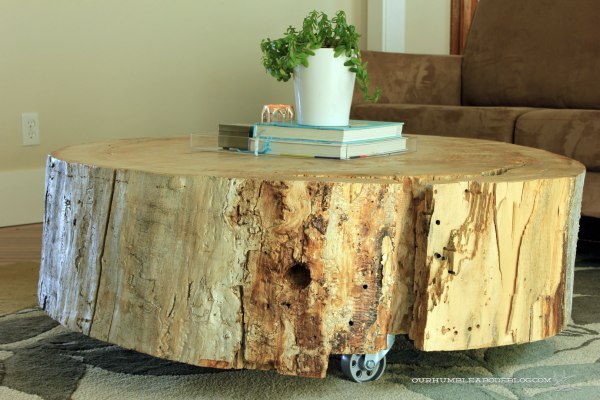
At 43 inches in diameter and 12 inches tall, this thing is massive, not to mention heavy.  Ben thought I was crazy, but loaded the beast up for me.

The affair started innocently, as I drove past the chopped up remains of a 25 foot tall dead trunk.  After a few days, I decided to ask by leaving a note with my name and number.  Instead of being the crazy woman knocking on the door, demanding a piece of wood.  A few hours later, a sweet gal called me back saying I could definitely take what I wanted.  Sa-weet.  I dropped by to pick out the piece and chatted for another one and a half hours.  I guess she didn’t think I was crazy.

Back to the wood.  This old cottonwood had died years ago.  The stump finally fell over.  Which means this thing has real character.  After a thorough sanding to get the surface splinter free and as flat as possible, I dug sawdust out of the bug trails.
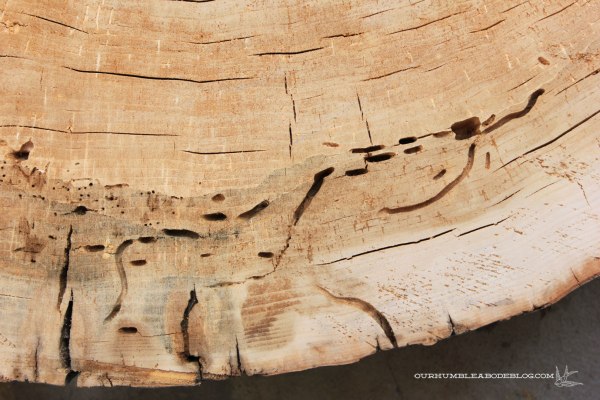
Stump-Coffee-Table-Bug-Trails

To get all dust and debris off and out of cracks, I lugged out the air compressor and a spray gun.  Worked like a charm to get the gunk out.  Then I gave the sides one coat of polycrylic.  For added smoothness, I applied three coats to the top, sanding between layers.  Sanding between coats is always important, but even more so on an unfinished piece of wood.

At 12 inches tall and somewhat uneven (notice a raised chunk toward the front in the photo below), I attached three steel casters.  Not only do the casters add a few inches in height, it makes this two hundred pound slab mobile.
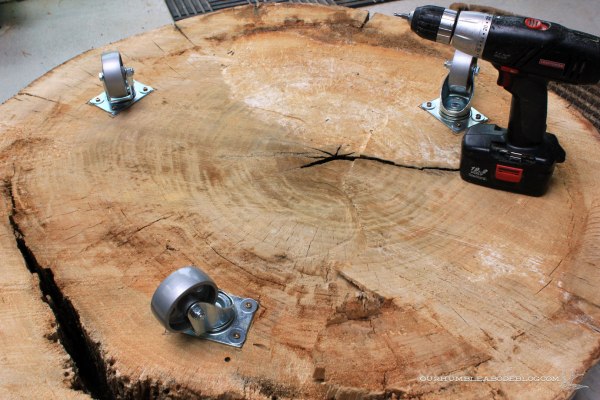
Stump-Coffee-Table-Three-Casters

I bought four, but after talking it over with Ben and looking at the base, three worked better.  Despite an uneven base, after flipping it over, the top was almost perfectly level.  As the old saying goes, “Almost only counts in horseshoes and casters.”  Under $6.00 each at Home Depot, these 300 pound rated wheels are heavy-duty.

Stump-Coffee-Table-Casters-at-Home-Depot

Four 2 1/2 inch long screws and washers keep the wheels in place.

Stump-Coffee-Table-Casters-Attached

With the piece sanded, clean, sealed, and wheeled, all we had left was to bring it inside.  Basically I made a heaftier version of this stump and put it inside my house.  Feast your eyes on our new, rustic meets industrial coffee table.
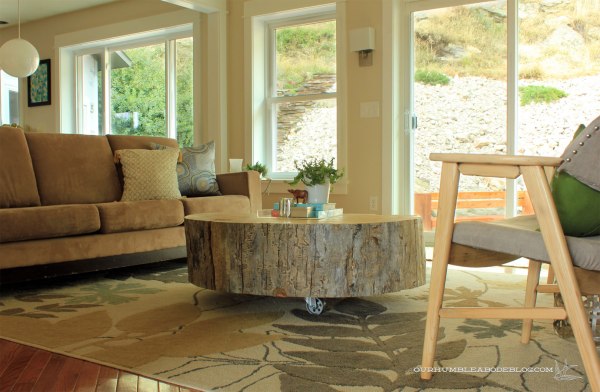
Stump-Coffee-Table-in-Family-Room-Toward-Doors

Adding the heavy (both in weight and appearance) table has helped ground the room.

Stump-Coffee-Table-in-Family-Room

I’m keeping the old table.  Because I love it and it could work well in our bedroom seating area.

Faux-Marble-Table-Top-in-Family-Room

This hulking piece was fun to work on and now has a fun story.

Stump-Coffee-Table-in-Family-Room-Toward-Fireplace

And character in spades.

Stump-Coffee-Table-in-Family-Room-Toward-Stairs

One side has a giant crack along with a woodpecker hole.

Stump-Coffee-Table-in-Family-Room-Toward-Cabinets

Stump-Coffee-Table-Cracked-Side-Detail

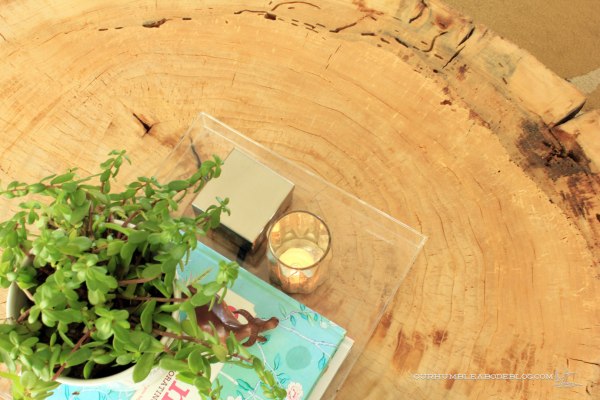
Some of the chainsaw marks are still noticeable on the top.

Stump-Coffee-Table-Top-Detail

Despite several rounds of sanding with 50 grit paper, the top isn’t completely smooth.  I mean, you won’t get slivers if you run our hand across the top.  Though it is far from your typical glossy mahogany furniture.

Stump-Coffee-Table-Top

You can feel bumps, divots, and a few rough patches.
Stump-Coffee-Table-Top-Bug-Hole-Detail

Stump-Coffee-Table-Top-Detail-Toward-Stairs

For a hot second, we considered screwing the crack back together.  Clearly, we decided against that.  It could have worked.  Or it could have made the split even bigger.

Stump-Coffee-Table-Large-Crack-Detail

Overall, this was a quick, easy, and inexpensive project.  Free stump + a few hours of sanding + 1 quart of polycrylic + three steel casters = my love in coffee table form.

Stump-Coffee-Table-Edge-Detail

Based on the 17 photos, some very similar, in this post, I think it’s safe to say I’m smitten.  What’s the craziest thing you’ve done in the name of cool furniture?

Box it Like it’s Hot

This project is a shameless West Elm knock off.  The Contrast boxes are fun and useful in nearly any room.

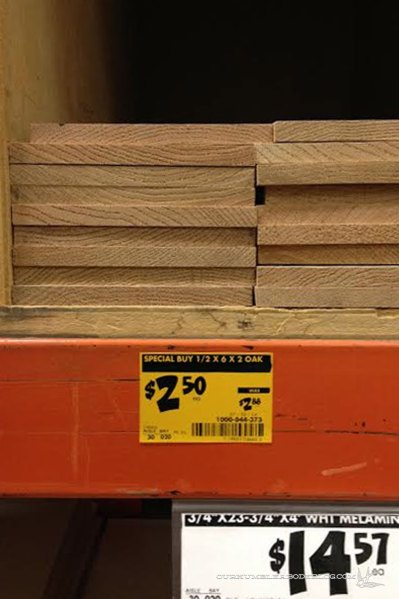
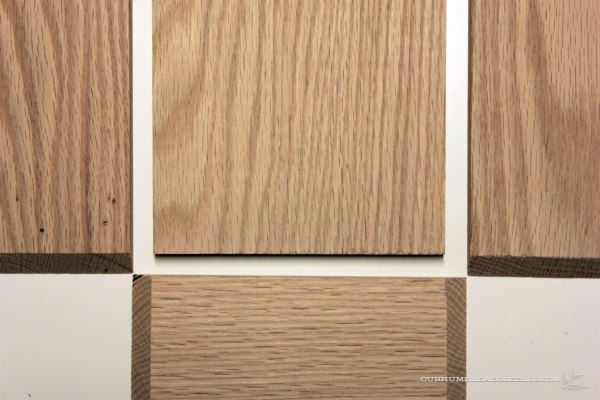
But, only the tray is available right now.  Hence the knock off.  I found the perfect wood while picking up some other supplies at Home Depot.  In the aisle with pre-cut sheets (varying thickness MDF, peg board, and plywood), I saw these 1/2 inch thick solid oak boards.  Only $2.50 per 1/2 inch by 5.5 inch by 2 foot board.

Two-Tone-Wooden-Box-Oak

I grabbed three and started building when I got back home.  Using the width of the plank as my top and base, I cut two rectangles at 8 inches.  To create the sides, I cut mitered corners to fit around the base.  Not on top, as I did with my recent tray project.  So the inside of my long pieces were 8 inches, short sides at 5.5 inches.

Two-Tone-Wooden-Box-Assembly

This is where a pin nailer comes in very handy.  For each side, I’d brush wood glue on each corner or joint, hold it in place until square, and then shoot four or five 3/4 inch long nails in.

Two-Tone-Wooden-Box-Glued-and-Nailed

It leaves teeny holes, but holds everything together until the glue sets.  For my triangle lamps, I used this same method of nails and glue and they’ve held up perfectly.  Now, to deal with the recessed top.

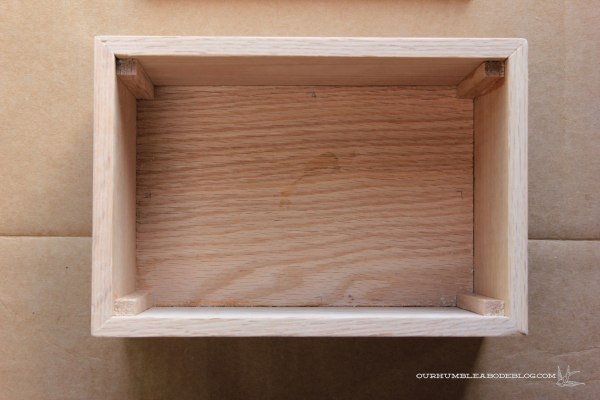
West Elm’s version has a routered top, but I decided it would be quicker and just as effective to add little ‘posts’ to each corner.  After measuring the inside of the box, I subtracted a half-inch and glued them in.

Two-Tone-Wooden-Box-Unfinished-Inside

My top is a 5.5 by 8 inch rectangle, allowing it to rest inside the frame, on atop the corner posts.  To accommodate the leather strap handle, I measured my leather.  At 3/16 thick, I cut a slightly larger slot by drilling holes in each end and connecting the pieces with a funky vibrating saw.

Two-Tone-Wooden-Box-Unfinished-Top

Before finishing, I sanded everything with fine paper.  Using stain and paint I already had, I finished the outside with stain, and the inside and top edge with paint.  Four coats of Polycrylic to protect everything and give a little shine.  For under eight dollars, I have a cute box to stash our junk on the coffee table.

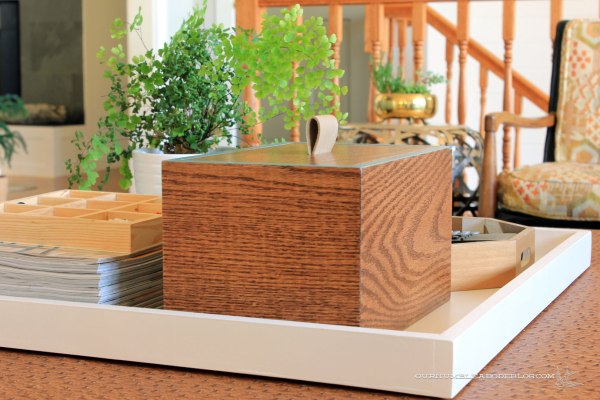
Two-Tone-Wooden-Box-on-Living-Room

It’s a nice wooden accent, but I’m worried it looks too tall.  Almost like a Kleenex box cover.  I might make a shorter one…

Two-Tone-Wooden-Box-Finished-Outside

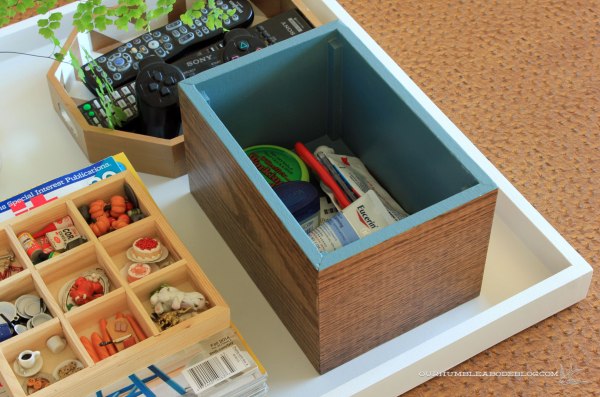
At any rate, it holds lotions, chapstick, nail clippers, and the boys’ toothbrushes.

Two-Tone-Wooden-Box-Finished-Inside

The leather handle is a lot easier for the boys to open than the metal bin we had used.

Square-Tray-On-Coffee-Table

Two-Tone-Wooden-Box-Leather-Handle

I couldn’t think of a better way to attach the strap, so I stapled it to the underside of the cover.  I’m guessing West Elm attached their handle differently.  Haha.

Two-Tone-Wooden-Box-Leather-Handle-Underside

A lower, longer box would be great to hold our remotes, too.  I could also use one in the bathroom for first aid supplies.

Scrap Pile Creations

When I get the urge to create something, usually my first step is to raid my supplies.  Be it fabric, paint, or in today’s case, our scrap lumber bin.  It starts with a specific need, but finding ways to use left over materials is a slight way to push myself creatively.  Much like my cedar tub shelf.  And both pieces I made add function to spaces.  For our living room, I built a large square tray to corral everything on the coffee table.

Square-Tray-On-Coffee-Table-Room

I started with a piece of 1/2 inch MDF that was 22 by 30 inches and an 8 foot strip of 1 1/2 inch wide 1/2 inch MDF.  I cut the 1/2 inch piece to 22 inches square and then four strips for the sides.  All trays are assembled the same way.  Thin base material with side material attached on top.  I used 1 inch staples in our air stapler to secure everything; undersides first, then corners.

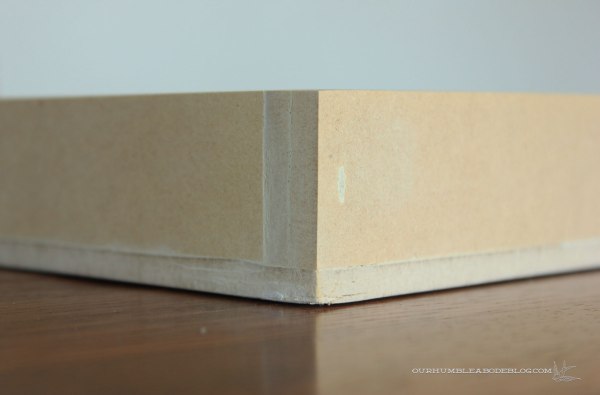
Square-Tray-Edge-Detail

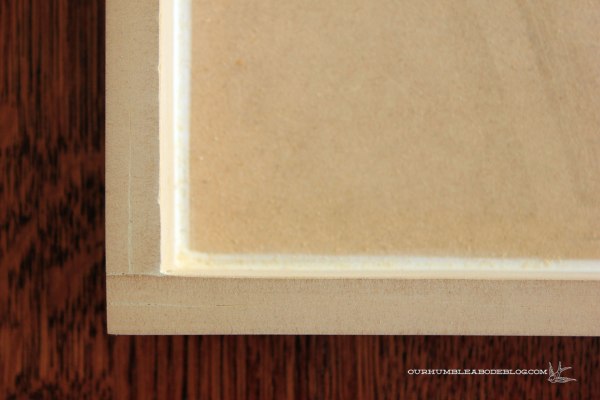
Due to the nature of MDF, it bulged out and cracked along the edges.  I wasn’t concerned because I knew I’d fill it with putty and caulk.  After filling the cracks and staple holes with wood filler, I caulked the inside corners.

Square-Tray-Assembly-Detail


Sanding everything smooth was quick and evened out the bumps.

Square-Tray-Top-Detail

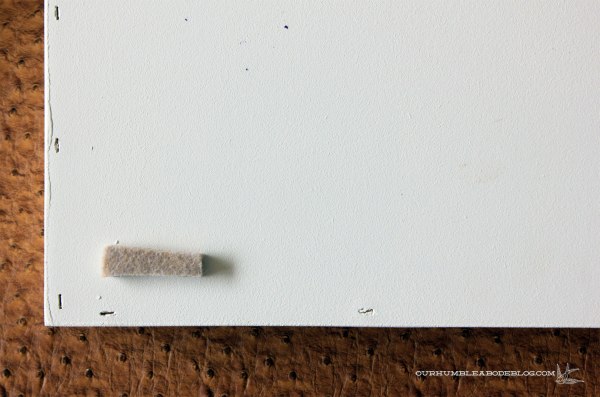
For durability, I used some white exterior paint.  After three coats, I took it outside to spray with clear gloss.  Two light coats in I noticed how the gloss had yellowed the finish.  Great.  I lightly sanded it again and did two more coats of white paint and called it a day.  Good enough, I can always repaint down the road.  To spare the table from damage, I added small rectangles of felt to the underside.  Clearly I didn’t care about the staples or paint drips on the bottom.

Square-Tray-Assembly-Detail-Underside

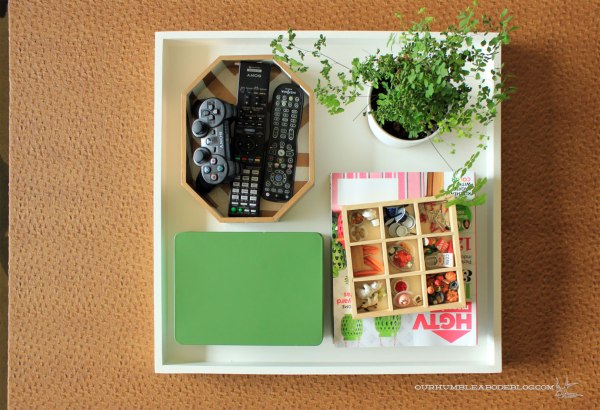
And now I’ve got a simple tray to keep magazines, remotes, and other crap (like the boys’ mini foods) organized.

Square-Tray-On-Coffee-Table-Corner

Because their minis are so adorable, I used a wooden drawer organizer (it was actually a tiny shelf) to display the collection.

Square-Tray-On-Coffee-Table

In other scrap pile happenings, I used a small chunk of left over cedar to make a shelf for our shower cubby.

Cedar-Shower-Shelf-Overall

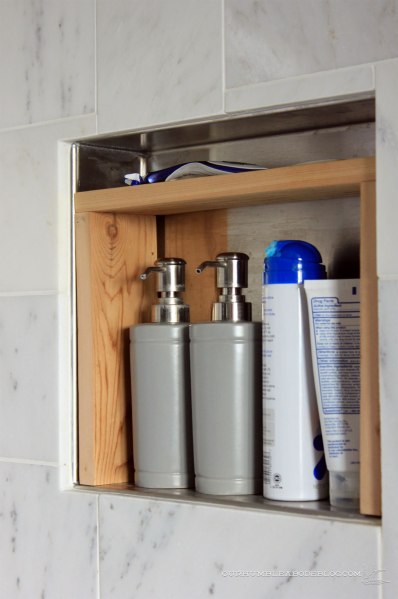
Before assembly, I sanded all sides with 220 grit paper and drilled two pilot holes in each end of the top board.  Obviously this shelf is exposed to water, so I used stainless steel screws so it wouldn’t rust.  Once assembled, I coated it with teak oil for a protective layer.

Cedar-Shower-Shelf

The shelf holds a razor and bar soap, leaving more room on the bottom for bottles.  There, two quick and easy scrap projects that don’t cost a dime.

Caddy Shack

Time for an intervention, folks.  I’m addicted to using old cedar planks.  It started innocently.  First, I used a few to create a slim entry shelf.  More recently, we planked one wall in our bedroom.  And now, our bathroom is rocking a new cedar tub shelf/caddy thingy.  What am I going to do when I run out?  Ahhh!

Cedar-Tub-Shelf-Detail

The process couldn’t have been easier, either.  I measured from outside edge to outside edge of the tub (29 inches) and added two more inches for overhang.  Then I measured the inside of the tub (24 inches).  I cut an extra piece of cedar down to 31 inches and made two 1 1/2 inch wide strips.  On the back side of my wood, I marked 3 1/2 inches (the difference between my outside and inside measurements) from either side to attach my small strips.

Cedar-Tub-Shelf-Cleats

Setting a flat board would certainly work, but I wanted the cleats to keep the shelf in place if it got bumped.  It can only move about 1/2 inch before it hits the other side of the tub so it can’t crash down.  To attach the strips, I used two screws in each and flipped it back over.  With a fine grit sand paper, I smoothed out the rough edges.

Cedar-Tub-Shelf-Edge-Detail

After sanding, I applied a light coat of teak oil to seal everything.  Took maybe 20 minutes to make.  And I’ve got a place to set a book or whatever while relaxing.

Cedar-Tub-Shelf

I considered making a walnut board, but I thought the darker color would draw more attention.  This way, light color blends in and allows other elements to shine.

Cedar-Tub-Shelf-in-Bathroom

Cedar is also more naturally water-resistant, so it should handle splashes better.  Crazy simple and totally functional.  Feels a little fancy-pants, too.