Concrete Cast Planter

Over the last year or so, I’ve amassed quite the collection of plants.  It’s border line hoarder, to be honest.  I can’t help myself, the cheery green has a way of brightening up a room like nothing else.  When NativeCast reached out to see if I’d be interested in trying one of their CYO (Cast Your Own) Concrete Planter Kits, I said yes.  First off, they’re freaking adorable.  Second, I’ve wanted to make a concrete planter for ages, and this fool-proof kit was a great test run.

Native-Cast-Small-Planter-Kit

Each kit creates a small planter, using a paper mache box as the mold.  Genius!  Part of my issue making my own was finding the perfect container.  Now I’m thinking a cardboard box or two would work wonderfully, though I may be proven wrong once I try.

The kit comes with everything you need: mold, concrete mix, dirt, seeds, a small mixing spoon, and instructions.  You only add a small bit of water.

Native-Cast-Small-Planter-Supplies

A certain someone was very excited to mix everything for me.

Native-Cast-Small-Planter-Stirring

With the concrete mixed, we pressed it against all sides.

Native-Cast-Small-Planter-Form

After letting it dry for 24 hours, I used a utility knife to cut away the box.  Inside is a perfectly imperfect, 100% cute pot.

Native-Cast-Small-Planter-with-Dirt

Just add dirt and the seeds.  Right now, I’m waiting for the seeds to sprout.

Native-Cast-Small-Planter

I’d really love to take this idea to cast a planter large enough for my fiddle leaf fig.  Right now, it’s in a bucket.  It’s not the worst, but I’d like something a with a little more heft and interest.

Fiddle-Leaf-Fig-in-Bucket-Planter

Repotting it would probably be best, because I can see some roots at the top.  Is this normal?  Or will it cause my tree to die if left alone?

Fiddle-Leaf-Fig-Roots

The leaves have looked a little droopy recently, perhaps the small exposed roots are the cause?

Fiddle-Leaf-Fig-Droopy-Leaves

I didn’t realize how much it has grown until I saw this picture from March.  That’s about a foot of growth in 8 or so months.

Fiddle-Leaf-Fig

Disclaimer:  I was given a NativeCast CYO Kit to use in our home and review.  All opinions are my own.  We choose products that we use/would like to try and are relevent to our DIY/home improvement content.  Thank you NativeCast for the lovely kit!

Floating Night Stands

Why is the master bedroom usually the last finished/decorated room?  Our bedroom was a mixed bag of old furniture, all functional, just not what we liked.

Master-Bedroom-Window-Trimmed

While inoffensive, the Ikea side tables just weren’t the best shape or size.  An off-center window left a little more space on one side of the room, too.  To play nicely with the planked wall, Ben built cedar night stands.

Master-Bedroom-Floating-Nightstands-at-Night

Originally, my plan was a simple double shelf, very similar to our entry console.

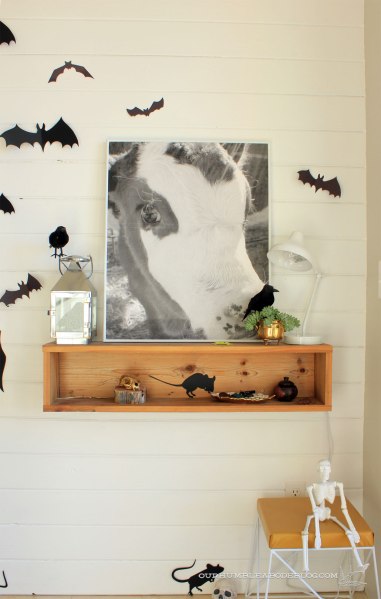
Halloween-Entry-ConsoleDecorations

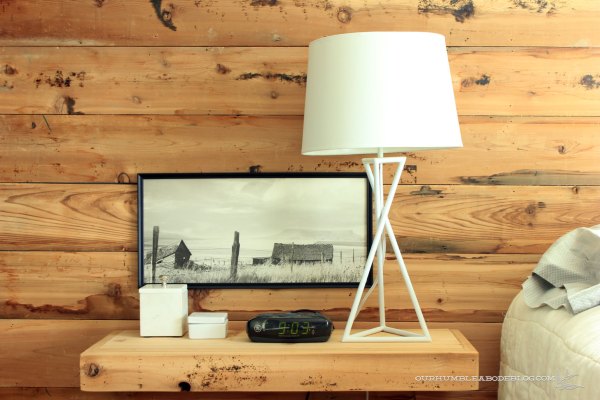
After using the entry shelf, I decided I wanted a single shelf, as the lower would be another surface to fill.  I tossed out the idea of a basic shelf with black brackets, but Ben thought it would look off.  We agreed a floating shelf would look great and blend best with the plank wall.  There are many ways to make a floating shelf, but here’s what we did.  For the base, we bought four heavy-duty right angle brackets.  Look for something with a consistent width, as this will determine the shelf spacing.  Mount the brackets into studs with the 90 degree angles to the outsides.

Master-Bedroom-Floating-Nightstand-Shelf-Brackets

Using scrap cedar, Ben built a hollow, tight-fitting box using the brackets as spacers.

Master-Bedroom-Floating-Nightstands-Hollow-Inside

Then, the box frame slides over the brackets.

Master-Bedroom-Floating-Nightstand-Frame-Cover

As a bonus, cords tuck inside the shelf, hiding away the extra length.

Master-Bedroom-Floating-Nightstand-Detail

My nightstand is 24 inches wide and centered on the area between the bed and wall.  I hung a small square print to add interest to the grouping.

Master-Bedroom-My-Nightstand

To make up for the slightly wider space on Ben’s side, we built his at 30 inches wide.  It’s mounted the same distance from the bed as mine.  A wider print fills the space nicely.

Master-Bedroom-Floating-Nightstand-Bens-Side

Now to finish painting the room and get longer curtain panels.

Master-Bedroom-Floating-Nightstand-Overall

And we should get the outlet properly mounted and covered.  Ahh, there’s always something.

His and Hers Tasks

Good news, everyone.  The siding is 99 percent finished!  Ben took the last three days off work to get everything done before this weekend’s cold snap hits.  After starting with the most tedious part, everything went up smoothly and mostly without incident.  With much hemming and hawing, we decided to wrap the bathroom bump out in steel.  During install, Ben was on the scaffolding while I was at the bottom pounding each panel up.  While pounding a panel in place, a prybar fell off the scaffolding and on my arm.  A string of four lettered words spewed out of my mouth.  Other than that, no problems.

Lower portions were a breeze by comparison and Ben had most finished by day 2.

Steel-Siding-Lowe-Section-on-Front

We know this siding choice is different.  People seem to love it or hate it.  Fortunately, several neighbors have come over to tell us how much they like it.  They could love the steel, or just that it’s finished.

Steel-Siding-on-Garage

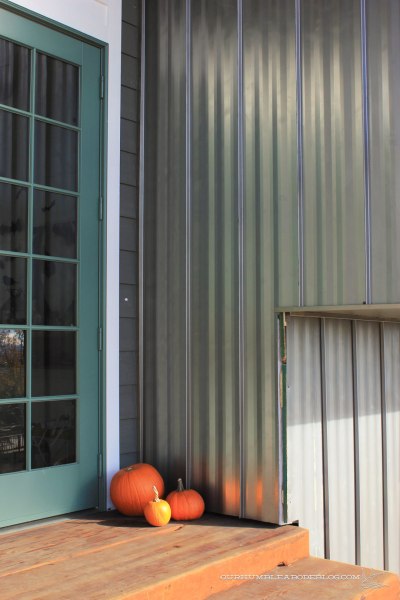
Regardless, we’re thrilled.  Both with the look and that we’re almost done.  To finish off the outside corners, we’re waiting on five pieces to cover the edges.  You can see one by the front door.

Steel-Siding-by-Front-Door

While Ben was siding (and didn’t need my help), I was inside painting trim and a few walls.  Here’s a peek at the first coat in our bedroom.  As the McDonald’s slogan goes, “I’m lovin’ it.”

Master-Bathroom-Wrought-Iron-Sneak-Peek

Hopefully tomorrow we’ll get our siding trim pieces to wrap things up.  Once that’s finished, we can take down the scaffolding and get working on kitchen plans.  Wishing you all a fun and productive weekend.

Siding of Steel

On Friday, Ben got the call we’ve been waiting for.  Our steel siding is done and  ready to pick up.  Hooray, we can actually finish the outside of our house!  However, we did stray slightly from our original plan.

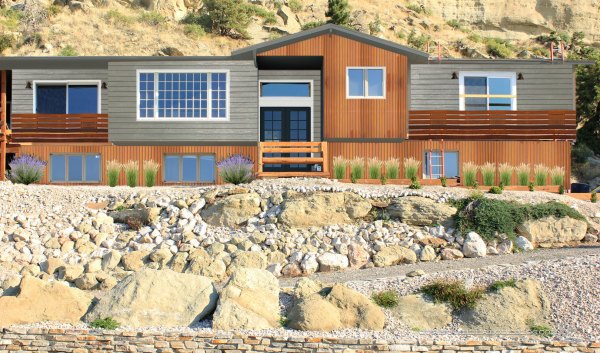
Photoshop-House-Plans-Bathroom-Bump-Out-Rust

Using corrugated rust steel was always the intention, until we started weighing the pros and cons.  Corrugated is more rigid and larger panels mean quicker install.  However, the 40 inch wide panels can make some cuts more difficult.  All exposed screws must be lined up to keep it looking nice, too.

So, what’s the other option?  Standing seam steel, that has a board and batten look.  These panels are 13 inches wide, which is better for intricate cuts and are easier to shimmy into the channels.  It is also secured with hidden fasteners, so there are very few exposed screws.  Standing seam was actually about 30 cents cheaper than the corrugated, but the hidden clips bump the price up another 50 cents per square foot.  After talking with the company, measuring, and giving them our cut list, we placed our order.  Then patiently waited for it to be manufactured and tackled a few loose ends inside.

Having never installed steel siding, we thought it best to start on the less visible back side.  Which also happens to be the most difficult area with angled cuts, windows and doors, and a few light boxes, too.  Overall, install went really smooth.  A special steel cutting blade (we bought ours with the steel) makes cuts quick and even.  Channels surround the windows and doors, allowing the steel to tuck inside for a tight seam.

Steel-Siding-Back-Progress

Every two feet or so, clips snap on to the steel, and then get screwed into the wall.  The next piece covers the edge and the process repeats.

Steel-Siding-Hidden-Fastener

Even with the learning curve and funky cuts, the back took less than a complete weekend to finish.

Steel-Siding-on-Back-Wall

Ben kind of freaked out the guy when he picked up the steel by jokingly asking, “If I leave this outside, it won’t rust, will it?”  Our plan is to see how much it weathers over the winter.  If we want to quicken (or even) the process, we can spray it with water.

Steel-Siding-on-Back

Next up, finishing the front and garage sides.  I’m sure everyone, neighbors included, will be happy when we’re finished.