Cedar Planked

I’ve mentioned this year’s big task, operation siding, many times.  While we’re still no closer to finishing due to weather, we have made some progress inside.  In the form of a reclaimed cedar planked wall.
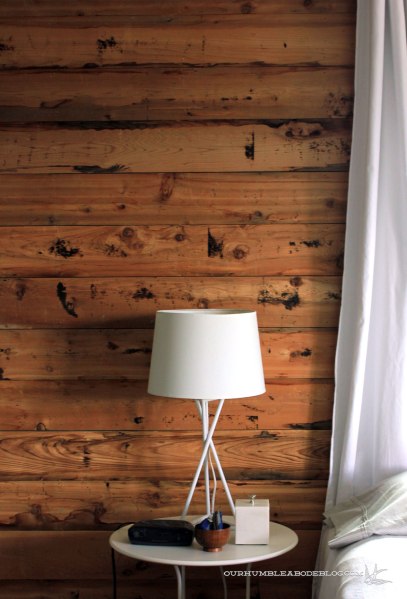
Cedar-Planked-Wall-with-Lamp

Our bedroom has received so little attention (only a coat of paint and plain Jane white curtains) and neither Ben or I ever felt excited about it.  Sad, because master bedrooms should feel like a retreat.

I never thought I’d love tattered old wood as much as I do in here.  The reclaimed wood feels like a big, warm hug for the room.  And the perfect starting point for a full makeover.
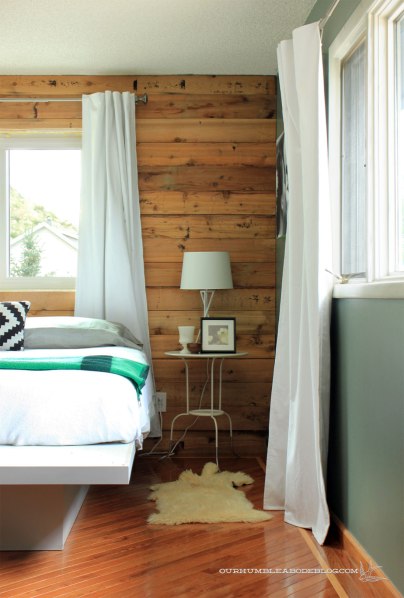
Cedar-Planked-Wall-Against-Table

Okay, calling it ‘reclaimed’ makes it sound super special and old.  Really, it’s just the back of old cedar siding.

Cedar-Siding-Before-Planks

Yes, our old, blue cedar siding.  While the finished side had seen better days, most of the backs were in great shape.

Several months ago, I told Ben I wanted to plank our headboard wall in old wood.  Being a dude, he was immediately on board.  Did ya get that pun?  We tossed out the idea of pallets, but we’d have to save and disassemble them.  Old barn wood can get pretty expensive these days.  So when we pulled off the siding, we knew we wanted to save it from the landfill and put it to use.  The first step was pulling out every nail and staple. Our siding is similar to tongue and groove, so Ben cut off the edges by running each piece through the table saw.  In the photo above, we had already finished one side.  Our pieces are 6 inches wide once ripped down.

Most of the pieces had cupped over time, creating a slightly less than straight piece.  To remove this and allow the boards to sit flat against the wall, Ben ran the blue sides through the planer.  We have the 13 inch Ridgid, if you’re looking for a nice, affordable planer.

Cedar-Planks-in-Planer

In our original plan, we wanted to plane both sides to a smooth finish.  Unfortunately, the cedar had different plans.  It gummed up and dulled the blades really quickly.  On to plan b.  Installing the planks as is to paint over.  To secure each piece to the wall, we marked out studs, drawing a line up with a level.  The arrows show each line:
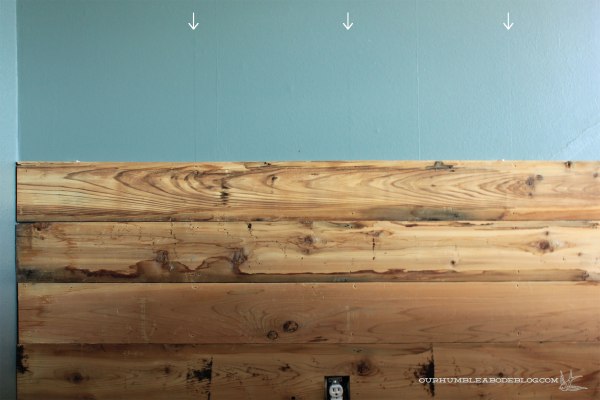
Cedar-Planked-Wall-Studs-Marked

Using the 2 1/2 inch 16 gauge nails, we nailed into each stud on the top and bottom.  Rather than butting the boards together, we used nickles to leave a small gap between each board.
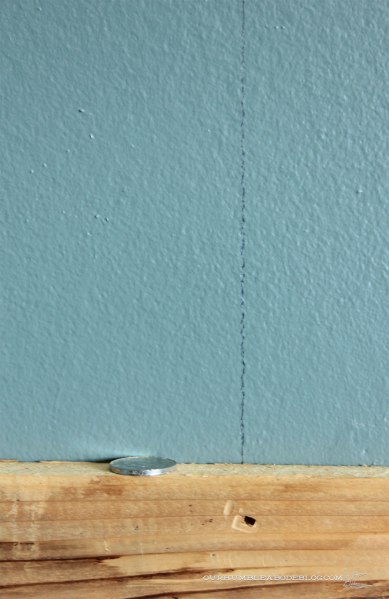
Cedar-Planked-Wall-Process-with-Studs-Marked

This process was super quick and we had a nearly finished wall in about two hours.
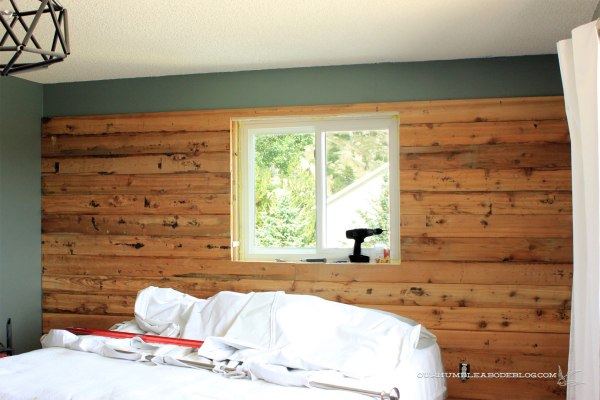
Cedar-Planked-Wall-in-Progress

Once we finished, we put the room back together, including the curtains.  And we absolutely loved the wall.  Old holes, bits of tar paper residue, and all; no painting necessary.

Cedar-Planked-Wall-Finished-Overall

One of the quickest, biggest impact projects we’ve done.  Let’s plank all the walls now!  And the first thing we’ve done in our room that has made me downright giddy to tackle more.
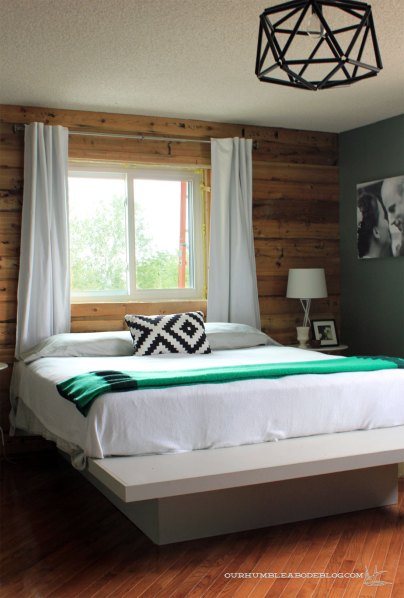
Cedar-Planked-Wall-to-Right

Because the rest of the room certainly needs help.  A lot of help.  And this was just the project to motivate my ass.
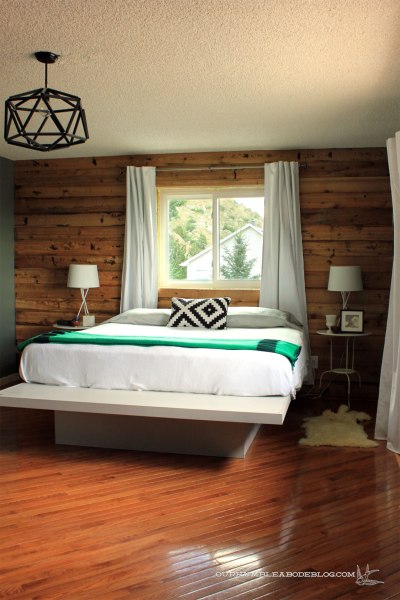
Cedar-Planked-Wall-to-Left

Next up, scraping the popcorn ceilings.  Fortunately I have experience in this department and it was surprisingly fun to do.  It’s the patching after that sucked the big one.  But, but! (and mine is a big one) if I want to work on the rest of the room, it must happen first.  I’ll be back with the rest of the plan for the room soon.  Until then, let’s talk old wood.  That’s what he said.

Chevron Leaves

Recently, I promised myself I’d bring more green and naturals into our house.  The bathroom is sporting a new lush look, why not add some to the living room?

Main-Bathroom-Green-Vanity-Overall

Until now I had my quirky sit and stay text bubble pillows on the chairs:

Map-Art-by-Window-in-Living-Room-Overall

Not at all natural, were they?  For a quick change, I pulled out a remnant of mossy green linen.  Great color, but alone it looked boring.

Green-Leaf-Pillow-in-Living-Room

Inspired by nature, I stamped a leaf design.  Three cheers for new life to that side of the living room!  Look at my plants, too.  Four over there, including the finicky maiden hair fern.  I haven’t killed it.  In fact, it has a ton of new growth.  It’s a miracle!

Green-Leaf-Pillow-on-Chair

After debating patterns (random, circles, lines) I settled on a chevron pattern.

To create the uneven texture, I used a piece of a foam to go box as a stamp.  Using a knife, I cut out a leaf shape.  A pencil tip worked perfectly to press light veins into the leaf.

Stamping-Supplies-Green-Leaf-Pillows

Stamping was quick and I didn’t fuss over evenness of the paint or placement.

Stamping-Green-Leaf-Pillows

Green-Leaf-Pillow-Detail

Green is good for my mood; it perks me and my home up.  Fun and fresh without being crazy or dramatic.

Green-Leaf-Pillow-in-Chairs

Green-Leaf-Pillows-in-Living-Room

What’s your favorite color to decorate with?

Faux Real

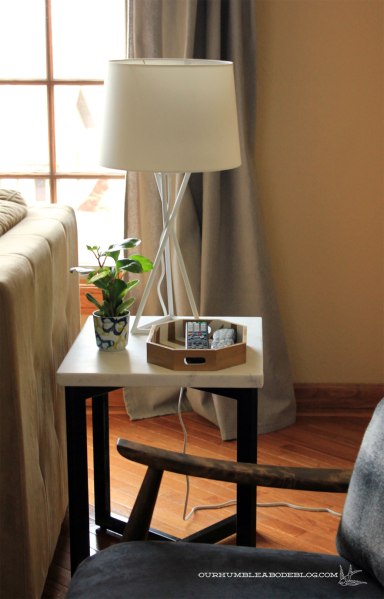
I’m still changing things in the living room.  The triangle lamps I made just weren’t perfect in the room.  Quite honestly, they got knocked over a lot because the bases are very light weight.

Honed-Marble-End-Table-Top-Right-Side

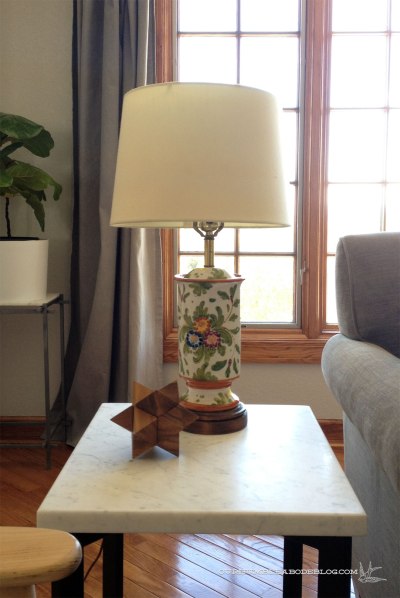
I still love them, so they’re in our bedroom and out-of-the-way of little hands.  While dropping a few things off at the thrift store, I spotted this lamp for five bucks.

Ceramic-Lamp-Before-Faux-Zinc

Instantly loved the shape, but not the design.  If it were only leaves, I think it would have looked beautiful.  The flowers and orange were too much for my taste.  So, I changed it up, inspired by pretty zinc lamps like this:

And this Zinc lamp from A Place in the Garden:

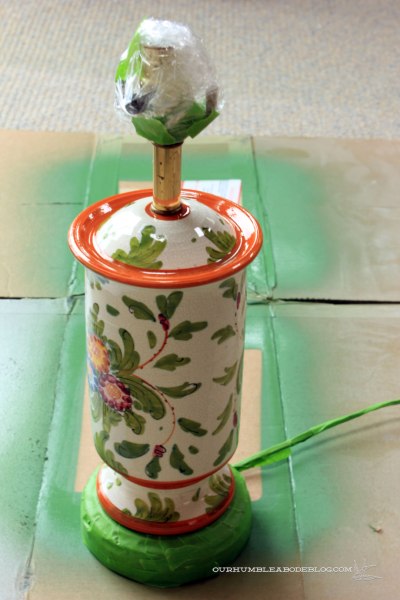
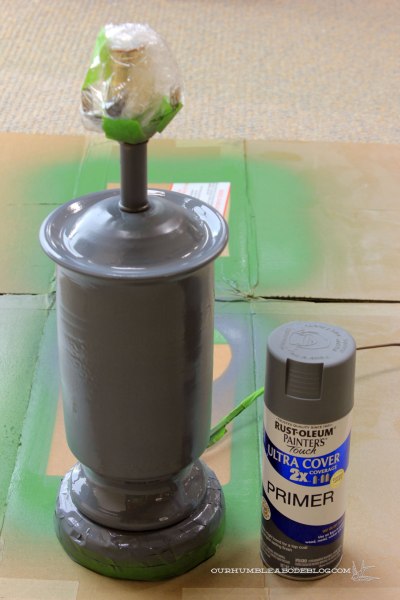
Before I could start spraying, I taped off the socket, cord and wood base.

Faux-Zinc-Lamp-Taped-for-Spray-Paint

Then gave the lamp two coats of gray primer, holding it upside down for the second to get the undersides.

Faux-Zinc-Lamp-Sprayed-Gray

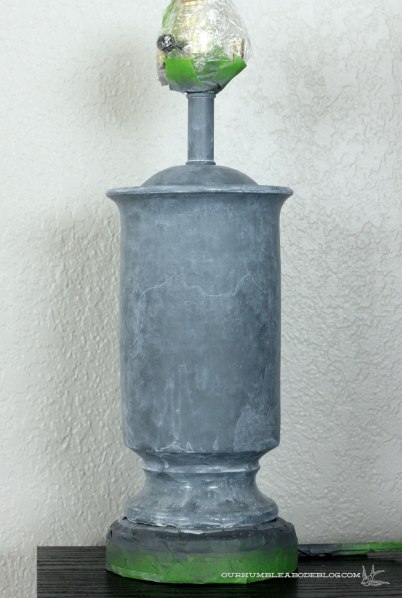
To create the aged effect, I diluted white craft paint with an equal amount of water.  Using a 1/2 inch craft brush, I applied the mixture to 4 inch sections all around the lamp.  Don’t go for even here and let it puddle and drip.

Faux-Zinc-Lamp-White-Wash

I followed up with a very crumpled, slightly damp paper towel.  Lightly blotting pulled off the extra, but I left enough to look worn.

Faux-Zinc-Lamp-White-Wash-Blotted

Here it is after it dried:

Faux-Zinc-Lamp-Finish-Dry

Liking the finish, I pulled the tape off and realized I didn’t want to keep the wooden base.  So I taped off the upper lamp and sprayed just the wood base gray.  After the faux finish, I had a zinc looking lamp that won’t tip over easily.

Faux-Zinc-Lamp-Overall

I also swapped the shade for a white drum I had for a sleeker look.

Faux-Zinc-Lamp-Finish

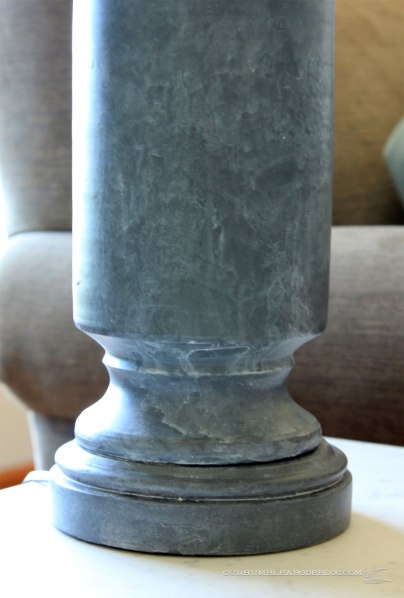
For added protection, I sprayed the lamp with three coats of clear matte.

Faux-Zinc-Lamp-Detail

For $5, I’m super happy with the look.  What do you think?  Have you tried a faux zinc finish?  Now to find the perfect floor lamp for the other side.

Natural Linen and Special Walnut

That ugly, dirty, orange thrifted sofa isn’t so ugly anymore.  Over the past week, I’ve given it a makeover and new life.

Thrifted-Vintage-Orange-Sofa-Front

I started by removing the cushioned section from the wooden frame.  The back middle leg was loose, so I glued the plugs and clamped it overnight.  Then I started pulling away the dated fabric.

Thrifted-Vintage-Sofa-Pieces

When tackling an upholstery project, I like to take pictures of pieces as I go.  If I get stuck or can’t remember how things went together, I have pictures to go by.

Thrifted-Vintage-Orange-Sofa-Arm-Underside

Back sections always go on last, so it’s the first to come off.

Thrifted-Vintage-Orange-Sofa-Back-Removed

Followed up with the arms.

Thrifted-Vintage-Orange-Sofa-Arm-Exposed

See all that nasty stuff that was stuck in the crack?  Eeew.  I also found old gum on the under side of the frame.

Thrifted-Vintage-Orange-Sofa-Arm

When I pulled the fabric off, I saw the arms were barely padded.  Underneath matching solid oak arms.  I opted to leave the arms open because I liked the look better.  A few screws, accessible from the underside hold the arms to the main frame.  I’ll skip the refinishing steps, because I didn’t really follow the rules.  Also, my hands were busy, so I couldn’t take photos.    Basically I sanded the entire frame with 220 grit paper until I was down to bare wood.  To give a rich finish, I applied one coat of Minwax Special Walnut stain, followed up with two layers of Teak Oil.

Thrifted-Vintage-Sofa-Overall-After

As for fabric, I fell for a natural linen.  I’ve never had linen upholstery, so I’m hoping this hold up.  If it doesn’t, I’m only out the cost of fabric and my time.  Because my fabric has a little more stretch than thicker upholstery fabrics, I decided not to sew box cushions for the back and seat.  This way, if the fabric stretches or looks saggy, I can give it a stretch without it looking strange.

Thrifted-Vintage-Sofa-in-Living-Room-After

I also replaced the old worn out seat foam with a 3 inch high density foam for extra padding.

Thrifted-Vintage-Sofa-End-After

Leaving the arms open is my favorite change.  With little padding, the arms weren’t soft and comfortable, so this is just a better looking version.   That’s one of the super Western and manly leather pillows Ben made, too.

Thrifted-Vintage-Sofa-Arm-Side-After


Simple lines on the back are my second favorite thing about this sofa.

Thrifted-Vintage-Sofa-Back-Overall-After

To keep it simple, I stapled a strip along the top for the fabric to fold over.

Thrifted-Vintage-Sofa-Back-Top-After

On the sides, I had to improvise.  I couldn’t find a tack strip to stuff the fabric into.  And nail heads looked too cluttered.  Instead I stapled along the top of the fabric, then made strips to hide the staples.

Thrifted-Vintage-Sofa-Back-Corner-After

Sleek and simple with a slightly rustic look.  The crazy oak grain is fun and the linen compliments it without drawing attention.

Thrifted-Vintage-Sofa-Back-After

Also, I’m not sure what main couch will stay in this room so I want a go with anything neutral.  Ben wants leather and I most like the look of the camel toned Foxtrot from Flexsteel.

Wouldn’t the camel and linen look great together?  Problem is, local stores don’t have this in stock.  We don’t know if it’s comfortable, if we like the look in person, or a price.  Clearly we still have some research to do before we can make a solid decision.

Feeling Groovy

Adding the West Elm Mobile Chandelier and vintage Longhorns added some interest to our blank entry.  But it was (and still is, really) a far cry from what I’d consider finished.  I mean, half torn off, waiting to be replaced crown doesn’t scream finished.  In fact, it looks awful.

West-Elm-Mobile-Light-in-Entry

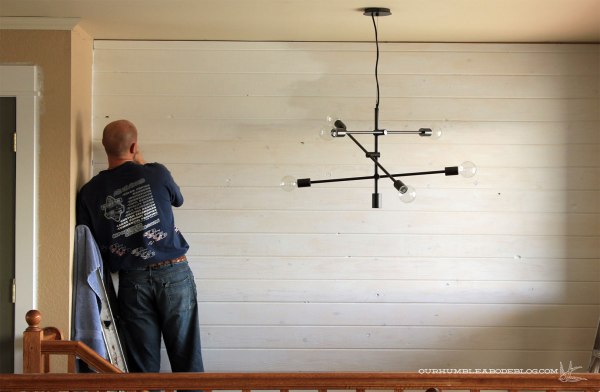
As do the peach, heavily textured knock down walls throughout the entry, living, and dining rooms.  It looks the worst on the large 12 foot expanse.  But, we did take a big step in the finished direction this weekend.  Luckily, Ben and I are both fans of painted tongue and groove strips; a great cover up option for ugly walls.  We’ve got a blank slate accent wall.

Tongue-and-Groove-Entry-Wall-from-Living-Room

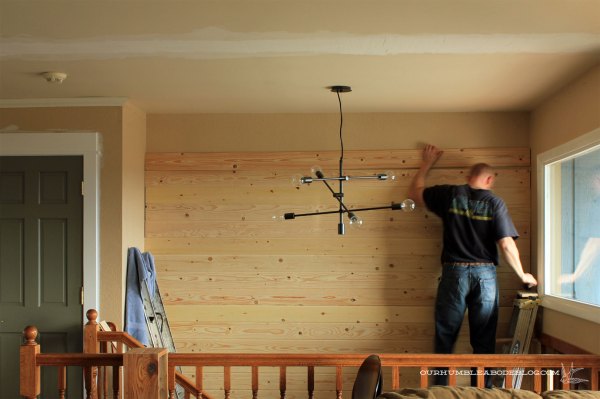
I’ve never had an accent wall.  We started with tongue and groove planks, starting level with the entry floor, then down and up from there.  Nailing into studs to secure the boards in place.

Tongue-and-Groove-Entry-Wall-Bottom-Install

Going down was easy, just a few angled cuts along the stairs.  But going up wasn’t so smooth.  Being 12 feet off the floor on the right side, and 16 off the left made it tricky to get everything to the top.  Fortunately Ben knows his way around a wobbly ladder.  Me?  Not so much.

Tongue-and-Groove-Entry-Wall-Install

I tried priming the wall, starting at the top, but my short T Rex-ish arms couldn’t reach.  Though he thought it hilarious, he instead took over the priming and painting.

Tongue-and-Groove-Entry-Wall-Starting-Paint

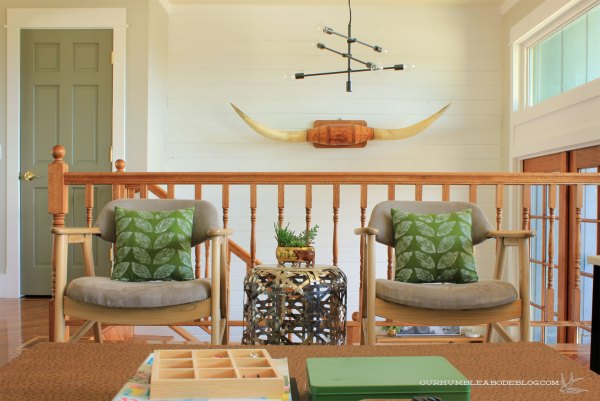
This pine has heavy grain and knots, so it has plenty of character and texture.  Even when painted.  But still looks neutral to allow the light and horns to be the real focal points.

Tongue-and-Groove-Entry-Wall-Texture-Detail

Though this railing isn’t my favorite, it looks significantly better against crisp white.

Tongue-and-Groove-Entry-Wall-with-Railing

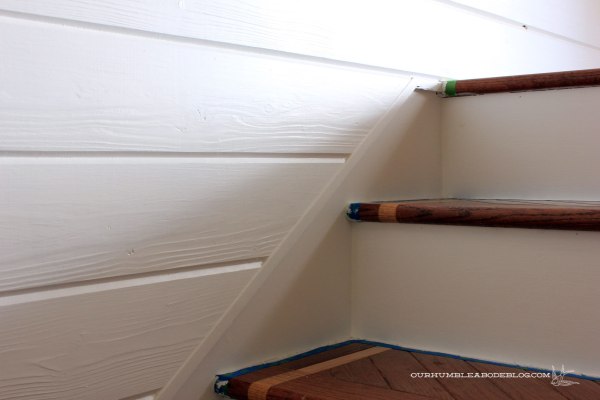
We still have some trim pieces to add before putting the final coat of paint on.  The angled trim pieces along the stairs are only 1/2 inch thick, so I’d like to add a cap to thicken it up.

Tongue-and-Groove-Entry-Wall-Stair-Trim-to-Thicken

We did this on the planked side, and it adds just enough thickness for the boards to sit against.

Tongue-and-Groove-Entry-Wall-Stair-Trim

Crown can go up around the entry, living, and most of the dining next.  Again, the lone piece isn’t the look we’re going for.

Tongue-and-Groove-Entry-Wall-from-Door

Except the back dining wall, where the 8 foot door goes to the ceiling.  We’ll have to add crown there after we’ve replaced the door with a window and a normal sized header.

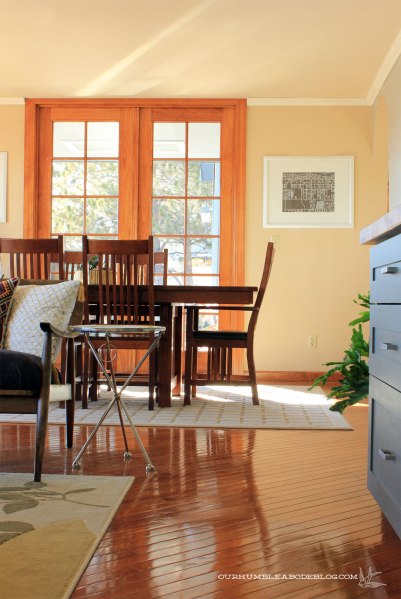
Grid-Rug-in-Dining-Room-from-Living-Room

But, I’m willing to paint the room, even if the windows and trim will change soon.  Those peach walls have been here too long.  I’ll paint the dark garage door and new railing white for a seamless look.