What’s the Deal?

Whether it’s family, friends, or readers, the most often asked question about our house is related to the most crazy feature: the pool house.  It’s a large room with a deep indoor pool.  Here’s the view from the house when we moved in:

New-House-Pool-Room April 13 2012

And looking back from the fountain seen above:

New-House-Pool-to-House-April-13-2012

Clearly, the main feature and purpose of this room is the pool.  But, if you look at the above photos, you’ll see a recessed hot tub and a raised wet bar area.  When we bought the place, the pool hadn’t functioned in several years.  In the 10 or so years the previous owner had been here, the hot tub had never worked.  Instead, the pool had very disgusting water lingering and festering.  We sucked out the remaining water and ripped out the sun bleached and damaged pool liner.

New-House-Pool-Tearing-Liner

Before we could landscape and build our single level deck, we had to knock out the platform:

Half-Demoed-Pool-House-Wet-Bar

To be able to cut out the concrete

Pool-House-Wet-Bar-Window-To-Lower

and lower the door and window:

Pool-House-Door-and-Window-from-Inside

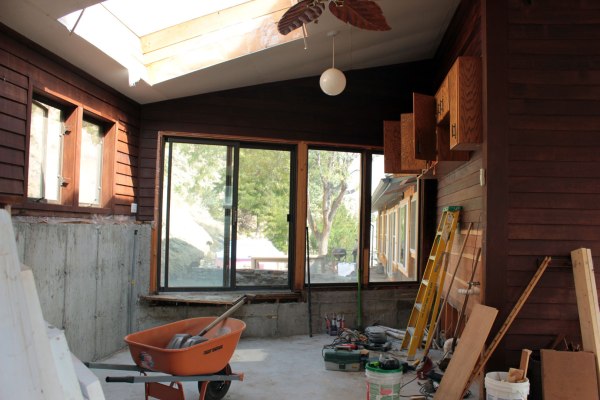
One thing always seems to lead to another.  Or requires something to be done before the next can happen.  All of that to say the pool house isn’t looking nice these days.  See what I mean?

Pool-House-from-Kitchen-Aug-2014

Essentially, we use the space as our personal warehouse.  Those stacks are rigid insulation that we’re using to wrap the house.  On the floor we’ve got siding and exterior trim.  You can see the saw horses where I prepaint the trim white.

Pool-House-Front-Aug-2014

When we replaced the cedar shake roof, the plastic wrap around the skylights came loose.  So that dangles down in a really graceful way.  Ha.

Pool-House-Side-Aug-2014

As stunning as it currently is, this isn’t our permanent plan for this space.  Before we can get to any of the pretty parts, we have to remove the plastic ceiling panels and the dark stained siding.  Then, we’ll wrap everything in two layers of the rigid insulation panels to hold in heat during the winter.

Here’s what we’ve discussed for the finishes in the room.  On the ceiling, we want to use tongue and groove wood.  Whether we leave it natural, stain, or paint it is still up in the air.  For the walls, we’re leaning toward the same lap siding, but painting it a lighter neutral.  A section of the back wall is two feet deeper than the rest.  We’ve thrown out the idea of creating a rust steel accent wall there, to help tie the exterior in.  Those giant beams will get a good sanding and clear coat.  I really like the original lights, so those will stay.

Pool-House-Back-Wall-Aug-2014

In place of the recessed hot tub, we’ll cover the hole, tile over it, and put in a stand alone tub.  They’re so much more efficient and accessing the plumbing is a necessity.

Pool-House-Hot-Tub-Area-Aug-2014

I mentioned tile, and we’re really hoping to use a natural material.  Perhaps the same slate we used in the master bathroom because we love it so much.  It’s not slippery or slick, and looks amazing.  Most of the doors and windows are fogged up, which means the seals are broken and need replacing.

Pool-House-Bath-and-House-Aug-2014

Over in this corner, we’ll add a kick ass kitchenette.

Pool-House-Back-Door-Aug-2014

Once we remodel the kitchen, the sink and some of the granite will get reused in here.  We thought the old range would live in here, too.  Until fate changed that plan.  Almost two years ago, we found a barely used 48 inch range on Craigslist for a song.  Initially, we thought we’d use it in the kitchen, but decided we’d rather have double wall ovens and a cooktop.  So, the steal of a deal range will allow us to bake out here in the summer, without heating up the house in the process.

Pool-House-Kitchen-Aug-2014

As for the pool itself, we do plan to fix it.  It might need some new plumbing work, and certainly needs a new liner.  Most of these plans aren’t a priority.  We’ll have to change out the doors and windows soon-ish.  Some kitchen work will probably happen when we work on the main kitchen.  Other than that, we’ll just have to see when things happen.  For now, it’s an extremely convenient place to store everything we need for larger projects.

Technicolor Landscape

With all the rock we hauled, moved, and spread last summer, this year’s landscape work is a walk in the park, comparatively.  That’s kind of a literal way of going about it, too.  A lot lately, I’m wandering around neighborhoods, looking at my favorite yards for plant inspiration.  Or local nurseries, Home Depot, and Lowe’s.  Over the last year, I’ve been collecting data, looking for full sun plants that can handle heat and cold.  Those twelve aren’t the only good/usable/pretty plants, though.

I’ve become borderline obsessed with Russian Sage.  It’s all over around here and I’m totally envious of the mature plants I see.

A plant that is cold hardy, loves full sun, and requires little watering gets an A+ in my book.  I’ve recently added a few to our yard, and I’m impatiently waiting to put in more after siding wraps up.

In addition to non native plants, like the leafy evergreen boxwood, bright spirea, and shade loving hostas, I want to layer in native plants.  Coneflower, black-eyed Susans, and Lupine grow wild in Montana.  These pink ones will add a nice burst of color.  Coneflower

At the very least, I’ll incorporate native looking plants, because most native plants aren’t available for purchase.  I’m thinking several ornamental grasses.  Foerester’s feather reed grass performs well, as do Elijah Blue Fescue and various fountain grasses.

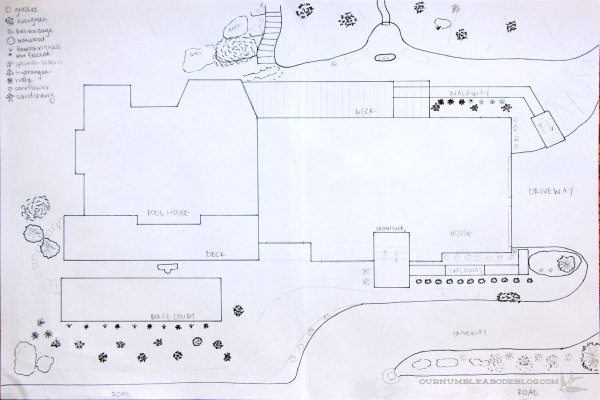
So I drew up a plan.  In part to show Ben exactly what I’ve got in mind.  Also because I can go plant crazy and need a plan to stay focused.  Or, for the times I go plant crazy and he wonders what the hell I’m doing with all those.  Here’s a full property plan, not at all to scale:

Landscape-Plan-Drawing

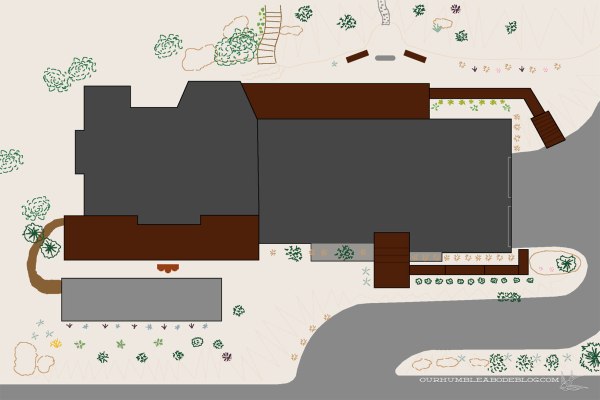
But because everything is better in color, this is the Wizard of Oz landscape plans, now in Technicolor:

Landscape-Plan-Current

The plan above is actually what I’ve already gotten in the ground.  Up front, along the bocce court I’ve added an assortment of evergreens, spirea, Russian sage, and grasses.  A few buffalo junipers, succulents, hosta, and hydrangea are living in the back.  Since planning (and really wanting to liven up the limestone) I’ve become a plant addict.  In my mind, I’ve got at least 50 more plants to add around the house.  To help you understand the crazy in my head, here’s a plant key to guide you.

Landscape-Plan-Plant-Key

That’s a lot of plants dotted around.

Landscape-Plan-with-Plants-to-Add

I know it’s hard to see everything, so I’ve divided the plan into quadrants to explain.  In the top right section, alongside the walkway, I’d like a mix bag of ornamental grasses and native-like flowers.  In the shaded side, a few more hosta plants to fill in the gaps.  After the siding, a row of tall grasses will border the garage side.  Which I think will look stunning against the rust steel siding.

Landscape-Plan-Top-Right

We’ve kept the top left quarter (behind the pool house) native, so it has short grasses and native Trilobe Sumac.

Landscape-Plan-Top-Left

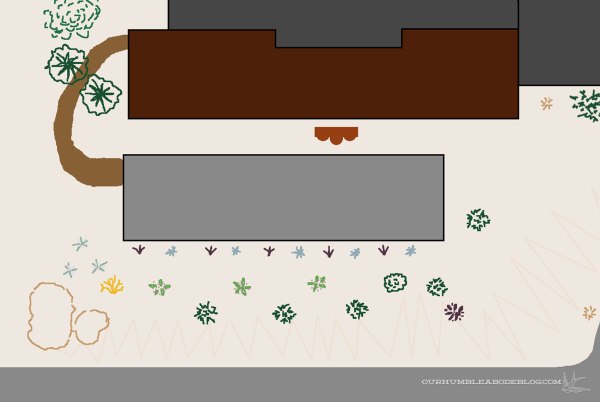
Going to the bottom left, we’ve got a row of alternating fountain grass and Elijah blue fescue close to the bocce court.  Next row has Russian Sage, a Spanish Broom, three spirea, and a boxwood.  Closest to the hill are nest spruce and a Purple Leaf Sand Cherry.  Oh, and the light zig zag is to show where the hills are.

Landscape-Plan-Bottom-Left

Last, between the road and driveway, another mix of creeping evergreens (to drape the rock in year round color) punctuated with Russian sage will soften the hill.  In addition to a straight line of bright green boxwood, I’d like a row of tall grasses close to the house.  They’re perfect because the upright nature doesn’t encroach on walking space.  Under the house bump outs, I want a few more grasses and low evergreens in front of the basement windows.

Landscape-Plan-Bottom-Right

I’m sure I’ll find other plants I have to incorporate, but the basic plan is in place.  My most impatient self is willing the plants to mature at a rapid rate.  Fill in, little buddies.

Lap it Up

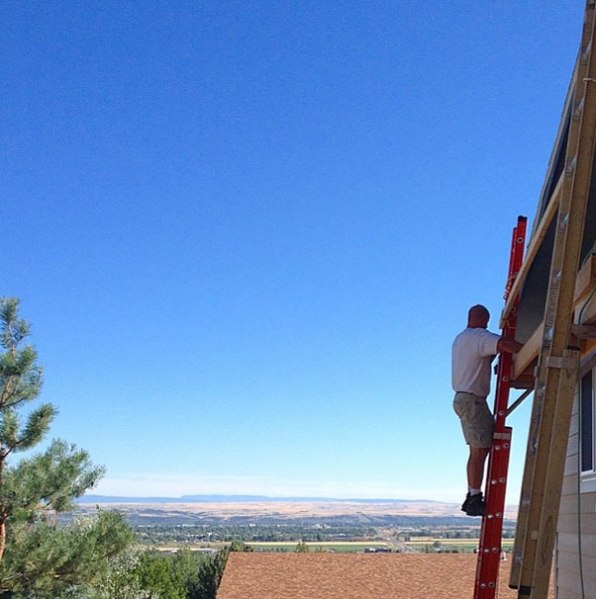
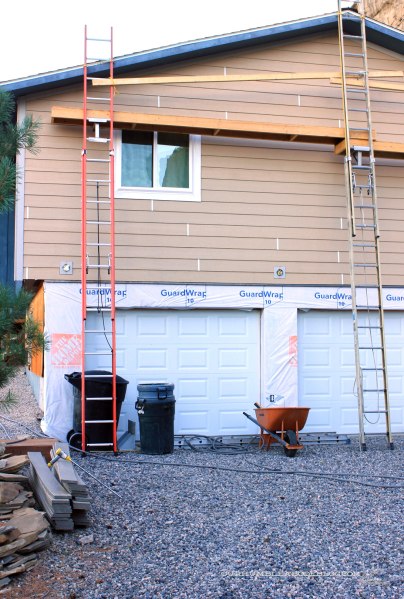
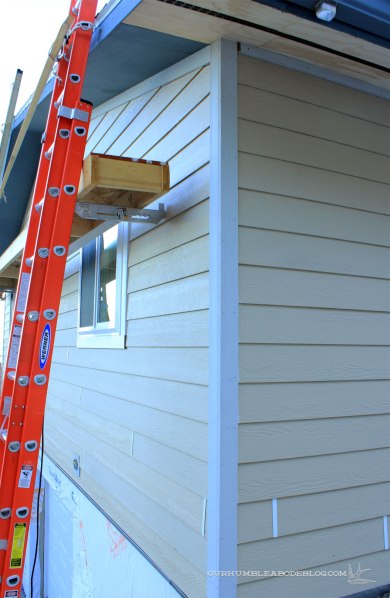
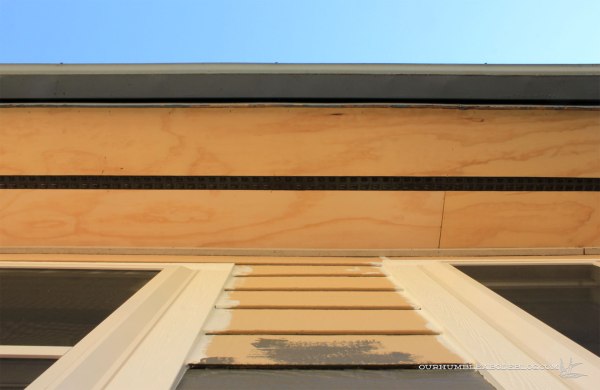
We had a wild and crazy weekend filled with siding projects.  Aren’t you jealous?  Friday afternoon, Ben finished installing the siding above the garage.  I caught him creeping outside the window. Friday-Night-Siding-Install Everything above the garage, to the peak, is lap siding.  Below will be corrugated rust steel, which we’ll install once the siding has been painted. Lap-Siding-Garage-End-Finished White, paintable metal pieces cover the ends of each board. Lap-Siding-Garage-End-Installed On the corners and edges, we used the same trim as the windows for the siding to butt into.  These pieces, along with the soffit and fascia, will get covered with dark gray paint. Lap-Siding-Corner-Deatil On Saturday morning, while we ate breakfast, we watched several hot air balloons take off and land. Hot-Air-Balloons After that, we went to work installing vented soffits. Lap-Siding-and-Vented-Soffit After that, I set out to caulk all the seams around the windows to be sure water can’t get behind the siding.  I followed up with two coats of trim paint to cover the caulking. Lap-Siding-and-Window-Detail We bought a few gallons of Mined Coal exterior paint from Behr to get started on edging. Lap-Siding-Cutting-in-with-Gray Lap-Siding-Finished-on-Back As usual, we’ve still got several steps to go before we can declare it finished.  Even then, we’ll still have to install the corrugated steel.  At least those are big sheets. Lap-Siding-On-Back-of-House More than anything, I’m looking forward to having a finished, not patched exterior.

Striped Sack

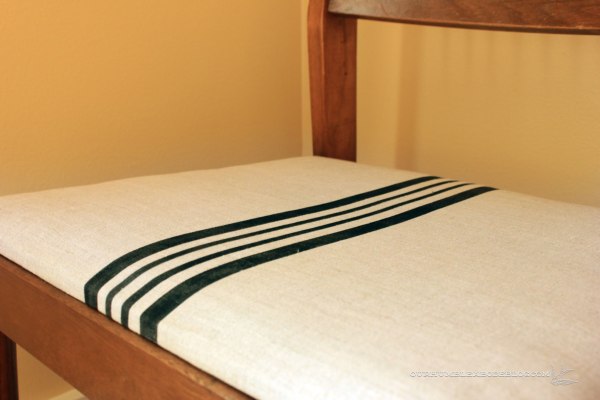
You know that free chair I got earlier this month?  Yeah, this one.  Also known as the three-legged wonder.  So I don’t actually call it that (just made it up, in fact), because that would be weird.  TLW just got a very quick new seat.

Flour-Sack-Chair-Seat-Finished-Stripe-Detail

If it looks like an old flour or grain sack design, it should.  Wanting to add more rustic elements, especially in the colorful guest room, I thought a the simple design was perfection.  Before starting, I gathered my supplies and inspiration.  To make a more authentic grain sack knock off, I searched images until I found a pattern I loved.  It happens to be this grain sack pillow featured on The Cavender Diary.  Four black simple stripes in varying widths.

To complete this I used a scrap of natural linen (ironed first), Frog Tape, a yard stick, pencil, black craft paint, and a natural bristle brush.

Flour-Sack-Chair-Seat-Supplies

To get started, I found the center of my fabric and made a mark at the top and bottom-where the lines would not be seen.  From those center marks, I measured my stripes.  My two middle stripes are 1/4 inch wide and 1/4 inch apart.  The two outermost lines are 1/2 inch wide.  At first, I started cutting down pieces of tape to make the narrow bands.  Then I wised up and taped off only one stripe at a time.

Flour-Sack-Chair-Seat-Stripes-Taped

For a varied look, I dipped the brush in paint, dabbed some off, and then painted between the taped lines.  Once that section dried, I pulled off the tape and moved to the next row.  After all four, I had my finished design.

Flour-Sack-Chair-Seat-Stripe-Detail

The old fabric reeked of cigarette smoke, so I pulled it (and another layer underneath) off before attaching my new piece.  Because I have only two hands (dammit, Gadget arms, work!) I centered my lines and taped each side to keep it in place when I flipped it.

Flour-Sack-Chair-Seat-Finished-Detail

Several staples on each side and two in each corner and I attached it to the frame again.  I saw past the broken leg because I loved the cute back so much.  Using a basic pattern (versus the detailed crewel fabric) better compliments the back.

Flour-Sack-Chair-Seat-Finished-with-Back

It looks mighty charming in the room, if I do say so myself.

Flour-Sack-Chair-Seat-Finished

Just realized, this too is a completely free project because I used left over fabric and supplies from other projects.  Even the chair was free.

Scrap Pile Creations

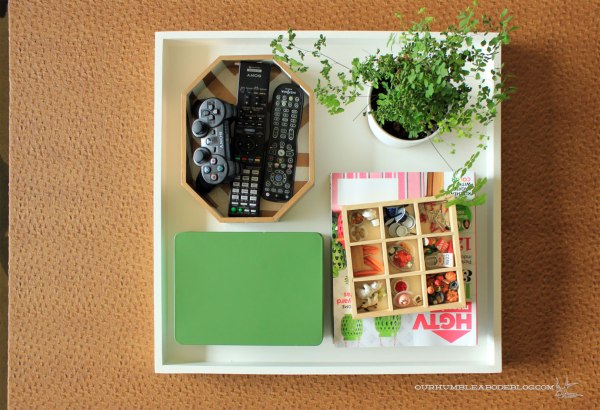
When I get the urge to create something, usually my first step is to raid my supplies.  Be it fabric, paint, or in today’s case, our scrap lumber bin.  It starts with a specific need, but finding ways to use left over materials is a slight way to push myself creatively.  Much like my cedar tub shelf.  And both pieces I made add function to spaces.  For our living room, I built a large square tray to corral everything on the coffee table.

Square-Tray-On-Coffee-Table-Room

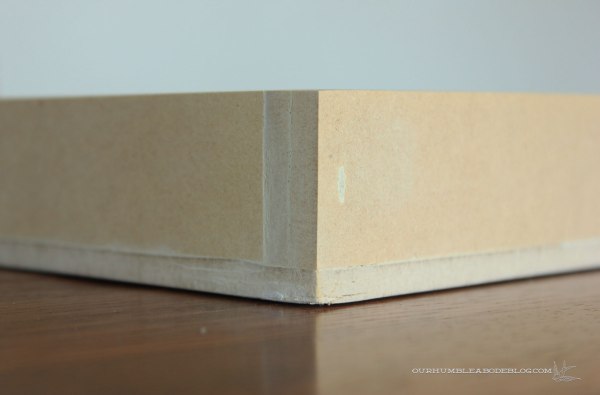
I started with a piece of 1/2 inch MDF that was 22 by 30 inches and an 8 foot strip of 1 1/2 inch wide 1/2 inch MDF.  I cut the 1/2 inch piece to 22 inches square and then four strips for the sides.  All trays are assembled the same way.  Thin base material with side material attached on top.  I used 1 inch staples in our air stapler to secure everything; undersides first, then corners.

Square-Tray-Edge-Detail

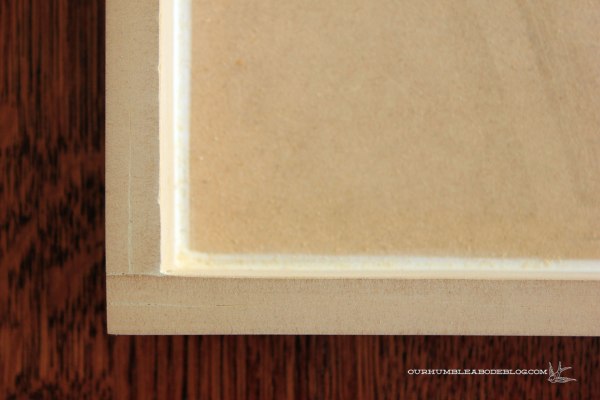
Due to the nature of MDF, it bulged out and cracked along the edges.  I wasn’t concerned because I knew I’d fill it with putty and caulk.  After filling the cracks and staple holes with wood filler, I caulked the inside corners.

Square-Tray-Assembly-Detail


Sanding everything smooth was quick and evened out the bumps.

Square-Tray-Top-Detail

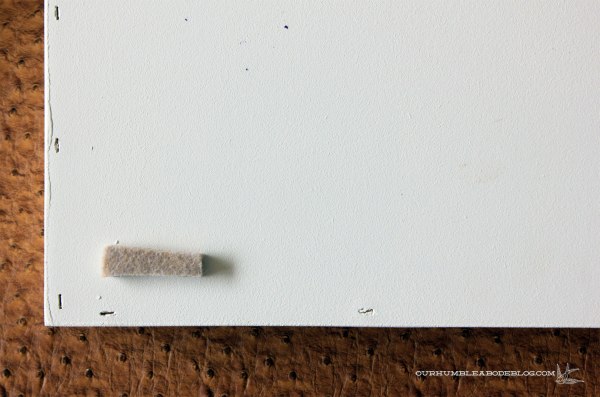
For durability, I used some white exterior paint.  After three coats, I took it outside to spray with clear gloss.  Two light coats in I noticed how the gloss had yellowed the finish.  Great.  I lightly sanded it again and did two more coats of white paint and called it a day.  Good enough, I can always repaint down the road.  To spare the table from damage, I added small rectangles of felt to the underside.  Clearly I didn’t care about the staples or paint drips on the bottom.

Square-Tray-Assembly-Detail-Underside

And now I’ve got a simple tray to keep magazines, remotes, and other crap (like the boys’ mini foods) organized.

Square-Tray-On-Coffee-Table-Corner

Because their minis are so adorable, I used a wooden drawer organizer (it was actually a tiny shelf) to display the collection.

Square-Tray-On-Coffee-Table

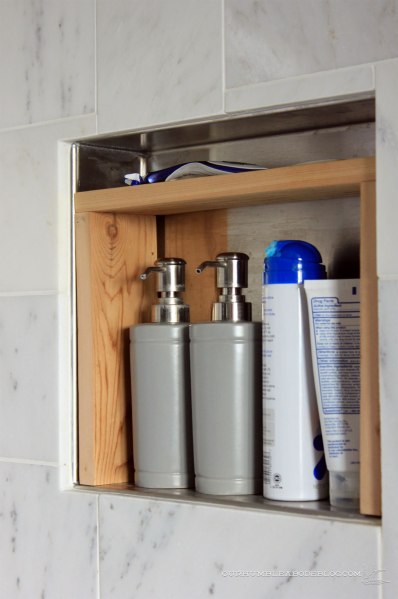
In other scrap pile happenings, I used a small chunk of left over cedar to make a shelf for our shower cubby.

Cedar-Shower-Shelf-Overall

Before assembly, I sanded all sides with 220 grit paper and drilled two pilot holes in each end of the top board.  Obviously this shelf is exposed to water, so I used stainless steel screws so it wouldn’t rust.  Once assembled, I coated it with teak oil for a protective layer.

Cedar-Shower-Shelf

The shelf holds a razor and bar soap, leaving more room on the bottom for bottles.  There, two quick and easy scrap projects that don’t cost a dime.