Walk This Way

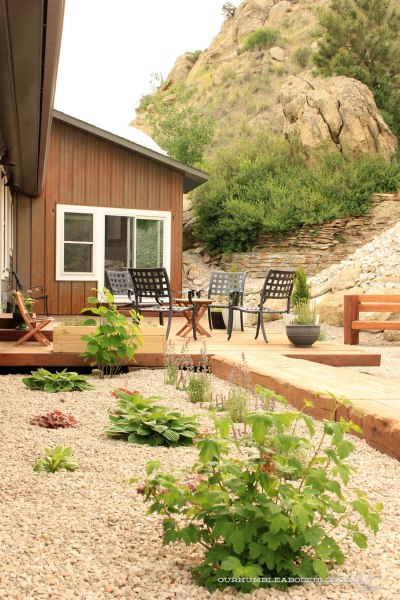
Over the last two years I’ve dreamed, researched, plotted, and planned, and at long last, I’m slowly tackling our landscape plan.  Having an incredibly steep lot, both front and back, has been challenging to say the least.  Before starting anything, we discussed oodles of options: wood, metal, concrete, or stacked stone retaining walls, all of which are difficult to secure enough to prevent leaning or toppling over time.  Yes, plenty of houses have these in our ‘hood, but they’re all leaning or have caved in heavy rains.  We kept coming back to one option, setting boulders against the natural slope to prevent erosion, but it also serves as a retaining wall, without being rigid and noticeable if it shifts a little.  But, that led to another decision to fill even the flat areas with rock, not knowing where or how to separate the slope from the flat areas.

Basically what I’m saying is, we have literal TONS, and tons, and tons of rock and while it’s super low maintenance, I’ve been looking for ways to break up large areas.  Of course, plants are a must and I’ve added 170 (no exaggeration) between this year and last, though I have deviated/changed up my landscape plan.  Sadly, I’m not finished, instead focusing my attention to the most noticeable areas, then I’ll take time to tackle the smaller, untouched areas later on.

Landscape-Plan-Current

Our bocce court is a water and hassle free way to section off a large rectangle.
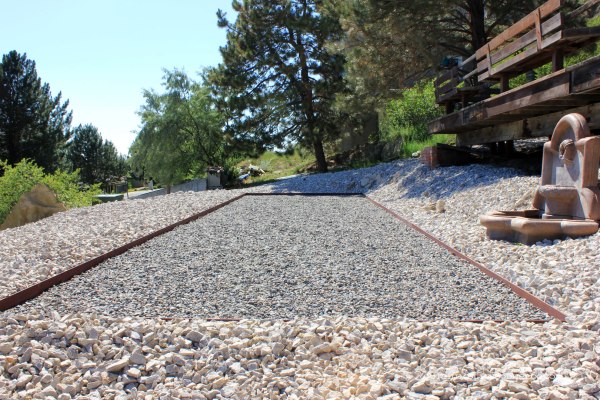
Another large part of the rock is broken up by the reclaimed beam back deck, stairs, and front steps, but between the bocce court and stairs was a long strip of super boring rock.  After nestling in a few pavers in the back, I knew adding a longer, winding path would add interest.

Flagstone-Pavers-to-Firepit-Detail

Reusing leftover pavers from the old back patio, I created a stepping stone walkway to connect the two areas.

Paver-Walkway-Toward-Wood-Stairs

Just off the step edge, narrower stones go between the Russian sage and day lilies.
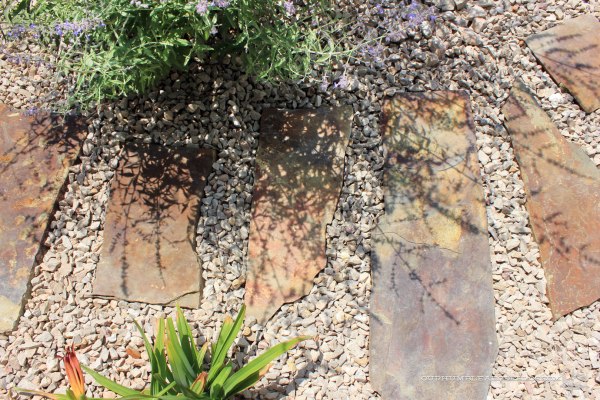
Paver-Walkway-Between-Russian-Sage-and-Lily

On the other side of the Russian sage, I plan to add a short ground cover plant below the basement windows, so I curved around, leaving room for growing plants.

Paver-Walkway-Start-of-Curve

Paver-Walkway-from-Steps-to-Bocce-Court

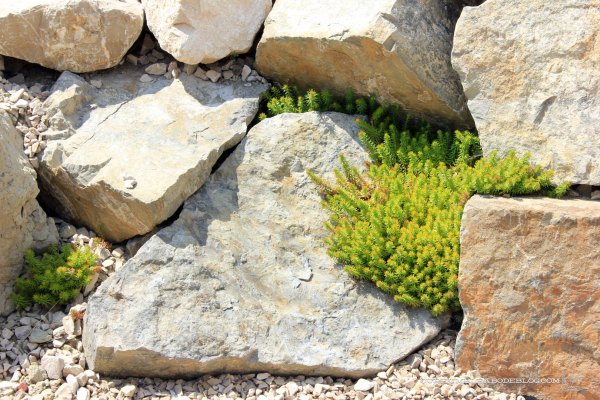
On the other side, I’ve already added my favorite succulent, a stonecrop Angelina.
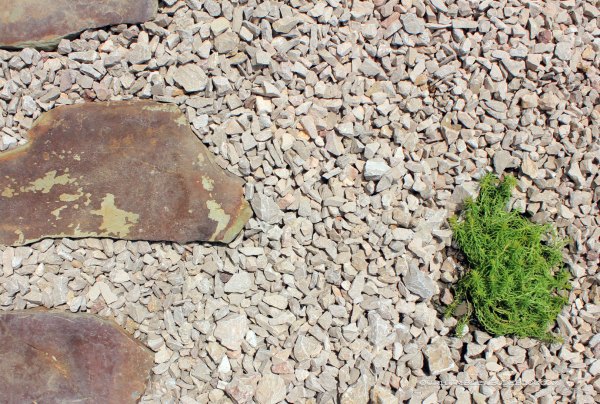
Paver-Walkway-Stonecrop-Detail

I know it grows well here with little water or effort because the one in the back near the waterfall has gone crazy over the last year.

Succulent-by-Waterfall-in-Back-Yard

Waterfall-Stonecrop-Angelina

Creeping junipers are always welcome, covering large areas with year round color, but need little maintenance.  To contrast against the deep emerald-green, I added two golden barberry plants.  Ben says the just look like dying plants, but I love the chartreuse color.

Paver-Walkway-Around-Plants

Looking from the bocce court toward the entry, things are taking shape, but still not finished.

Paver-Walkway-Toward-House

I find adding plants extremely enjoyable, bordering on addicting, but waiting for each to mature is a different story.  Much like children, even fast growing plants are hard to notice growth when seen on a daily basis.  You don’t see a startling difference, but looking back on pictures proves just how much they’ve changed in a short time span.

Big-Ass-Bench-on-Front-Landing

Look at the puny Russian sage not even a year ago, now they’re almost five feet tall!  Can you tell plants and landscaping have been at the front of my mind these warmer months?  Never before did I enjoy gardening, but I’m totally digging it now.  Oh the puns, the hilarity.  Now I feel like going through old photos of my kids and plants to fully appreciate the changes and growth that have taken place right in front of my face.  I didn’t realize how nostalgic a simple walkway could make me feel.

My Good Friend

I’m not sure about your house, but we have hard water, which leaves hard water spots that are especially noticeable on our stainless steel.  If the water gets wiped up right away, we don’t have problems, but of course, we actually live in our house so that doesn’t always happen.  Unfortunately, it leaves our sink area looking like this:

Stainless-Steel-Sink-Before-Bon-Ami-Cleaning

I know, it’s not completely awful, but my OCD side disagrees and I needed something that would work.  After discovering how awesome these cleaning wipes worked on our appliances, I thought I’d rest easy.  Cue the sad sound effects, because the wipes did work, but only until we wiped the sink with a wet rag and the spots showed up again.  I headed back to the store to see what else I could find, and that’s when I met my good friend, Bon Ami.

Bon-Ami-Cleaner-for-Stainless-Steel

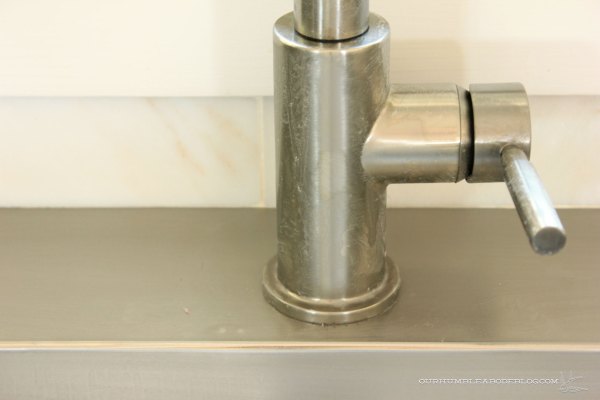
It’s about two dollars and basically powdered rocks, so it gently polishes the surface.  A damp sponge with a little sprinkle, followed up by a wet cloth to remove the residue, then a drying session does the trick for small areas like faucets.

Bon-Ami-Residue-on-Faucet


Always go with the grain of stainless to avoid scratching, but it’s amazing and thrilling how shiny the stainless looks after.

Stainless-Steel-Sink-After-Bon-Ami-Cleaning

What I really needed this for is our stainless steel shower pan.  As much as we love it, the water does spot like crazy.

Stainless-Steel-Shower-Pan-Before-Bon-Ami-Cleaning

See what I mean?

Stainless-Steel-Shower-Pan-Before-Detail-Bon-Ami-Cleaning

Finally, I’ve figured out a way to fight back, without using harsh, smelly chemicals.  To get a good clean, I generously sprinkle the base with the powder, then scrub, scrub, and scrub some more before rinsing and drying.

Stainless-Steel-Shower-Pan-After-Bon-Ami-Cleaning

This was after a light scrubbing, which removes the droplets, but a more intense scrub gets the drain lines sparkly, too.

Stainless-Steel-Shower-Pan-After-Detail-Bon-Ami-Cleaning

Not only does it work well on stainless, porcelain and enamel can get spiffed up.  Our old cast iron tub had a rust streak from the faucet, which came off with a good scrub.  Just thought this might be useful if you’re an OCD crazy and are prepping for guests this holiday weekend.

More Cushion

Just a few months ago, I ordered an 8 by 10 foot Jute Herringbone rug from West Elm to soften our family room.  I absolutely adore the neutral tones, subtle pattern, and how soft it is underfoot.  No scratchy material or nubby texture that hurts to walk on here, just a pretty rug to round out the seating area.

West-Elm-Rug-in-Family-Room-Overall

What I don’t love is that it lacks a backing, allowing it to stretch and bunch easily, especially around the coffee table and the sofa.  With such a heavy table on casters, it’s still easy to move, but the rug usually moves with it.  And the couch gets jumped on and pushed around by two little boys I know, which stretched one of the corners.  Ben wanted it to go, but I wasn’t about to let that happen.

West-Elm-Rug-in-Family-Room-Detail

I’ve seen plenty of cheap rug pads at box stores, but they’re thin and always smell awful, so I didn’t want to waste money on those.  Knowing rug pads aren’t the most glamorous or exciting detail, I put off my search.  Ironically, just after straightening out the rug, again, I received the perfect offer from RugPadUSA.

I could pick which of their rug pads suited my floors, rug, slip factor, cush level, and size to use in our home.  After looking at the many options, I landed on the 3/8 inch thick Premium-Lock Felt + Rubber rug pad, cut just a few inches smaller than my rug dimensions.  It arrived within a week and I wasted no time clearing the room, thoroughly vacuuming the floors, and unrolling it.  The pad had just the slightest odor, presumably from the rubber backing, but it quickly dissipated.

West-Elm-Rug-with-Rug-Pad-Corner-Folded

The under side is covered in a natural rubber backing, preventing slipping and sliding against smooth surfaces, while the top is cushy felt with a slightly sticky texture.  That sticky texture keeps the rug securely in place, but offers a nice cush underfoot.

West-Elm-Rug-and-Rug-Pad-Face

After getting the rug pad and rug back in place, I called Ben over to give it a test walk.  I joke that he’s a rug snob because he loves thick, dense, wool rugs.  He thinks the boys’ rug is so comfy that I should get another one for the living room, despite it being too small and well, too blue for any other rooms in our house.  For the first time since ordering the rug, he approved of the pad + rug combo.  With the official seal of approval, we brought the table, sofa, and chairs back in place.

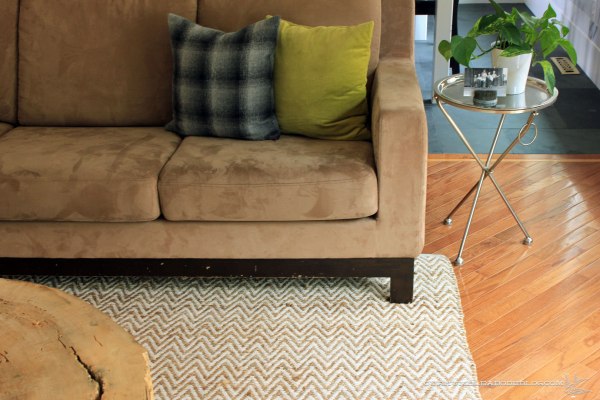
West-Elm-Rug-with-Pad-Under-Couch

Over the last few weeks, I haven’t had to adjust the rug at all, nor have I noticed any stretching.  Count that a serious win in my book, but even better, the nearly 1/2 inch thick pad makes it plush, keeping Ben happy.  Who knew rug pads could save rugs, but also marriages?!  Ha, that’s incredibly dramatic, but, it did keep me from having to find and buy yet another rug for this space.  In summary, if you’re considering the West Elm jute rug, I’d highly recommend getting even a thin rug pad, just to keep it from bunching and stretching.

Freeze Frame!

Near the beginning of the year, I ordered a lovely 18 by 24 inch leaf print from Minted, with intentions of immediately hanging it in our living room.  After coming up short on the perfect frame, I planned to make a 24 by 30 inch frame to protect and display the print.  At that time, we were just beginning our kitchen remodel (which is still nearly finished, with one more cabinet to build and hang-hence the lack of reveal) and time was limited to pertinent projects only.  Until recently, the frames were on the back burner, but after seeing the art sitting in my closet, begging to be seen by others, I jumped in and got it done.

Before building, I bought two pieces of plexiglass from Ace Hardware because these frames are in the living room and could get bumped or hit with a ball.  Shattered glass is always a concern with two boys in the house, so this seemed like a safer choice.  You certainly don’t need to buy glass first, but if you’re making a big frame, make sure your size is available before building.

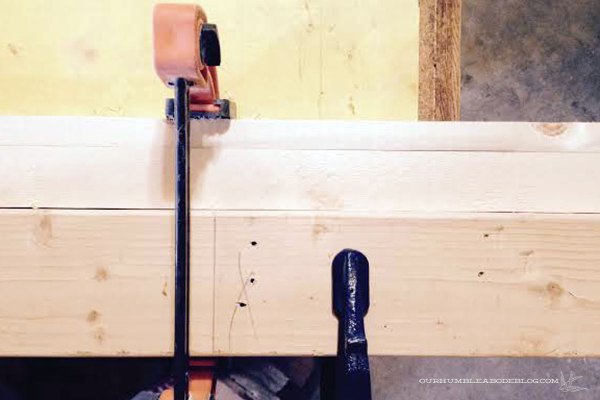
For my project, I wanted a square edge thin frame, so I bought four 1 by 2 sticks and had the store cut each one into 3 and 5 foot lengths.  To create the channel for the glass, mat, and backing to rest in, I had to router out a groove.  Pine is a soft wood, so I found it easiest to clamp a few boards down to create a guide to run the router against.

DIY-Picture-Frame-Clamped-Before-Router

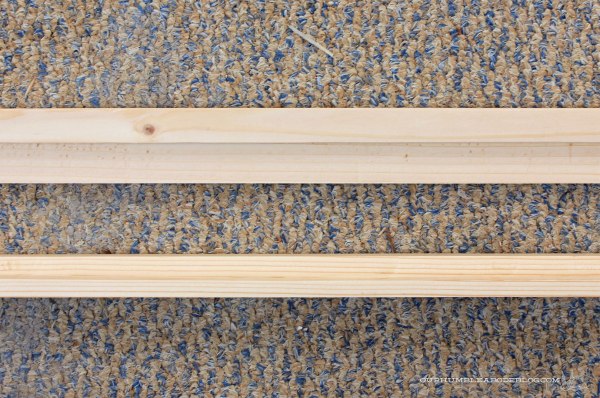
I set the router depth to 7/8 inches deep and slowly let it cut the channel, slowing at knots or weak points to prevent splitting.  Then I smoothed everything out with a thorough sanding.  Below, the top board shows the wide side, and the bottom the narrow face after cutting.

DIY-Picture-Frame-Routered-Strips

After grooved, I cut my pieces to length, mitering the corners but leaving an extra 1/8 for a little wiggle room.  Cutting after left perfectly square inside corners that a router can’t create after assembly, and with such a small face, I didn’t have much space to lose.

DIY-Picture-Frame-Checking-Corners

With tight corners, I pulled the glass out and held the pieces tight before nailing.

DIY-Picture-Frame-Mitered-Corner

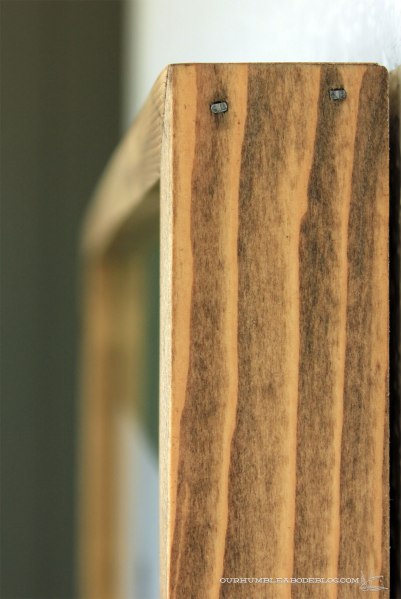
I found it easiest to set the two sides on a flat surface, letting just the corner over hang the counter while nailing.  This way, I didn’t angle the nailer funny to shoot it out somewhere and with narrow margins, it was important.  Two little nails are visible on each side, but not noticeable after staining.

DIY-Picture-Frame-Side-Nails

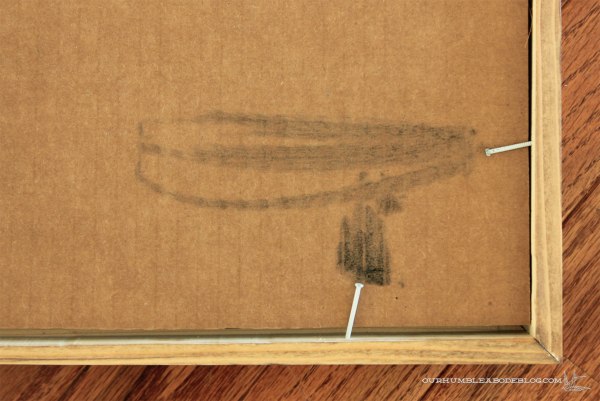
To darken the pine, I applied a quick coat of Special Walnut stain.  I love the richness it adds to the cheap wood, and it brings out the character of each board.  Normally, I’d staple the glass, mat, and backing in place, but I didn’t want to weaken the thin sides.  Instead, I tapped small nails in.

DIY-Picture-Frame-Backing

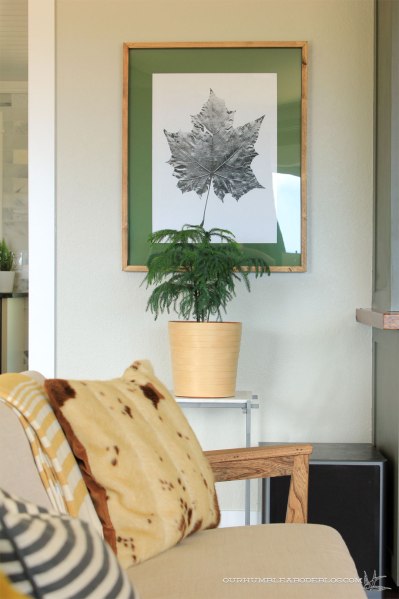
And there’s the King now, matted in grass-green to bring a little splash of the curtain color across the room.

DIY-Picture-Frame-Right-Side

DIY-Picture-Frame-Side-Profile

To balance out that print, I dried a maple leaf, photographed it, edited it, and printed a black and white engineer print.

DIY-Picture-Frame-Left-Side

Finally, we have art flanking the entertainment center, even more importantly, out of my closet!  Another to do list project is just staring at me in that last photo-move or create a cover for the ugly subwoofer.  With a cover, I could make it look kind of like a plant stand, right?  Let’s be honest though, who knows when that’ll happen; we’ve waited on entertainment center doors for years.  Perhaps that should happen next.  It wouldn’t be much different from making picture frames, but these would hide the ugly junk.

Rusted Steel & Curb Appeal

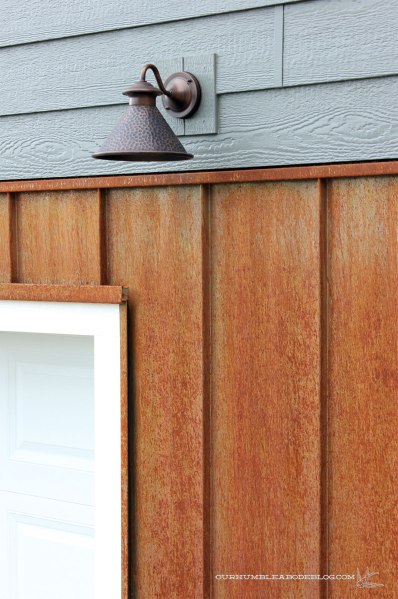
In last week’s deck and garden update, I shared a few pictures with peeks at the CorTen steel siding that has now started to rust.

Back-Garden-and-Deck-from-Side-Stairs

For those not familiar, CorTen is a steel alloy that develops an outer layer of rust patina, protecting from further corrosion. When purchased, the steel is gray with a slight sheen but as it is exposed to weather, it rusts, but only as a surface layer.

Standing-Seam-Steel-on-Back-of-House

Snow, rain, and two rounds of spraying with a water/vinegar mixture has warmed it up, though the process isn’t perfectly even.  See how much darker the rust looks closer to the house roof?  Vinegar quickly starts the rusting process, and helps even out the color.

Pool-House-Back-Rusted-Steel-Wall

Right after install and before rusting, the front looked very monotone and boring.  We wanted a maintenance free material to contrast against the traditional painted lap siding and break up the long, simple rectangle.  When freshly installed, the steel looked like a shiny version of the gray painted lap siding.

Standing-Seam-Steel-on-Front-from-Side-2

The addition of plants, the start of our bedroom balcony, and weather, the front looks very different.  When fully rusted, it actually looks like stained wood board and batten from short distances.  Once up close, the mottled look is noticeable and proves it’s actually rusted steel.  Again, you can see where moisture naturally hits the siding versus the eaves and protected areas.  Another round of spraying is on my to do list soon.

Rusted-Steel-Siding-on-Bathroom-Bump-Out

Notice how similarly toned the stained beams and bench are to the rust?  After finishing the railing install and staining, our balcony will fit right in.

Front-of-House-Side-Angle-Rusted-Steel-Siding

Rusted-Steel-Siding-Front-Door-Detail

When sprayed, gravity comes into play and darkens the bottoms more.  I’m going to experiment with a rag to see if rubbing vinegar will even out the top sections-at least on the easy to reach parts.

Rusted-Steel-Siding-Under-Bedroom

The most evenly and thoroughly rusted side is the garage end.

Rusted-Steel-Siding-on-Garage-End

A lack of overhang leaves the entire section open to water.  Note: even after fiddling with settings, some of the colors are a little off; the photo above is the most accurate color representation of the paint and steel.

Garage-End-Rusted-Steel-Siding

The local supplier/manufacturer created custom edge trim to go over the painted frames to help prevent the steel from dripping on the white.

Rusted-Steel-Siding-Variation-Detail

One area got a little more water and it has streaked the white on one side, but that’s nothing a quick coat of paint can’t fix.

Rusted-Steel-Siding-Left-Garage-Side-Detail

So far, we’re 100% thrilled with the results and ease of care, and our neighbors seem pretty happy as well.  On several occasions, people have stopped to compliment the new look, which is nice to hear considering our house is part of their view.  Heck, they probably look at the exterior more often than we do!