Bentwood and Marble

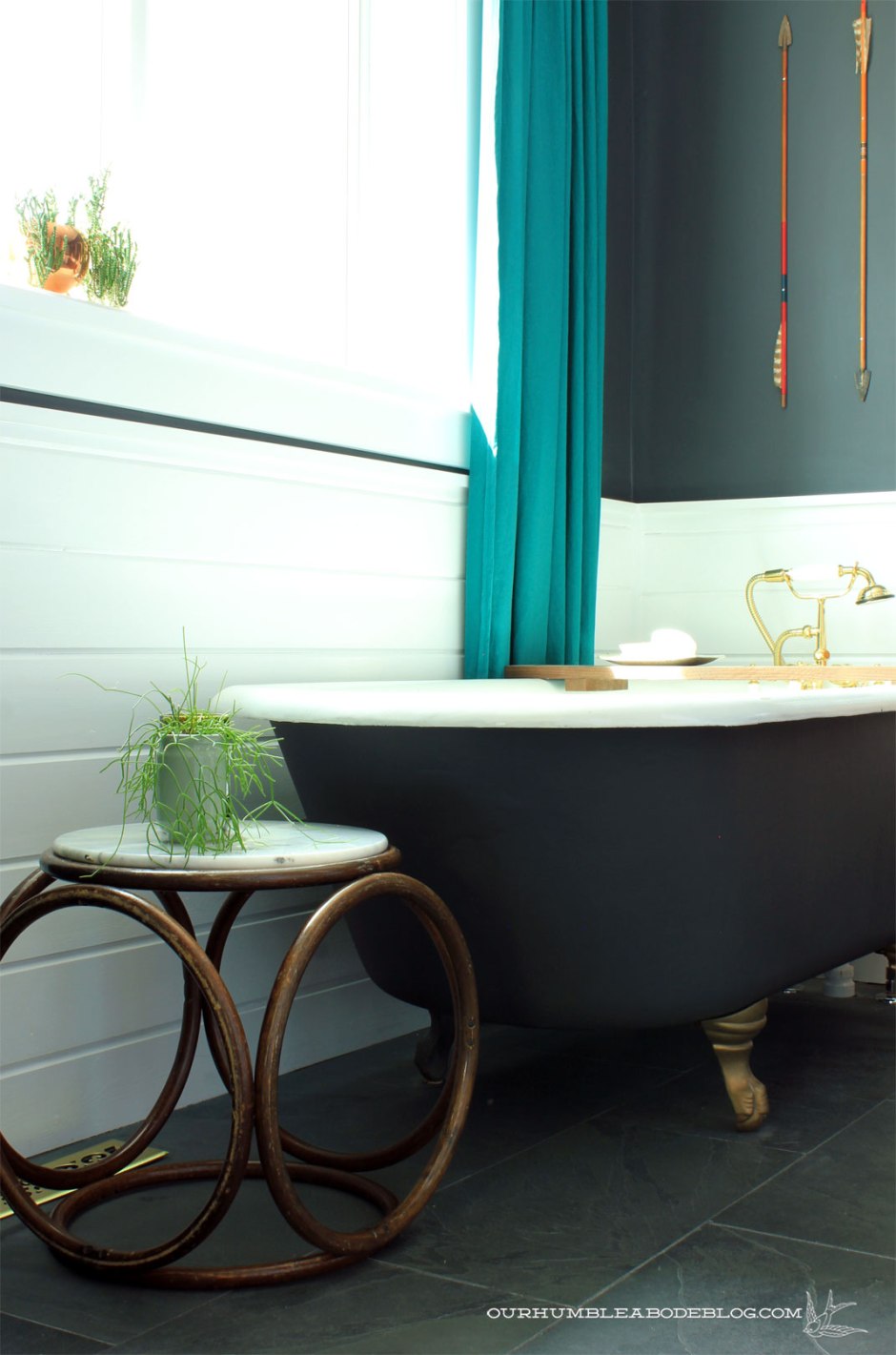
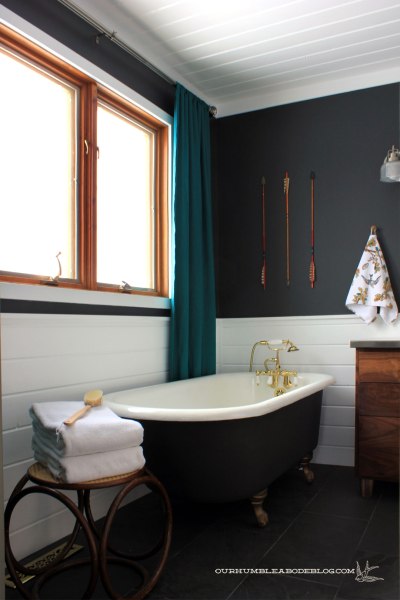
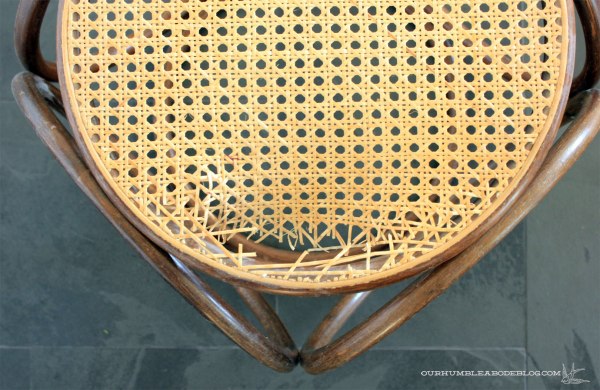
Three years ago I stumbled on a cute little bent wood stool with a cane top.  It was a mere eight dollars and cute as can be.  Sadly, the cane top was already broken, a slight tear along the edge.  Regardless, I set it by the claw foot tub in the master bath, to hold towels and such.

Master Bathroom with Clawfoot Tub

Several months ago, someone, I don’t know who, stepped or sat on the top and further damaged it.

Bentwood-Stool-Broken-Cane

Bentwood-Stool-Broken-Cane-Detail

On another thrift shop stop, I spotted a white marble serving tray, priced at three bucks.  Not having an exact use, I still bought it, knowing I’d find a use for it somewhere/sometime.

Marble-Serving-Board-for-Bentwood-Stool

It sat in the cabinet for a few weeks.  As I was cleaning the bathroom, I moved the stool, and a lightbulb went off.  Would the marble fit on the stool?  I dug it out, flipped the stool to a side, and set the marble on.  Wouldn’t you know it, the marble was a perfect match!

Bentwood-Stool-with-Marble-Top-by-Tub-2

Knowing the shoe (marble) fit, I cut off the broken cane.  After pulling the outer cane strip off, I set the marble back on.

Bentwood-Stool-with-Marble-Top-by-Tub

It’s the perfect pairing, adding a solid surface to set a plant and candle, or stack of towels on.

Bentwood-Stool-with-Marble-Top-in-Master-Bath

Not exactly a DIY, more a matter of luck, but it made a huge difference.  In fact, we did something similar to update our living room end tables.

Honed-Marble-End-Table-Top-from-Side

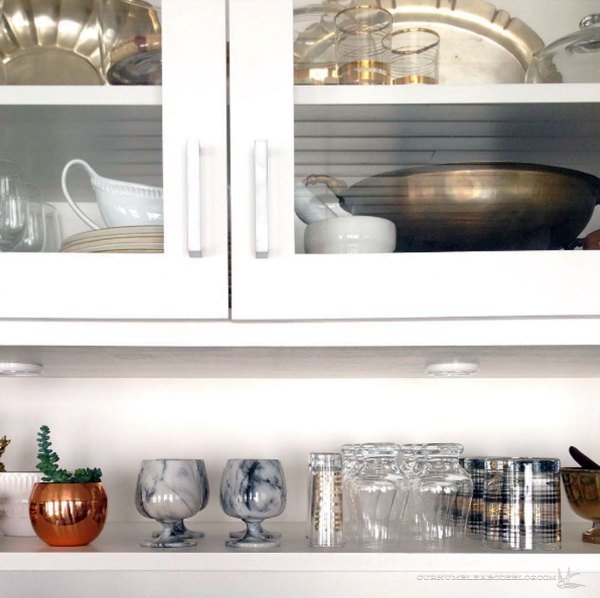
Further proof that white marble can cure nearly home related problem.  Moral of the story?  Buy all the affordable white marble when you see it.  Even if they’re cute, relatively useless small stemmed glasses.

Marble-Stemmed-Glasses

Just trust me on this one, you’ll find a use for it.

Carpet Sampling

Choosing carpet isn’t something we’ve done often.  In our first house, the only rooms with the cushy stuff were the basement bedrooms.  At this house, hardwood and tile are the only flooring types currently installed, but that will change soon.  Before we can get to install, we had shopping and serious deliberations to go through.  Ironically (or luckily?) carpet is the element Ben and I disagree on most.

At the beginning of our search, I said I preferred patterns created by texture, something like this.  A shorter, dense pile that holds up better to foot traffic, with subtle interest from the pattern.  All great selling points in my book.

Home-Decorators-Texture-Pattern-Carpet-Sample

Ben, however, prefers for his carpet to feel, well, like a wall to wall mattress.  Thicker + cushier = better.  I tease that he’s a princess about area rugs and carpet, and he doesn’t argue against that.

Basement-Carpet-Samples-Sharkskin-and-Gray-Flannel

He also wanted nylon fibers, which greatly whittle down the available options.  After hitting up several stores, we dragged any and all interesting sample boards home to evaluate.

I nearly had him ready to pull the trigger on the waffle-esque  pattern, but then he talked to installers.  Always researching, that guy.  Turns out, installers don’t really like the pattern, because it takes considerably more time and effort to keep the lines straight.  Essentially, the pattern is like tile and grout lines, but can easily be stretched out of alignment.  Crooked walls are even more of an obstacle.  Unlike tile, as carpet wears the fibers loosen and look saggy, needing restretching down the road.  Often times, the wear is not even throughout the room, and certain areas can be stretched up to several inches while others go untouched.  For these reasons, a patterned carpet was officially out of the running.  Womp, womp, wooooomp.

Back on the hunt for a plush carpet we could agree on.  Here were our basic considerations to get to our final choice:

1.  Fiber type:  In our search we found that the majority of carpets carried are polyester, polypropylene, or a polyester blend.  Yes, there are some nylon, wool, cotton and other fibers, but polyester seems to greatly outnumber the other options.  Generally speaking, nylon costs more, but is the strongest fiber, thus can handle heavier foot traffic.  Nylon carpets hold their twist better, preventing the worn look of frayed ends.  For this reason alone, Ben wanted a nylon carpet.

2.  Pile length:  From my wish list, I wanted a shorter, dense pile to minimize the look of traffic patterns.  Just like grass, the longer it is, the more obvious the wear.

3.  Face weight:  The face weight of a carpet is how many ounces of one yard of actual fiber (not including the backing).  To generalize, the higher the weight equals a more dense and better quality carpet.  That is, assuming the pile length is the same.  If it’s really easy to feel (or even see) the backing, the lower the face weight will be.

4.  Coloring: With the carpets we considered, we had the choice between solid or flecked.  I immediately eliminated the obviously speckled look, since it’s just not my thing.  On the other hand, in some cases, Ben likes the interest it adds.

5.  Price:  Like all products, there’s a wide variety, covering all ends of the price spectrum.  We didn’t set a budget for carpet, instead, we wanted the quality and durability to take priority.

After checking all of those boxes, we had our winner: a nylon, 70 ounce face weight, subtly speckled plush carpet that feels like walking on a cloud.

Basement-Carpet-Sample-Back-Info

Of course, there was one last debate-colors.  I loved the lighter slightly oatmeal gray, Sharkskin, to keep the rooms feeling bright.  Ben, being the more practical of the two of us, liked the darker, more forgiving if spilled on Grey Flannel.
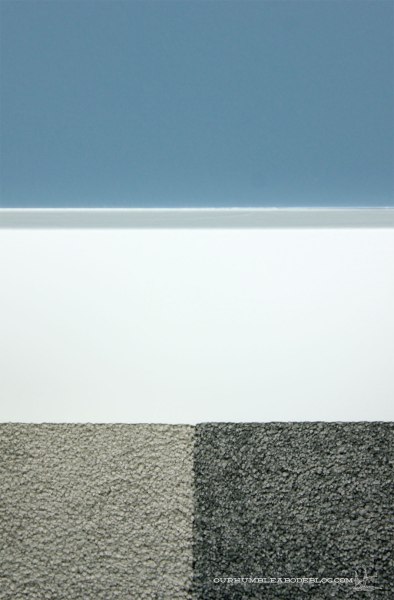
 

Basement-Carpet-Samples-in-Bedroom Both are good neutrals and will work, but I really pushed for the lighter, arguing these aren’t high traffic areas.  Ben still insisted on the dark, and I gave up the fight.  When making so many house design/decor decisions, we’re in 100% agreement.  Sometimes, Ben just doesn’t have an opinion (typically when paint colors are involved).  Since he so rarely insists on something, I couldn’t argue.

Basement-Carpet-Samples-in-Theater-Room

In both doorways, the carpet will butt up to the slate tile, so the darker will allow the color to flow a bit more seamlessly.

Basement-Carpet-Samples-by-Slate-Tile

The basement has been measured, carpet is ordered, and we’re waiting for it to arrive and be installed.  One last step to moving furniture back into these rooms and finishing the laundry and bathroom.


Door Handles

For the most part, decisions for the basement have been made based on the main level.  Mainly what will flow, so we’ve carried elements throughout for continuity.  Painted six panel doors, same trim, slate flooring, and white tongue and groove are all joining the party.  One choice however, has prompted a change on the main level:

Schlage-Door-Handle-on-Entry-Closet-Door

It’s subtle, but maybe this will make it more obvious?

Schlage-Door-Handle-Detail

If you still can’t tell, we changed out all the door handles and hinges.

Schlage-Door-Handle-Passage-Detail

After looking at several options, we landed on the Latitude series from Schlage in satin nickel.  I chose based on looks while Ben’s choice was based on durability, reputation, and a lifetime guarantee.

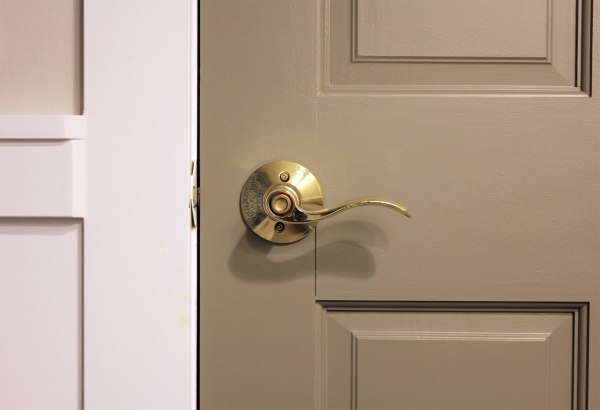
Gone are the shiny brass paddle style levers that adorned each main level door when we bought this house.   I know the brass trend is still going strong, but I prefer it in unlacquered form.

Main Bathroom Painted Door Handle

The basement had all standard cheapo knobs straight out of the 70’s.

Basement-Door-Trim-and-Handle

Now that we’re at the point in the basement to, you know, install/need doors and handles, we bit the bullet and bought enough for both levels.

Schlage-Handle-on-Bathroom-Door

Clean, tailored lines are beautiful, but also really easy to wipe down.  With two messy boys, wipeability is always a consideration.

Schlage-Door-Handle-Locking-Detail

More often than not, it’s the tiny details that make me happiest.  Even something as miniscule and trite as door handles.  It’s always a great reminder not to ignore smaller elements, as they still have an impact on every finished space.

The Case for Teak Oil

When finishing a wooden product, I know a coat or two of polyurethane is a standard sealant option.  And for good reason-it’s water-resistant, wipeable, and usually durable.  It’s the top coat I’ve used on several pieces I’ve refinished and they look just as good years later.

Boys-Bedroom-with-New-Rug-and-Lamp-on-Dresser

But polyurethane isn’t the only option, nor is it my favorite.  Over the years, in an experiment of sorts, I put several alternative products to the test: mineral oil, cutting board oil, Danish oil, butcher block oil, paste finishing wax, and Teak oil.

Oil-and-Wax-Testing

Why, you ask?  Well, because unlike a traditional poly, all the products mentioned above can be reapplied at any time.  But why would I want to recoat when I could just use poly and be done?  I’d love to explain.  Of all the options I’ve tried, Teak oil is my favorite, with Danish oil a close second.  The rest, well, they certainly have a use in the right application, like refreshing a cutting board.  For furniture purposes, mineral oil products just aren’t durable or long wearing enough.  Teak oil, however, penetrates and creates a long-lasting water-resistant surface.  It’s great for sealing furniture, as I did with my wood frame linen sofa.

Thrifted-Vintage-Sofa-Back-Corner-After

Teak oil has also been my go to for sealing the walnut cabinetry we’ve made, both in the master bathroom and kitchen island.

Master-Bathroom-Vanity-Half-Oiled-Drawers

Island-Drawers-Overall

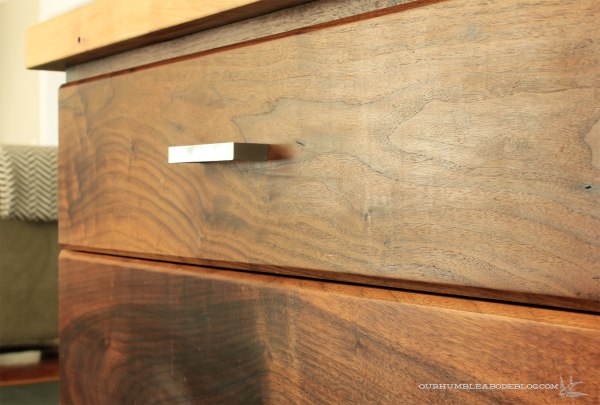
So what’s so special about this?  First off, it enhances the grain of wood, bringing out the depth and character.  Look what a quick swipe will do:

Walnut-Drawer-Half-Oiled

From blah and ashen to bold and rich.

Walnut-Drawers-Oiled-vs-Not

Application is also crazy easy and brush stroke free.  Simply pour a little on a scrap of an old t-shirt, rub on, and wipe off with a clean, lint free cloth.  That’s it.

Island-Drawer-Detail

Even better, oil can be reapplied over an old coat without sanding, which is not the case with polyurethane, making it ideal for wooden pieces in high traffic/use areas.  Have a scratch, gouge, or dent?  Don’t fret, just dab a little oil on and you’re set.  Ooh, rhyme time!  This finish won’t crack, peel, or flake off.

Island-Drawer-Water-Spots

The only down side is that over time, water spots can appear.  Upon close inspection, the most often used kitchen drawers, mainly the utensil and trash, show signs of use.  It has been at least a year since the last application, so when I find the time, I’ll give each drawer a light sand and touch up coat for a quick refresh. Now, that’s something you can’t do with polyurethane finishes.

Luck of the Irish

I may not have Irish heritage, but I undeniably love the color green.  As a kid, when coloring or painting, I didn’t consider my work done until I added a splash of green somewhere.  If you’re wondering, yes, I was a complete nerd who loved to draw, paint, build and decorate cardboard doll houses.  I remember making a yellow-backed floral wall paper by drawing on white printer paper.  It’s too bad I don’t have photos, because I’m sure it was just lovely-haha.

To me, green adds a vibrancy and lively element no other colors can.  Yes, yellow is bright and cheery, but it doesn’t add the right warmth.  Blues are beautiful and soothing, but can’t quite make the statement green can.  Green is so abundant in nature, whether light, fresh spring green, dark mid summer grass-green, or the muted tones found in fall and winter.  As a general green lover, I’ve incorporated some of each throughout my home and I urge you to do the same.

Some rooms have just a sprinkle (nothing too in your face) of green, such as our family room. In a mostly neutral space, nearly citron green pillows liven up the couch and add a jolt of color.

Sofa-Swap-Old-in-Family-Room-Detail

A brightly colored green and blue landscape painting perks up the mantle while the lumbar pillows pull the color down to the neutral chairs.  Just a few small green accessories like books, a small vase, and candles pepper the color around the rest of the room.

MCM-Chairs-Updated-in-Family-Room

Our kitchen counters are dark, nearly black green soapstone that still reads as a neutral.

Long-Narrow-Cutting-Board-in-Kitchen-Toward-Ovens

Small additions like towels, plants, dishes, even fruit are quick, zero commitment ways to add even more color.

Kitchen-Dish-Cabinet

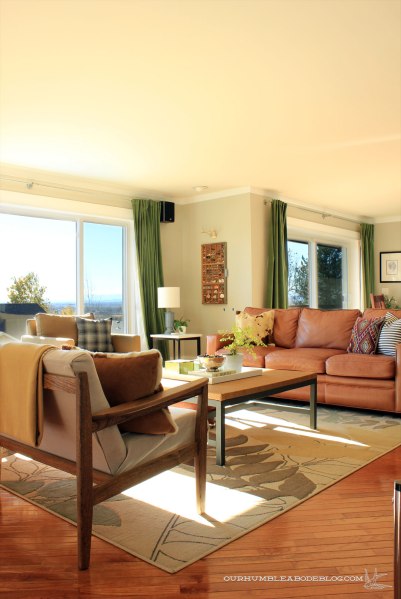
Other rooms have a slightly bigger swath of green, like our living room.  Six sets of luscious grass-green velvet curtains flank the windows.

Parallel-Couch-Window-Seat-Arrangement-From-Stairs

Cover the curtains with your hand and you’ll notice just how much life and personality they bring to the room.  When in doubt, always default to house plants to get that bit of color without overwhelming a room.  Bonus, you don’t have to deal with picking paint colors or fabrics.

Horizontal-Railing-and-Living-Room

Speaking of paint, sometimes a quart can make the biggest impact.  At less than $20, what do you have to lose by giving it a try?  Our main bathroom rocks an olive-green vanity, which has so much more character than any neutral ever will.

Campaign-Mirror-in-Bathroom-Overall

Toss a few more green accessories, in this case, hand towels and a nearly ugly 70’s landscape painting, around the room to complete the look.

Main Bathroom Overall

According to the color wheel, green is a cool color, but it certainly adds warmth to any space.  A muddy sagey olive acts as an almost neutral backdrop in our guest bedroom.

Guest-Room-Makeover-Green-Walls-Upholstered-Headboard

Pairing with bright white it feels so fresh, clean, and simple.  But greens really shine next to warm wood tones, much like a tree trunk and leaves.

Green-Guest-Room-Dresser-Chair-and-Art

By far the most overtly green room in the house is the boys’ bedroom.  Back when I gave their room a makeover, I asked each of them what color walls they wanted.  One said green and the other said yellow.  We compromised with this lemongrass yellow-green.  It’s fun and happy, but is tempered by white, gray, and navy.

Boys-Bedroom-with-Large-Rug-from-Door

Our master suite, though mostly white and black, has green tucked here and there.  More grass-green velvet wraps the headboard for a touch of color against an otherwise white wall.

King-Bed-Frame-Finished-Overall

Opposite the bed, a few bright green plants and (soon to be framed) landscape painting flank a dresser, bringing color around the room in a simple, easy-going way.

Craigslist-Dresser-with-Emily-Jeffords-Art-by-Bathroom

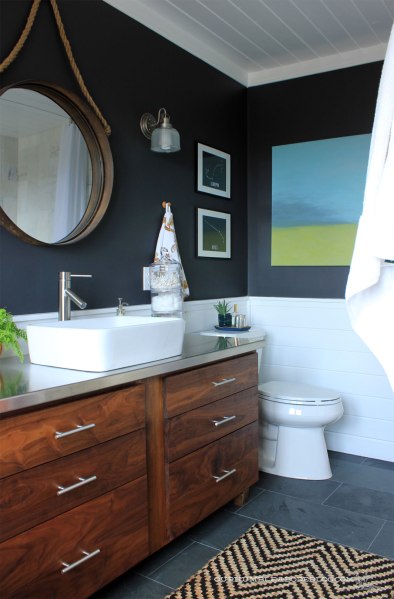
Even our master bathroom has touches of green via plants and a very abstract landscape.

Abstract-Landscape-Painting-in-Bathroom-Version-2-with-Vanity

Though we’re not quite at the point of the basement remodel to paint and add accessories, I’m trying to narrow down green paint options to use down there in a few ways.  I think we all have a color we naturally gravitate toward, right?  What’s yours, and more importantly, how do you use it in your decor?